
Last Updated on October 13, 2026 by Jennifer Hanson
Social skills are among the most commonly written but most inconsistently taught goals in IEPs. When we talk about IEP goals for social skills, we’re not just checking a box, we’re aiming for real improvements in how a student understands, initiates, and sustains interactions with peers and adults. In this guide we explain why social skills belong in the IEP, how to assess them, and how to convert observations into measurable, classroom-ready goals. We’ll also share age-appropriate sample goals and practical monitoring strategies you can use during the 2026 school year and beyond.
In this guide, IEP Social Skills Goals How To Write Measurable Practical Targets That Improve Peer Interaction In 2026 is explained with clear steps and tips.
Key Takeaways — IEP Social Skills Goals How To Write Measurable Practical Targets That Improve Peer Interaction In 2026
- IEP goals for social skills are essential for promoting meaningful participation in school and improving outcomes like classroom engagement and post-school independence.
- Effective social skills goals must be specific, measurable, and linked to the student’s access to instruction or transition plans under IDEA.
- A thorough assessment using observations, rating scales, checklists, and student input guides the creation of accurate, targeted social skills goals.
- Writing measurable goals involves clear target behaviors, baselines, criteria, and contexts using active verbs and realistic expectations tailored to the student’s needs.
- Progress monitoring should be frequent, practical, and documented, with accommodations like social scripts, peer supports, and environmental modifications to enhance skill acquisition.
- Clear assignment of roles and supports within the IEP ensures goals for social skills are actionable and legally defensible, leading to better educational and social outcomes.
Why Social Skills Belong In The IEP: Purpose, Legal Basis, And Real-World Outcomes
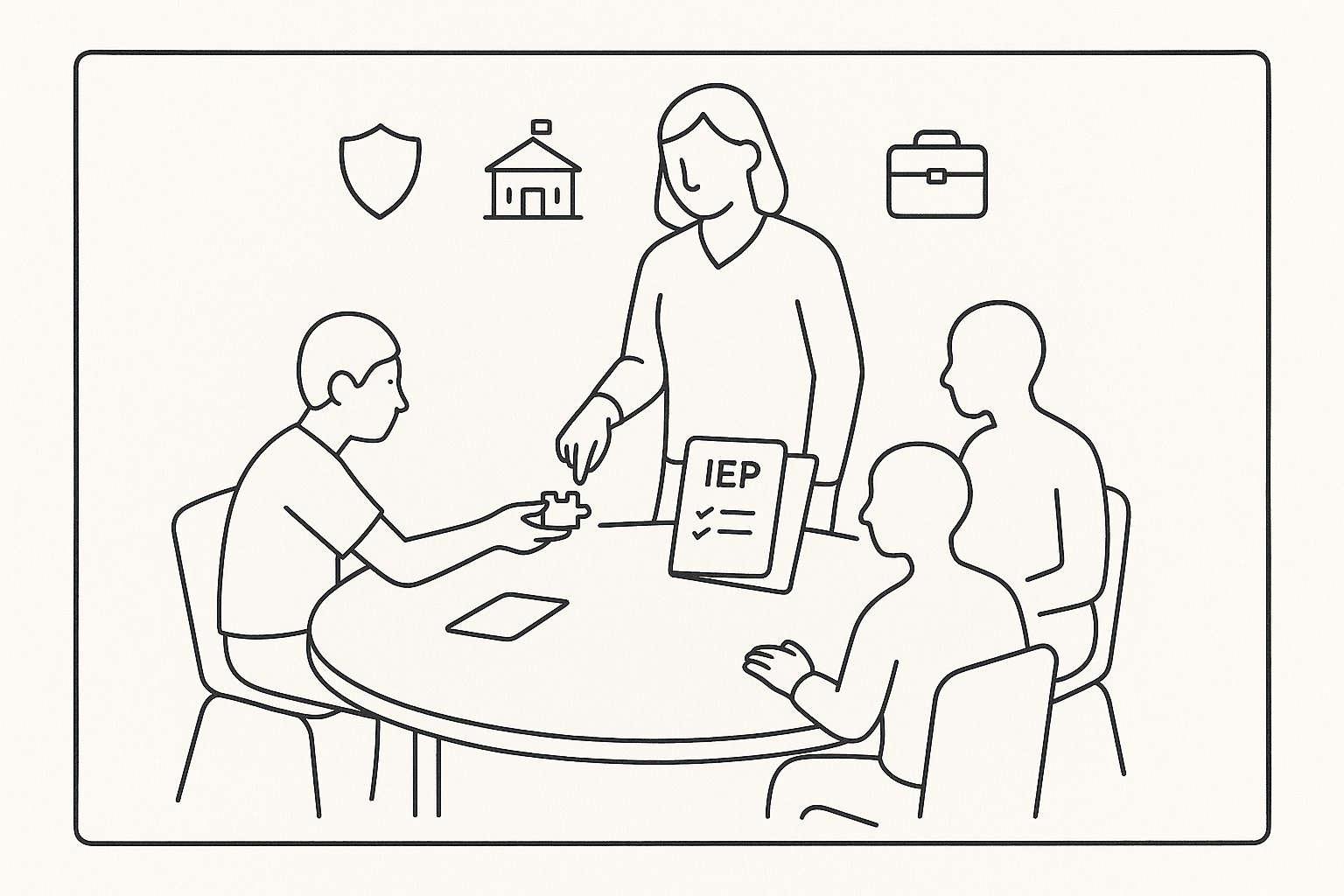
Social competence affects access to learning, safety, and later employment. Under the Individuals with Disabilities Education Act (IDEA), an IEP must address the student’s unique needs, including those that affect participation in school. Social skills that impede access to instruction, peer relationships, or transition goals hence fall squarely within the IEP team’s responsibility.
Practically, poor social skills lead to exclusion from group work, increased behavior referrals, and fewer opportunities for leadership or extracurricular involvement. Legally, services or supports should be provided if social deficits negatively affect educational progress. That doesn’t mean every shy child needs a social goal: it means teams must document functional impact. We should tie social goals to present levels of performance, curriculum access, safety, or transition plans.
Finally, the outcomes matter: measurable social gains predict improved classroom engagement, decreased disciplinary action, and better post-school outcomes like employment and independent living. So when we write IEP social skills goals, we’re supporting the student’s right to meaningful participation and a smoother transition to adulthood.
Key Assessment Steps To Inform Social Skills Goals (What To Measure And How)
Good goals start with good assessment. We recommend a multi-source, multi-method approach:
- Direct observation: Use structured observations across settings (classroom, recess, lunch) and record frequency, duration, and context of target behaviors. Time sampling or event recording works well.
- Standardized rating scales: Tools like the Social Skills Improvement System (SSIS) or the Vineland Adaptive Behavior Scales provide norm-referenced data and help identify domains (communication, cooperation, assertion, responsibility, empathy).
- Social behavior checklists from teachers and caregivers: Short, repeated checklists over 2–4 weeks reveal consistency across environments.
- Curriculum-based probes: If a student struggles in group tasks, create probes that simulate group roles and measure task initiation, turn-taking, and requests for help.
- Student interview and self-report: For older students, self-awareness is critical. Brief interviews can reveal goals that matter to the student.
From these data we define the target behavior (what we want changed), baseline rate or level, contexts where the skill is required, and criterion for success. For legal defensibility, document data collection methods and show how the goal links to the student’s access to instruction or transition plans.
How To Write Measurable Social Skills Goals That Teams Can Use
A measurable social skills goal contains four elements: a clear target behavior, baseline, measurable criterion, and context/conditions. Use active, observable verbs (initiates, responds, waits, requests help) and avoid vague language like “improve social skills.”
Goal formula we use: “Given [conditions], the student will [observable behavior] as measured by [method] with [criterion] within [timeframe].” Example: “Given a small-group academic task, the student will initiate a relevant comment or question during group discussion in 4 out of 5 opportunities across three consecutive sessions by the end of the second semester.”
Be realistic with criteria: frequency goals (e.g., 4 of 5) work for discrete behaviors: duration or latency measures suit waiting or staying-on-task skills. For complex behaviors (e.g., conflict resolution), break the skill into component steps and write scaffolded goals that build toward independence.
Assign roles and supports in the IEP: who will teach the skill, how often, and in what setting? Include data collection responsibilities. That makes the goal actionable rather than aspirational. Now, practical samples by age and area.
Progress Monitoring, Accommodations, And Classroom Strategies To Support Goal Achievement
Progress monitoring must be frequent and practical. We suggest weekly or biweekly brief probes (5–10 minutes) that match the goal’s criterion and setting. Use simple tools: tally sheets, frequency counts, or a 3-point rubric for quality of interaction. Graph results to spot trends quickly.
Accommodations and strategies to support social goals include:
- Structured routines: predictable group roles and visual schedules reduce anxiety and cue participation.
- Social scripts and role-play: provide rehearsal for expected language, then fade prompts.
- Peer-mediated instruction: train peers as partners or models: peer supports often generalize faster than adult-led drills.
- Prompt hierarchies and errorless learning: start with maximal prompts and systematically fade to independence.
- Environmental modifications: rearrange seating for better access to peers or provide small-group opportunities for initial practice.
For documentation, include who collects data, how often, and how the team will respond if the student isn’t making progress (modify goal, increase intensity, add supports). For legal clarity, link accommodations to access: for example, a student who can’t request help may miss assignments, the IEP should state supports to prevent that loss of educational benefit.
Conclusion
IEP goals for social skills are only useful when they’re specific, measurable, and tied to real access. By assessing carefully, writing clear target behaviors, and using practical monitoring and classroom strategies, we can create goals that produce observable change. In 2026, with growing emphasis on transition and inclusion, strong social goals will continue to be a cornerstone of meaningful educational programming, and they’re an area where thoughtful teams can make a big difference.
Frequently Asked Questions About IEP Goals for Social Skills
What are IEP goals for social skills and why are they important?
IEP goals for social skills focus on improving how students interact with peers and adults to enhance access to learning and participation. They’re important because social competence affects classroom engagement, safety, and future employment, making them critical for meaningful educational progress.
How do IEP teams assess social skills to create effective goals?
Teams use a multi-method assessment including direct observation, standardized rating scales, teacher and caregiver checklists, curriculum-based probes, and student interviews. This comprehensive approach identifies specific social behaviors, baseline levels, and contexts to inform measurable goals.
What is the formula for writing measurable social skills goals in an IEP?
A measurable goal typically follows this formula: ‘Given [conditions], the student will [observable behavior] as measured by [method] with [criterion] within [timeframe].’ Goals must include clear target behaviors, baseline data, measurable criteria, and defined contexts for success.
How can teachers monitor progress and support students working on social skills IEP goals?
Progress can be monitored weekly or biweekly using brief probes like tally sheets or rubrics aligned with the goal’s criteria. Supports include structured routines, social scripts, peer-mediated instruction, prompt hierarchies, and environmental modifications to encourage skill generalization.
When should social skills goals be included in a student’s IEP?
Social skills goals should be included when deficits impact the student’s educational progress, such as hindering access to instruction, peer relationships, or transition plans. The IEP team must document the functional impact and tailor goals accordingly under IDEA requirements.
Can well-written social skills goals improve post-school outcomes for students?
Yes, measurable improvements in social skills correlate with better classroom engagement, reduced disciplinary issues, and enhanced outcomes after school such as employment and independent living, supporting students’ transition to adulthood.