
Last Updated on July 8, 2026 by Jennifer Hanson
When a student with a disability poses a safety risk at school, schools and parents face a high-stakes question: how do we protect the school community while honoring the student’s right to an appropriate education? The Individuals with Disabilities Education Act (IDEA) includes a specific mechanism, an Interim Alternative Educational Setting (IAES), designed for these situations. In this guide we’ll explain what IAES means, the legal rules and timelines, when it’s required or allowed, how it fits with a student’s IEP and FAPE, and practical steps parents should take to protect their child’s rights. Our goal is clear: give families and school teams usable, up-to-date information they can act on in 2026.
In this guide, What Is IAES In Special Education A Practical 2026 Guide For Parents And Schools is explained with clear steps and tips.
Key Takeaways — What Is IAES In Special Education A Practical 2026 Guide For Parents And Schools
- An Interim Alternative Educational Setting (IAES) allows students with disabilities to continue education in a safe, temporary placement while addressing behavioral concerns under IDEA.
- IAES placements last up to 45 school days and require a manifestation determination review if disciplinary removal exceeds 10 days, except in cases involving weapons, drugs, or serious injury.
- Schools must provide educational services in IAES that enable progress toward IEP goals and maintain access to the general curriculum to uphold the student’s right to FAPE.
- Parents should actively participate in IEP meetings, request detailed IAES plans, document all communications, and advocate for equivalent services as specified in the IEP.
- If IAES services are inadequate or rights are violated, parents can challenge the placement through state complaints, mediation, or due process hearings, possibly with legal counsel assistance.
What IAES Means And Why It Matters
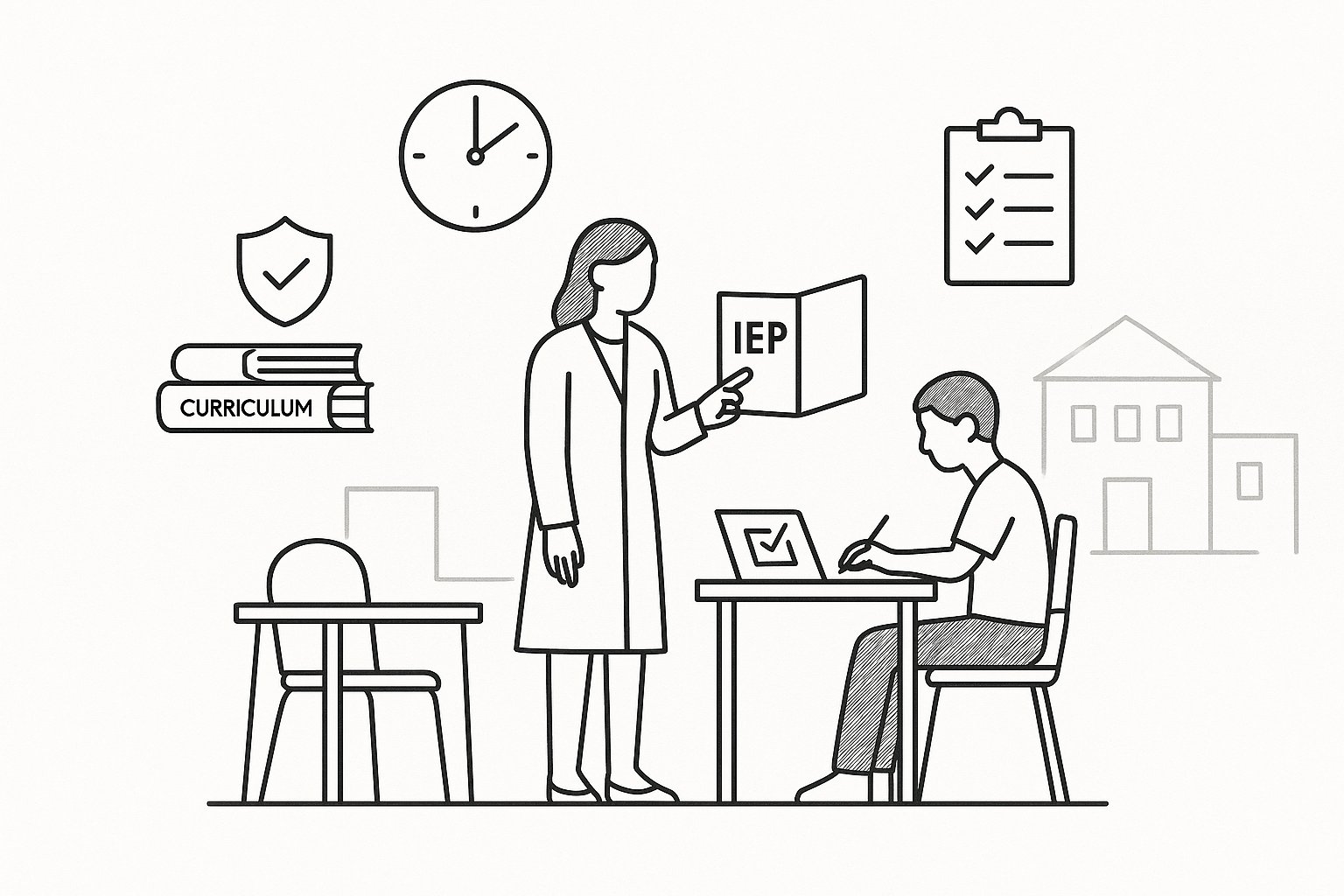
An Interim Alternative Educational Setting (IAES) is a temporary placement where a student with a disability receives educational services after the school changes the student’s placement for disciplinary reasons. IAES isn’t punishment, it’s intended to preserve the student’s access to education while addressing safety and behavioral concerns. Under IDEA, the IAES must allow the student to continue progressing toward IEP goals and to receive services that enable them to participate in the general curriculum to the extent appropriate.
Why IAES matters: it’s one of the few tools that balances safety and educational rights. Parents often worry an IAES will mean lost instruction, stigma, or a de facto long-term exclusion. Schools worry about liability and maintaining a safe environment. Properly implemented, an IAES should be a short-term, purposeful setting with individualized supports. Misuse or failure to provide equivalent services, but, can violate the student’s right to a Free Appropriate Public Education (FAPE) and lead to disputes or due process claims.
In practice, an IAES can take several forms, a separate classroom, another school site, therapeutic day programs, or even specialized instruction delivered off-campus. The key is that services are sufficient, documented, and tied directly to the student’s educational needs as identified in the IEP.
Legal Basis: IDEA Rules And Time Limits For IAES
The IAES provisions are found in IDEA and corresponding federal regulations. The baseline rule allows schools to change a student’s placement for disciplinary reasons for up to 45 school days. That 45-day limit applies whether the change is to an IAES after an infraction or to another disciplinary placement like suspension.
Key legal points we must keep in mind:
- Manifestation determination review (MDR): Before placing a student in an IAES for more than 10 school days cumulative in a school year, the IEP team must complete an MDR to decide whether the conduct was caused by, or had a direct and substantial relationship to, the student’s disability, or whether it resulted from the school’s failure to carry out the IEP. If the behavior is a manifestation, school cannot discipline in the same way and must look to IEP-based supports.
- Special circumstances: IDEA permits an IAES placement for up to 45 school days without regard to the MDR in cases involving weapons, illegal drugs, or serious bodily injury. This is an exception that prioritizes immediate safety.
- Services during IAES: The student must continue to receive educational services that enable progress on IEP goals and participation in the general curriculum. Courts have held that failure to provide adequate services during the 45-day period can constitute denial of FAPE.
- Due process and procedural protections: Parents have the right to prior written notice, to participate in IEP team meetings, and to challenge disciplinary IAES placements through state complaint procedures or due process hearings.
When An IAES Is Required Or Permissible
Deciding whether an IAES is required or permissible blends bright-line rules and substantive judgment. We’ll look at mandatory situations where the law permits immediate IAES placement, and discretionary cases where the team must weigh evidence, safety, and educational needs.
How IAES Works With IEPs, Services, And FAPE
An IAES does not erase the student’s IEP obligations. Our responsibility, whether we’re parents, school staff, or attorneys assisting families, is to ensure services in the IAES are meaningful, individualized, and tied to the IEP.
Specific obligations schools must meet during an IAES:
- Continue IEP services: The student must receive related services (speech, counseling, OT, PT) and specialized instruction as necessary to work toward IEP goals.
- Maintain access to the general curriculum: Even if the setting is separate, curriculum access should align with peers to the extent appropriate.
- Regular review: The IEP team should monitor the student’s progress, reassess behavior plans, and reconvene before the end of the 45-day period to determine next steps.
FAPE implications: If the services in the IAES are insufficient to allow progress toward IEP goals or to maintain educational benefit, parents may have a viable claim that the school denied FAPE. Courts and hearing officers examine documentation: was the IAES placement individualized, were services delivered as promised, and did the school try to return the student to the least restrictive environment as soon as safe and appropriate?
Finally, an IAES placement can trigger broader legal and educational processes, evaluations, re-written BIPs, or even long-term placement changes, but those changes must follow IEP procedures and parental participation rights.
What Parents Should Do: Procedural Steps, Documentation, And Advocacy
When an IAES is proposed or implemented, parents should move quickly and deliberately. We recommend this practical checklist:
- Get the written notice. Schools must provide prior written notice explaining the removal, the facts, and the proposed IAES. Keep that notice and read it closely.
- Request IEP team participation. Insist on attending any IEP or MDR meetings. If the school schedules meetings without you, request new dates in writing and document communications.
- Review the IAES plan. Ask for a written description of the IAES: where instruction occurs, which teachers and related service providers will work with your child, the schedule, and how progress will be measured.
- Demand equivalent services. Verify that the IAES includes services equal in intensity and frequency to those on the IEP and tied to goals. If services aren’t specified, push for clarity in writing.
- Seek assessments if needed. If behavior suggests unmet needs, request an updated FBA or evaluations to inform a revised BIP and placement decision.
- Document everything. Keep emails, notices, progress reports, and notes from meetings. Documentation is critical if you later challenge the IAES.
- Know your rights. You can file a state complaint, request mediation, or seek a due process hearing. Temporary injunctive relief is rare, but a hearing can result in remedies like compensatory education if FAPE was denied.
- Consider legal counsel. If the facts are complex, serious injury allegations, unclear evidence, or prolonged removal, consult an attorney experienced in IDEA. Firms like ours provide neutral, procedural guidance to families navigating these disputes.
Advocacy tips: stay focused on educational outcomes. Ask specific questions about how the IAES will help your child progress academically and behaviorally. Offer constructive proposals for supports and follow up on agreed actions with timelines.
Frequently Asked Questions About IAES in Special Education
What is an Interim Alternative Educational Setting (IAES) in special education?
An IAES is a temporary placement for a student with a disability who is removed from their current setting for disciplinary reasons. It ensures the student continues receiving educational services and progressing toward IEP goals while addressing safety concerns.
When can a school place a student in an IAES under IDEA?
A school may place a student in an IAES for up to 45 school days after disciplinary incidents, especially in cases involving weapons, illegal drugs, or serious bodily injury, without a manifestation determination review. Otherwise, placement requires an MDR before exceeding 10 days in a year.
How does IAES relate to a student’s Individualized Education Program (IEP) and Free Appropriate Public Education (FAPE)?
During IAES placement, students must continue to receive services aligned with their IEP, accessing the general curriculum and making progress toward goals. Failure to provide equivalent services can violate their right to FAPE.
What steps should parents take if their child is placed in an IAES?
Parents should obtain written notice of the placement, participate in IEP and MDR meetings, review the IAES plan for equivalent services, document communications, request additional assessments if needed, and know their rights to challenge decisions through complaints or hearings.
Why is an IAES important in balancing safety and educational rights?
An IAES protects the school community’s safety while ensuring students with disabilities continue receiving appropriate educational services. It prevents long-term exclusion by providing a structured, supportive setting during disciplinary removals.