
Last Updated on October 16, 2026 by Jennifer Hanson
When we talk about instructional materials for special education, we’re describing the tools and resources that make learning accessible, measurable, and meaningful for students with diverse needs. In 2026, advances in technology, updated legal expectations around accessibility, and a stronger emphasis on individualized education program (IEP) outcomes mean educators, therapists, and families must be intentional about what they select and how they adapt it. This guide gives practical, actionable guidance: what these materials are, core types with real examples, and clear steps to align and adapt resources to IEP goals so students make demonstrable progress.
In this guide, Instructional Materials for Special Education A Practical Guide to Choosing Adapting and Using Resources in 2026 is explained with clear steps and tips.
Key Takeaways — Instructional Materials for Special Education A Practical Guide to Choosing Adapting and Using Resources in 2026
- Instructional materials for special education are tailored tools and resources designed to meet individual learners’ needs and achieve measurable IEP goals.
- Effective materials reduce accessibility barriers, support multi-modal learning, and enable reliable data collection to track student progress.
- Core types include low-tech supports, print and leveled texts, assistive technology, digital curricula, functional life-skills materials, and assessments, each serving unique purposes.
- Selecting materials involves aligning with IEP objectives, analyzing access barriers, prioritizing essential features, piloting with data, and training stakeholders for consistent use.
- Adapting existing materials before replacing can save resources and improve learning by simplifying tasks and adding visual or interactive supports.
- Documentation and collaboration are vital to ensure instructional materials meet legal, ethical, and educational standards while promoting equity and effectiveness.
What Instructional Materials For Special Education Are And Why They Matter
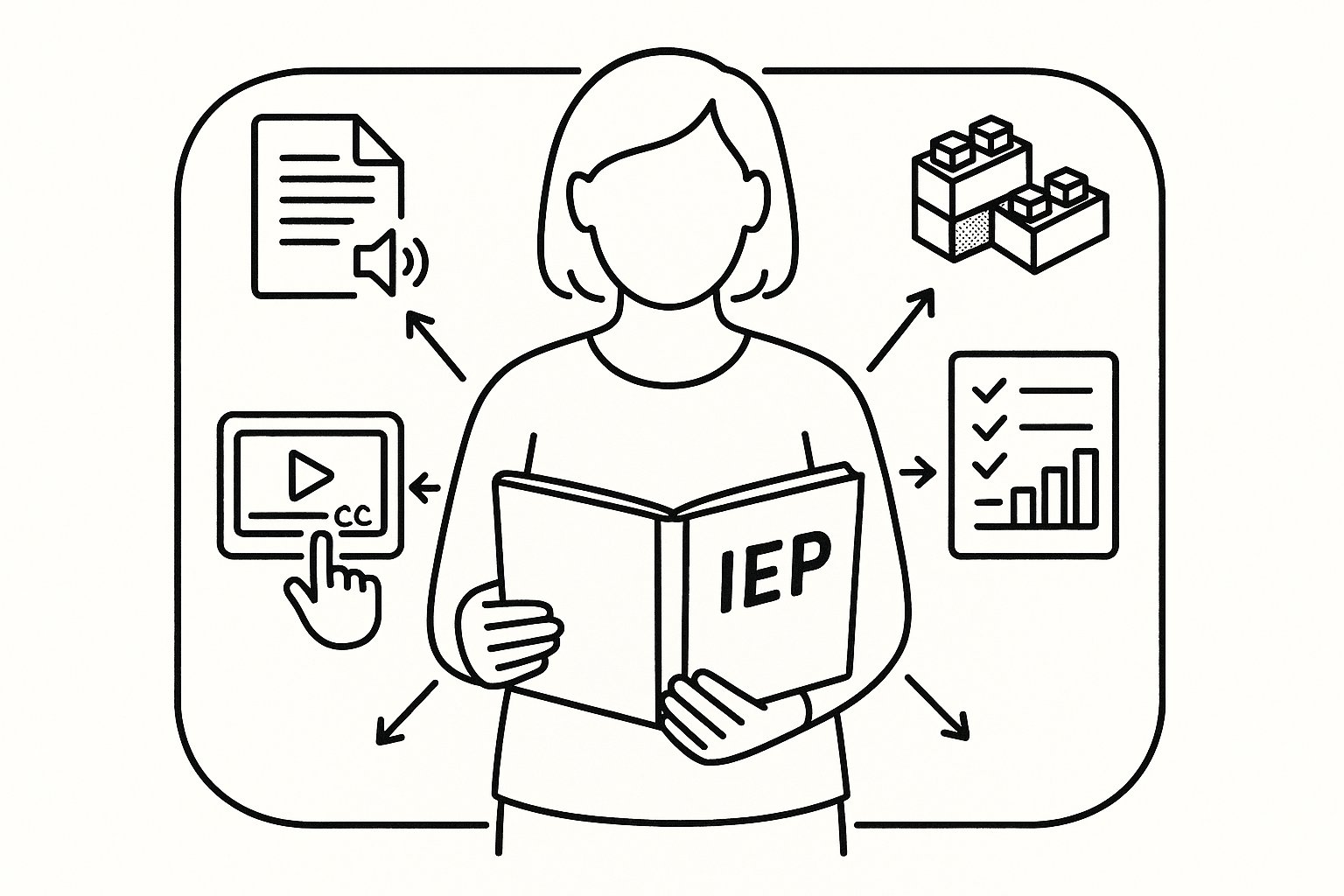
Instructional materials for special education include everything teachers and support teams use to teach skills, assess progress, and engage students: printed texts, manipulatives, assistive technology, visual supports, digital apps, and assessment tools. They aren’t simply “modified textbooks.” Instead, they’re curated and adapted resources designed to meet individual learners where they are and to deliver on IEP goals.
Why this matters: special education is legally and ethically driven by individualized outcomes. Under IDEA and related state laws, instructional decisions must be evidence-based and clearly tied to measurable goals. The right materials do three things well: reduce barriers to access, provide multiple ways to demonstrate learning, and allow reliable progress monitoring. When materials fail those tests, accommodations become mere band-aids, compliance without true learning.
A few high-level principles we use when evaluating materials:
- Universality and flexibility: Materials should support multiple levels of entry. For example, a reading passage with integrated audio, simplified language, and extension questions serves a wider range of learners without multiple separate sets.
- Multi-modal access: Students benefit when content is available visually, auditorily, and kinesthetically. This includes captioned videos, tactile manipulatives, and gesture-based response systems.
- Aligns to IEP objectives: Every material we choose should have a clear path to at least one IEP goal, whether it’s expressive language, functional life skills, or academic standards.
- Data-friendly: Good materials make it simple to collect data. Rubrics, checklists, or apps that log responses let us show progress objectively.
Putting these principles into practice avoids common pitfalls like over-reliance on low-engagement digital games, one-size-fits-all worksheets, or resources that look accessible but don’t generate usable data. In short: materials matter because they directly shape the quality, equity, and defensibility of instruction and outcomes.
Core Types Of Instructional Materials With Practical Examples
To choose wisely, we first categorize materials. Here are core types and practical examples we lean on, with notes on when each is most useful.
- Low-tech tactile and visual supports (classroom-ready)
- Examples: PECS cards, sensory fidgets, magnetic letter sets, visual schedules, task strips.
- Best for: Students with sensory needs, young learners, and those who benefit from concrete, manipulable representations.
- Practical tip: Use laminated task strips with velcro icons for multi-step ADL or classroom routines: they’re durable and adaptable across settings.
- Print and leveled texts
- Examples: Decodable readers, simplified nonfiction with predictable text frames, social stories.
- Best for: Phonics-based reading instruction, building background knowledge, and social-pragmatic skill teaching.
- Practical tip: Pair a leveled text with an audio recording and a 3-question comprehension checklist to support access and quick data collection.
- Assistive technology (AT)
- Examples: Speech-generating devices, text-to-speech and OCR apps, switch-accessible toy controls, AAC apps like Proloquo2Go.
- Best for: Communication support, access to written content, physical access to instruction.
- Practical tip: Match AT to the communicative function: request, comment, protest. Training and implementation time are as important as device selection.
- Interactive digital curricula and apps
- Examples: Accessible math manipulatives (virtual base-ten blocks), customizable language apps, platforms with built-in progress data (e.g., platforms that export CSV of responses).
- Best for: Differentiated practice, remote instruction, and quick progress monitoring.
- Practical tip: Vet for accessibility features (keyboard navigation, screen reader compatibility, captioning) and data export capability for IEP documentation.
- Functional and life-skills materials
- Examples: Community-based curriculum packets, vocational task cards, cooking kits with graded steps.
- Best for: Older students with goals around independence, employment readiness, and community participation.
- Practical tip: Simulate real-world tasks in controlled settings first: use video modeling and backward-chaining for complex routines.
- Assessments and progress-monitoring tools
- Examples: Curriculum-based measurement (CBM) probes, behavior frequency counters, mastery trackers.
- Best for: Providing objective data tied to IEP goals.
- Practical tip: Keep probes brief and routine: consistent administration is vital for valid trend data.
Each category is useful in isolation, but the strongest programs blend them. For instance, pairing an AAC app (AT) with a visual schedule (low-tech) and a leveled text (print) creates redundancy of access that increases the likelihood of measurable learning.
How To Select And Adapt Materials To IEP Goals And Individual Needs
Selecting and adapting materials is a collaborative, evidence-based process. We recommend a stepwise approach that keeps the IEP at the center and documents decision-making for accountability.
Step 1, Start with the IEP: identify the measurable objective.
Before any purchase or adaptation, ask: what specific skill or behavior are we targeting? We map every material to at least one IEP goal. For example, if the goal is “student will initiate a request using 2-word phrases in 4/5 opportunities,” materials must elicit spontaneous communication opportunities and allow precise recording of initiations.
Step 2, Conduct an access and barrier analysis.
Determine sensory, physical, cognitive, linguistic, and environmental barriers. If a student has fine motor challenges, a paper worksheet that requires tiny handwriting is not accessible without adaptation. For each barrier, name an accommodation (e.g., provide a scribe, enlarge response fields, or use switch-accessible alternatives).
Step 3, Match features, not brands.
Instead of choosing by vendor, we list required features: multi-modal presentation, adjustable complexity, data export, portability, and caregiver-friendly instructions. Choose materials that match the feature set.
Step 4, Adapt before replacing.
Often a low-tech adaptation achieves the goal more quickly and sustainably than expensive new tech. Examples:
- Simplify text by reducing sentence length and adding pictorial supports.
- Break tasks into smaller, sequenced task cards and use errorless teaching for new skills.
- Add timers and clear visual feedback to support task persistence.
Step 5, Pilot with clear data collection.
Run a short baseline and intervention phase. Use CBM or brief probes aligned to the IEP skill. If the material yields measurable improvement within a predetermined window (e.g., 4–6 weeks), keep it. If not, iterate.
Step 6, Train stakeholders and plan for generalization.
Materials are only effective when implemented consistently. Provide short, role-specific training for teachers, paras, and family members. Create generalization plans: use the material across several settings, increase naturalistic opportunities, and fade prompts gradually.
Step 7, Review for legal and ethical considerations.
We document choices in IEP meeting notes: why a material was chosen, how it was adapted, and objective data showing its impact. For teams in health-related fields, this documentation supports defensible educational decisions and, when relevant, coordination with allied health providers.
Practical examples of adaptation:
- Converting a worksheet into a sequence of interactive task cards that allow hand-over-hand modeling and independent attempts.
- Pairing a commercial reading app with teacher-made vocabulary slides that include personalized visuals and names.
- Using a voice-output device but restricting vocabulary to high-frequency functional words during initial teaching to promote use.
This structured approach keeps our choices student-centered, practical, and defensible, and it increases the chance the material will produce meaningful, measurable learning.
Conclusion
Choosing and adapting instructional materials for special education is both a craft and a science. By centering the IEP, analyzing access barriers, prioritizing adaptable features, and piloting with clear data, we create instruction that’s equitable and effective. As technology and legal expectations evolve in 2026, our commitment remains the same: select resources that remove barriers, promote measurable progress, and prepare students for meaningful participation in school and community life.
Frequently Asked Questions About Instructional Materials for Special Education
What are instructional materials for special education?
Instructional materials for special education are tools and resources like printed texts, assistive technology, visual supports, and assessment tools designed to meet individual learner needs and support measurable IEP goals.
Why is it important to align instructional materials with IEP goals?
Aligning materials to IEP goals ensures instruction is individualized, evidence-based, and focused on measurable progress, reducing barriers and promoting meaningful learning outcomes for students with diverse needs.
What types of instructional materials are commonly used in special education?
Core types include low-tech tactile supports (e.g., PECS cards), print and leveled texts, assistive technology like speech-generating devices, interactive digital apps, functional life-skills materials, and assessment tools for progress monitoring.
How can educators adapt materials to support students with fine motor challenges?
Educators can adapt materials by enlarging response fields, providing scribing assistance, or using switch-accessible alternatives, ensuring students with fine motor difficulties can access and engage with instruction effectively.
What features should be prioritized when selecting instructional materials for special education?
Materials should offer multi-modal access, flexibility, alignment to IEP objectives, data collection capabilities, portability, and caregiver-friendly instructions to support diverse learner needs and measurable outcomes.
How does using assistive technology benefit students in special education?
Assistive technology supports communication, access to written content, and physical interaction, tailored to functions like requesting or protesting, enhancing student participation and enabling precise progress tracking.