
Last Updated on April 20, 2026 by Jennifer Hanson
Families, educators, and providers often ask: “What are IEP goals examples?” We wrote this guide to demystify those IEP goals, what they look like in 2026, how to make them measurable, and sample goals you can adapt. Whether you’re preparing for an IEP meeting, drafting goals with a teacher, or simply trying to translate legal requirements into classroom-ready targets, we’ll walk through clear examples across academic, behavioral, and functional domains and show the components that make a goal defensible and effective.
In this guide, IEP Goals Examples Practical Measurable Samples And How To Write Them In 2026 is explained with clear steps and tips.
Key Takeaways — IEP Goals Examples Practical Measurable Samples And How To Write Them In 2026
- IEP goals are measurable statements that guide instruction and set clear expectations for student progress within a school year.
- Well-written IEP goals include measurable behavior, conditions, criteria, baseline levels, timeframes, and progress monitoring methods to ensure clarity and accountability.
- Using SMART criteria—Specific, Measurable, Achievable, Relevant, and Time-bound—helps create effective and legally sound IEP goals.
- Examples of IEP goals span academic, behavioral, and functional domains and should be tailored to individual student baselines and instructional contexts.
- Clear IEP goals improve collaboration among educators, families, and providers by defining when a goal is met or needs adjustment.
- Consulting experts or advocates can help ensure IEP goals meet legal standards and protect students’ rights to appropriate education.
What Are IEP Goals And Why They Matter
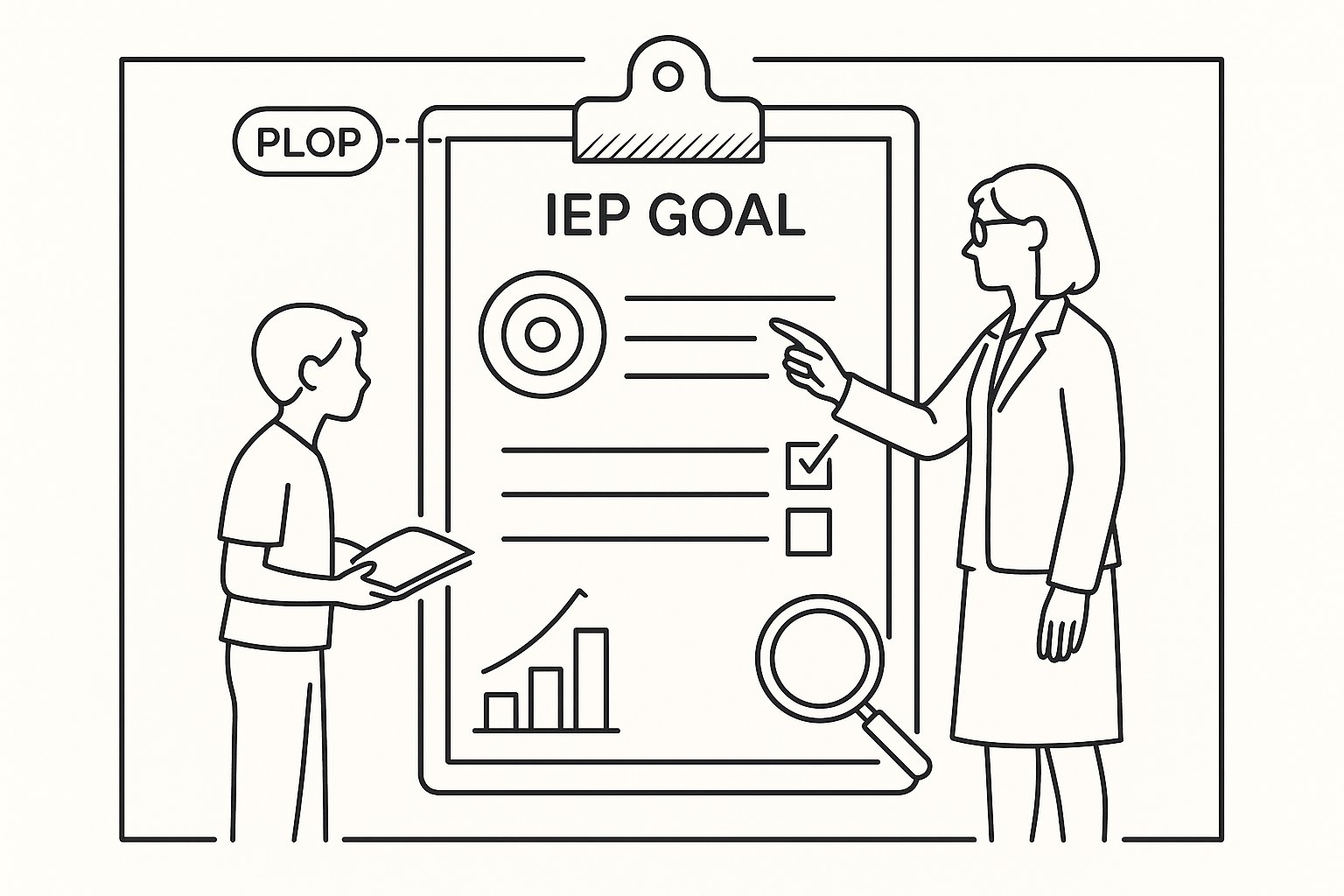
An Individualized Education Program (IEP) goal is a written, measurable statement describing what a student with a disability will reasonably accomplish within a school year. IEP goals are the roadmap from evaluation results and identified needs to instruction and progress monitoring. They’re not vague hopes, every goal should guide instruction, define evaluation, and set expectations for progress.
We care about well-written IEP goals for three reasons: student progress, legal clarity, and collaboration. First, clear goals focus instruction on skills that matter, so teams can teach with intention and measure growth. Second, goals create a record that aligns with legal requirements under IDEA (the Individuals with Disabilities Education Act), which helps families and schools stay accountable. Third, measurable goals make team conversations productive, teachers, therapists, and parents can agree when a goal has been met or when adjustments are needed.
In practice, goals connect present levels of performance (PLOP) to targeted interventions. A goal that’s too broad (e.g., “improve reading”) leaves room for disagreement. A precise goal (e.g., “read grade-level text with 90% accuracy on literal comprehension questions in 4 of 5 trials”) tells us how to teach, how to test, and when to celebrate success or revise instruction.
Key Components Of Effective IEP Goals
Effective IEP goals follow a consistent structure so everyone, parents, teachers, related service providers, and administrators, understands what to expect. We use these essential components when drafting and reviewing goals:
- Measurable behavior or skill: The goal must describe the observable skill (what the student will do). Use action verbs like “name,” “read,” “initiate,” or “independently use.”
- Condition: Specify when or under what conditions the skill will occur (given a teacher prompt, during a small-group lesson, using a communication device). This clarifies instructional context.
- Criterion: Define how well and how often the student must perform to meet the goal (accuracy, frequency, percentage, or level of assistance). Be specific, “improve” is insufficient.
- Baseline / Present Levels: Include the student’s starting point so progress is anchored (e.g., currently reads 35 words per minute at grade-level passages).
- Timeframe: Most IEPs use an annual timeframe, but we also specify short-term objectives or benchmarks when appropriate, especially for complex skills.
- Progress monitoring method: State how progress will be measured (CBM probes, teacher-created assessments, observation data) and reporting frequency.
We also recommend writing goals that are SMART: Specific, Measurable, Achievable, Relevant, and Time-bound. That helps instruction stay student-centered and legally sound. Finally, include accommodations or supports tied to the goal, these show how the student will be taught and what scaffolds will be used.
Examples Of IEP Goals By Domain
Below are practical, measurable IEP goals organized by domain. These samples reflect common needs we see and are written to be adapted to a student’s present levels. Use them as templates: insert a student’s baseline and adjust conditions or criteria to match their program.
Academic/Reading And Math Examples
- Reading (Decoding): Baseline, student decodes 40% of grade-level multisyllabic words independently. Goal: Given grade-level multisyllabic words in isolation, the student will decode with 85% accuracy in 4 out of 5 probes as measured by weekly decoding assessments by June 2026.
- Reading (Comprehension): Baseline, student answers literal questions about a passage correctly 50% of the time. Goal: Given a 300–400 word grade-appropriate passage, the student will answer literal and inferential comprehension questions with 80% accuracy in 3 of 4 trials as measured by biweekly comprehension checks.
- Math (Computation): Baseline, student solves two-digit addition problems with regrouping correctly 45% of the time. Goal: Given two-digit addition problems with regrouping, the student will compute accurately in 9 out of 10 problems across three consecutive assessments.
- Math (Problem Solving): Baseline, student uses a strategy to solve single-step word problems independently 30% of trials. Goal: When presented with one-step word problems, the student will select and apply an appropriate strategy and explain the reasoning in writing with 80% accuracy in 4 of 5 trials.
Conclusion
Well-crafted IEP goals bridge evaluation and instruction. When we write measurable, contextualized goals, we create clearer plans for teaching and fairer ways to monitor progress. Use the samples here as starting points, tailor baselines, conditions, and criteria to your student. And if the team needs help ensuring goals meet legal and educational standards, consider consulting a knowledgeable advocate or attorney to protect the student’s right to an appropriate program.
Frequently Asked Questions About IEP Goals
What are IEP goals and why are they important?
IEP goals are measurable statements describing what a student with a disability will achieve within a school year. They guide instruction, ensure legal clarity under IDEA, and support collaboration among educators, families, and service providers.
What components make an effective IEP goal?
Effective IEP goals include a measurable skill or behavior, condition of performance, criterion for success, baseline data, timeframe for achievement, and a method for monitoring progress, ensuring goals are clear and actionable.
Can you provide examples of measurable IEP goals in reading and math?
Yes. For example, in reading decoding: “Given grade-level multisyllabic words, the student will decode with 85% accuracy in 4 out of 5 probes by June 2026.” In math problem-solving: “The student will solve one-step word problems with 80% accuracy in 4 out of 5 trials.”
How do SMART criteria apply to writing IEP goals?
IEP goals should be Specific, Measurable, Achievable, Relevant, and Time-bound (SMART), which helps keep goals student-centered and legally defensible while focusing instruction effectively.
What strategies can help monitor student progress on IEP goals?
Progress can be monitored through curriculum-based measurements (CBM), teacher-created assessments, observation data, and regular reporting intervals to ensure ongoing evaluation and instructional adjustments.