
Last Updated on October 16, 2026 by Jennifer Hanson
When an Individualized Education Program (IEP) team decides a student cannot be educated in general education full time, we must explain why. That explanation, the Least Restrictive Environment (LRE) justification statement, must be specific, data-driven, and legally defensible. In this guide we’ll demystify what an LRE justification statement is, walk through the core components every statement should include, and provide multiple real-world examples with plain-language explanations. Whether you’re a special educator, an administrator, or a family navigating IEP meetings, we’ll help you write statements that meet both educational needs and compliance expectations in 2026.
In this guide, LRE Justification Statement Examples A Practical 2026 Guide To Writing Clear Compliant Statements is explained with clear steps and tips.
Key Takeaways — LRE Justification Statement Examples A Practical 2026 Guide To Writing Clear Compliant Statements
- An LRE justification statement must be specific, data-driven, and legally defensible to explain why a student cannot be educated full time in general education.
- Effective LRE statements include five core components: present levels of performance, concrete evidence, interventions tried, rationale for exclusion from general education, and recommended placement with supports.
- Clear and measurable data connecting a student’s needs and prior supports attempted are essential in crafting defensible LRE justification statements.
- Properly written LRE statements reduce conflict by clarifying the rationale for placement decisions to educators, parents, and service providers.
- Avoid vague language and demonstrate consideration of less restrictive alternatives to ensure the LRE justification aligns with IDEA requirements and withstands legal scrutiny.
What Is Least Restrictive Environment (LRE) And Why A Justification Statement Matters
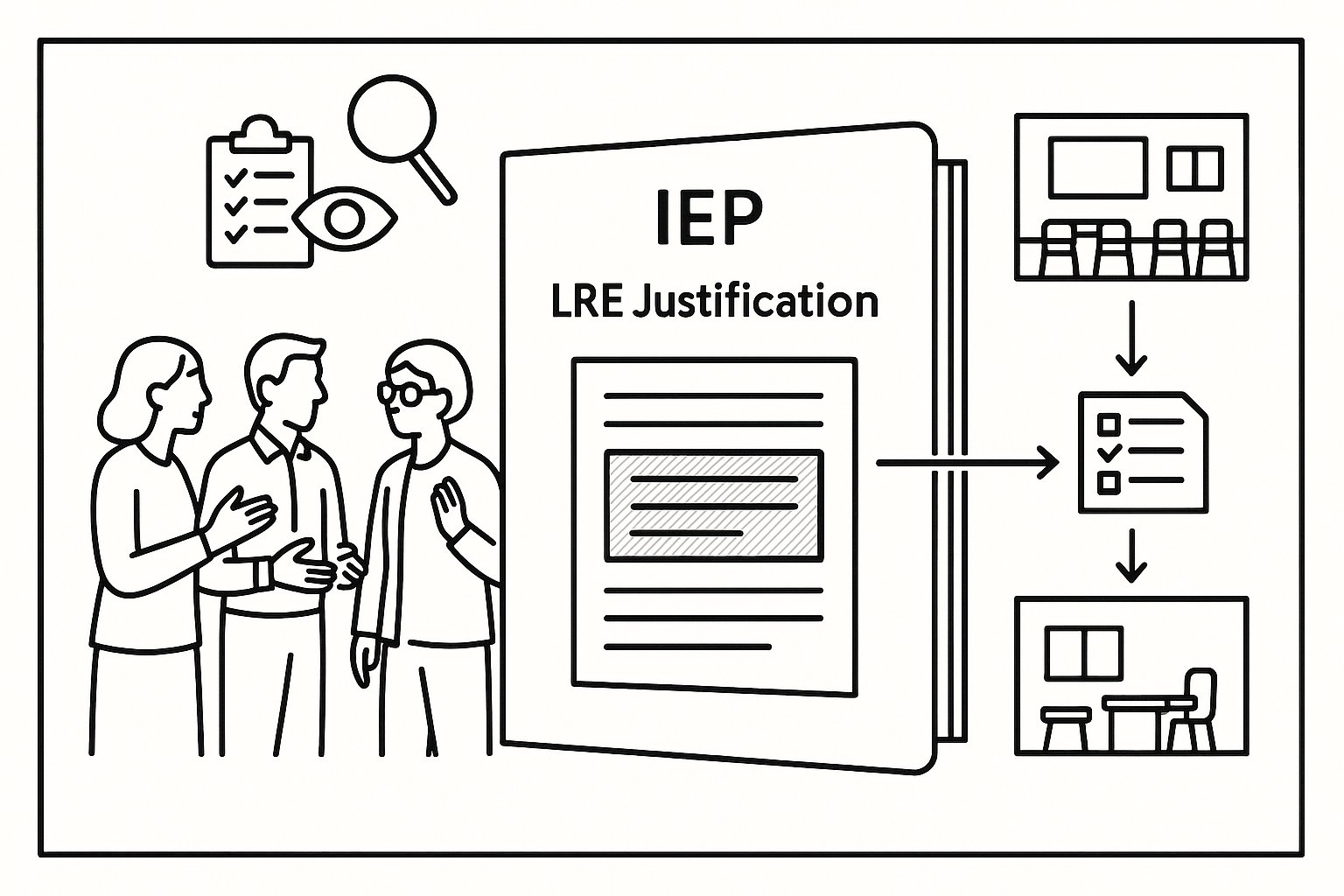
Least Restrictive Environment (LRE) is a foundational principle of the Individuals with Disabilities Education Act (IDEA). It requires that, to the maximum extent appropriate, students with disabilities be educated with peers who are nondisabled and that special classes or separate schooling occur only when the nature or severity of the disability prevents satisfactory education in general education settings. The LRE justification statement is the IEP team’s written explanation when a student is not placed in general education for some or all of the day.
Why this statement matters: it’s the record that ties placement decisions to documented educational need. Courts and administrative hearing officers scrutinize justification statements to confirm the IEP team considered supplementary aids and services, tried to make general education work, and chose a placement supported by evidence. A weak, vague, or boilerplate statement risks disagreements, complaints, or due process. Conversely, a clear statement reduces conflict and improves implementation because it makes the rationale transparent to teachers, parents, and service providers.
We often see three common pitfalls: (1) generic language such as “student needs intense support,” without describing what that means: (2) failure to reference assessments, observations, or trial interventions: and (3) ignoring less restrictive alternatives or why they were ruled out. An effective LRE justification ties placement decisions directly to the student’s present levels of performance, measurable goals, prior interventions, and the specific barriers preventing success in general education.
Key Components Of An Effective LRE Justification Statement
An effective LRE justification statement is concise but layered. We recommend structuring each statement around five essential components, present levels, evidence, interventions tried, rationale for exclusion, and individualized supports, so reviewers can follow the decision-making thread.
- Present Levels of Academic and Functional Performance (PLAAFP)
- Start by summarizing the student’s current, observable performance. Use specific data (reading level, math computation accuracy, attention duration, ADL independence), with dates. For example: “As of March 2026, Julia reads at a 2.5 grade equivalency and correctly decodes 65% of grade-level multisyllabic words on curriculum-based measures.”
- Concrete Evidence
- Reference assessment results, progress-monitoring data, observational notes, and teacher reports. Quantify when possible: percent correct, frequency counts, off-task minutes, error rates. These anchors make the justification objective instead of subjective.
- Interventions and Trialed Supports
- Describe evidence-based supports and classroom accommodations the team tried (co-teaching, preferential seating, extended time, visual schedules), duration, and student response. If a 6-week co-teaching trial produced insufficient progress, name that and include data.
- Why General Education Alone Is Insufficient
- Explicitly connect the data to the barrier: e.g., “Even though adapted materials and a co-teaching model, the student is unable to access grade-level curriculum independently due to decoding deficits that impede comprehension and participation in whole-class instruction.” Avoid assertions without linkage to evidence.
- Placement and Supplementary Aids/Services
- State the recommended placement and why it addresses the documented needs. List specific supports that will accompany the placement (pull-out instruction, speech-language therapy minutes, assistive technology). Also note why less restrictive options were considered but deemed inadequate, was the support intensity unavailable in general education? Did the student require segregated, small-group explicit instruction to make sufficient progress?
We suggest using plain, professional language and keeping the tone collaborative: “The team considered X, Y, and Z: but, given A, B, and C, we recommend placement in…” That phrasing shows deliberation and that less restrictive options weren’t dismissed out of hand.
Sample LRE Justification Statements With Explanations
Below are three practical examples spanning common scenarios. After each sample we explain why the language works and what to avoid.
Sample 1, Reading-Based Support (Partial Inclusion)
“Given current data (September–April curriculum-based measures: 40–55% accuracy on grade-level passage comprehension: decoding at 1.8 grade level), and documented fatigue during whole-class instruction (teacher log: off-task 30+ minutes/day), the team finds that the student cannot access grade-level reading independently in a 90-minute ELA block. The student responded to a 10-week, daily small-group intervention with 5% gains. Because intervention gains were limited even though fidelity, the team recommends 45 minutes daily in a specialized reading class for explicit decoding and comprehension instruction, with the student joining general education for content-related activities with visual supports and adapted texts.”
Why this works: specific data, trialed intervention (10-week), measurable response, and a clear bridge to participation in general education for related activities.
Sample 2, Behavioral/Emotional Need (Separate Setting With Inclusion Opportunities)
“Behavioral observations (Jan–Mar) show the student exhibits physical aggression on average 2x/week during large-group transitions: seclusion/restraint incidents occurred three times in the last semester. Prior supports included a 6-week positive behavior intervention plan and 1:1 para support during transitions: incidents decreased but remained unsafe for large-group instruction. Hence, the team recommends placement in a therapeutic day program for intensive behavior supports with scheduled inclusion for art and PE when de-escalation is stable.”
Why this works: ties safety concerns to specific frequency counts and prior strategies, indicates temporary/restrictive placement with planned inclusion.
Sample 3, Complex Medical/Related Services Need (Related Services Emphasis)
“Due to significant medical needs requiring daily nursing care and frequent in-class monitoring (medical log: 4–6 interventions/day), the student requires a health services-supported classroom where nursing staff are present. The team determined that general education cannot provide continuous medical supervision while ensuring access to curriculum. The student will attend the specialized classroom and participate in general education for music and science twice weekly with a nurse or trained staff present.”
Why this works: clarifies the non-educational but necessary reason for placement and preserves access to general education for appropriate activities.
Common cautions for all examples: avoid subjective descriptors like “severe” without data: don’t rely on parental preference as the sole justification: and don’t omit the team’s consideration of less restrictive alternatives.
Conclusion
Writing a defensible LRE justification statement is about clarity, evidence, and process. We recommend documenting current performance, citing measurable data, describing interventions and outcomes, and explaining precisely why a less restrictive option would not meet the student’s needs. When we use specific language and show that we considered alternatives, the IEP becomes a stronger educational plan and a sound legal record. For teams who want a checklist or template tailored to healthcare-related educational supports, our firm at Chelle Law can help translate clinical and functional needs into clear, compliant statements.
Frequently Asked Questions about LRE Justification Statements
What is a Least Restrictive Environment (LRE) justification statement?
An LRE justification statement explains why a student with disabilities cannot be educated full-time in general education settings. It must be specific, data-driven, and legally defensible, linking placement decisions to the student’s educational needs and documented evidence.
What are the key components to include in an effective LRE justification statement?
An effective LRE justification includes present levels of academic and functional performance, concrete evidence (like assessments and observations), interventions tried, reasons why general education is insufficient, and details about the recommended placement and supplementary aids or services.
Why is specific data important in an LRE justification statement?
Specific data, such as assessment results or behavioral observations, provides objective evidence that supports the placement decision. It makes the statement legally defensible and transparent for teachers, parents, and administrators.
How should an IEP team document attempts to include a student in general education before deciding on a more restrictive placement?
The team should describe evidence-based interventions and trial supports, including duration and student response, and explain why these attempts did not meet the student’s needs despite fidelity, thereby justifying the need for a more restrictive placement.
Can you give an example of how an LRE justification statement links data to placement decisions?
For example, a statement might say, “Despite a 10-week small-group intervention leading to only 5% gains in reading accuracy, the student cannot access grade-level curriculum independently. Therefore, 45 minutes daily in a specialized reading class is recommended,” clearly linking data to placement.
What are common pitfalls to avoid when writing LRE justification statements?
Avoid vague language like “intense support needed” without specifics, failing to reference assessments or interventions, ignoring less restrictive alternatives, and relying solely on parental preference without educational evidence or rationale.