
Last Updated on October 16, 2026 by Jennifer Hanson
Special education is a landscape of legal requirements, individualized instruction, and daily problem-solving. As IEP teachers, we carry responsibilities that blend pedagogy, paperwork, and partnership, with families, related-service providers, and school administrators. This guide breaks down what we actually do day-to-day, how to create and carry out legally defensible Individualized Education Programs (IEPs), and best practices for documentation and communication in 2026. Whether you’re new to the role or refining your practice, we’ll give you clear, actionable steps to stay compliant, student-centered, and efficient.
In this guide, IEP Teacher Responsibilities The Practical Guide Every Special Educator Needs In 2026 is explained with clear steps and tips.
Key Takeaways — IEP Teacher Responsibilities The Practical Guide Every Special Educator Needs In 2026
- IEP teachers deliver individualized instruction aligned with students’ present performance levels and IEP goals while supporting behavior and tracking progress through regular data collection.
- Developing an IEP involves precise assessment, measurable goal writing, and practical accommodations to provide meaningful access without lowering standards.
- Daily collaboration with families, related service providers, and general educators is essential to maintain alignment and support student progress effectively.
- Maintaining meticulous documentation and adhering to legal timelines ensures compliance with IDEA requirements and protects students’ rights.
- Effective communication, including clear summaries and meeting documentation, reduces misunderstandings and prepares teams for possible disputes.
- Flexibility and ongoing data-driven adjustments allow IEP teachers to respond to students’ changing needs while promoting steady, measurable educational progress.
Daily Classroom Duties: Instruction, Behavior Support, And Progress Tracking
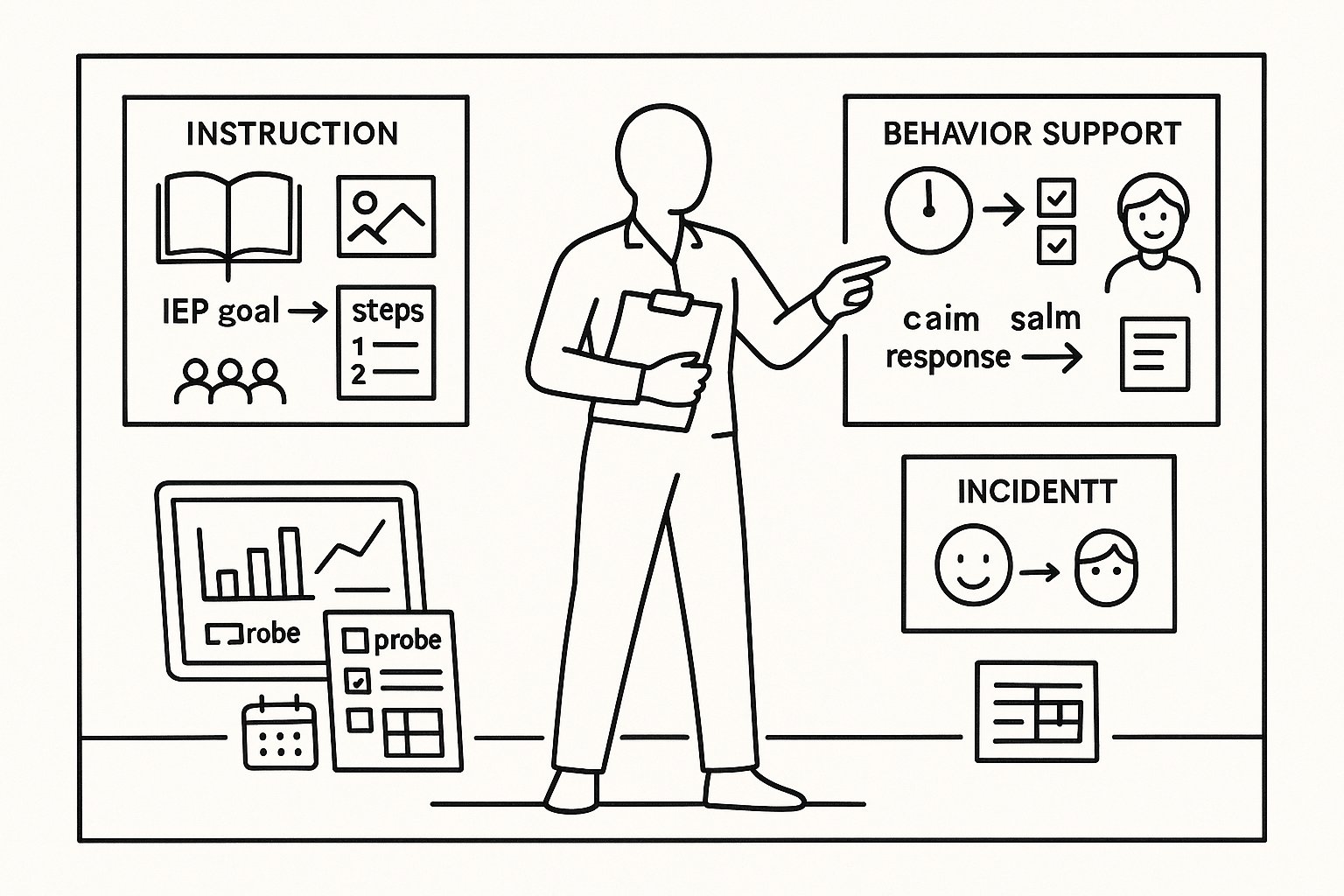
Being an IEP teacher means our daily schedule blends direct instruction with frequent, flexible problem-solving. At the classroom level we focus on three intertwined responsibilities: delivering individualized instruction, providing behavior supports, and tracking progress in ways that inform instruction.
Instruction: We plan lessons that align with students’ present levels of performance and IEP goals while still connecting to grade-level standards. That often requires scaffolds, modified materials, visual supports, simplified language, and alternative response formats. A practical routine we use is backward design: start with the IEP goal, identify the skill breakdown, design quick formative checks, and build small-group or one-on-one lessons targeted to the gap. Co-teaching models (parallel teaching, station teaching, or teaming) let us keep students included while differentiating instruction without isolating learners.
Behavior support: For students with behavioral challenges, we carry out Positive Behavior Interventions and Supports (PBIS) and Functional Behavior Assessments (FBAs) when indicated. Our daily duty is to prevent escalation by using antecedent strategies (clear schedules, choice options), teach replacement skills, and respond with consistent, data-informed consequences. We document incidents succinctly, what preceded behavior, the response, and how the student was redirected, so patterns emerge and plans can be adjusted.
Progress tracking: Progress monitoring is not optional: it’s the data that justifies our instruction. We use curriculum-based measures, brief probes tied to IEP goals, and digital tools for ongoing capture. Weekly or biweekly probes for reading fluency, math computation, or behavior frequency let us make timely instructional changes. Practical tips: keep probes short, score immediately, and maintain a simple dashboard (spreadsheet or secure app) that flags students who aren’t making expected progress. That dashboard becomes critical during IEP team meetings and when we need to recommend revisions or additional services.
Collaboration and flexibility: Finally, the day-to-day job requires us to be relentless collaborators. We check in with parents, related-service providers (speech, OT, PT), and general educators frequently. Quick, structured communication, two-sentence email updates or brief weekly summaries, keeps the team aligned and reduces surprises at meetings. And we accept that flexibility is part of the role: an IEP teacher’s best-laid plans change when a student needs crisis support, assessment time, or a home visit. The goal is steady, measurable forward movement.
Developing And Implementing The IEP: Assessment, Goal Writing, And Accommodations
Developing an effective IEP requires skillful assessment, precise goal writing, and practical accommodations that work in real classrooms. We approach each IEP as both a legal document and a roadmap for instruction.
Assessment: Good IEPs begin with quality data. We gather formal assessments (standardized tests, eligibility evaluations), informal data (work samples, classroom observations), and family input. When we suspect a specific learning need, we request targeted evaluations or progress-monitoring baselines before writing long-term goals. Timelines matter: initial evaluations, re-evaluations every three years, and periodic reviews must meet state timelines. We document consent and notices meticulously, missing a deadline creates legal risk and undermines trust.
Goal writing: Clear, measurable goals are the heart of the IEP. We write goals that answer four questions: who (the student), will do what (measurable behavior), under what conditions (supports/accommodations), and how well (criteria). For example: “Given a teacher-created comprehension probe and a graphic organizer, Jayden will identify the main idea and two supporting details in grade-level passages with 80% accuracy on three of four consecutive probes.” We avoid vague language like “improve reading” and anchor goals to observable success criteria and timelines.
Accommodations and modifications: We balance access and expectations. Accommodations (extra time, preferential seating, simplified directions) provide access without changing the curriculum. Modifications (reduced assignments, alternate assessments) change expectations. Our guiding question: does the accommodation enable access while maintaining meaningful participation? Practical implementation includes creating an accommodations checklist for every teacher and service provider and ensuring materials (digital texts, enlarged print, speech-to-text tools) are ready before the student needs them.
Service delivery and scheduling: We clearly document how, when, and where services occur, pull-out, push-in, consultative. Recent guidance and pandemic-era shifts have expanded telepractice and hybrid service models: we specify modes (in-person vs. remote) and contingency plans. Least Restrictive Environment (LRE) analysis must be explicit: justify any removal from the general education classroom with supporting data and describe steps taken to reintegrate.
Parent and student involvement: We involve families and, when appropriate, students in goal selection and strategy planning. When parents feel heard, implementation is smoother. We also ensure the student’s voice is represented, self-advocacy goals, transition planning, and accessible translations of the IEP help foster ownership.
Documentation, Compliance, And Communication: Legal Duties And Recordkeeping Best Practices
IEP teachers sit at the intersection of education and law. Our documentation and communication practices protect students’ rights and reduce liability for districts and providers.
Legal basics and timelines: We must comply with IDEA (Individuals with Disabilities Education Act) requirements and relevant state regulations. That means timely evaluation consents, annual reviews, three-year re-evaluations, proper notice for meetings, and documented parental refusals when services are declined. Missing a procedural step can limit a family’s remedies, or expose the district to complaints, so we treat timelines as non-negotiable.
Recordkeeping: Practical recordkeeping keeps us defensible and efficient. We maintain a central, secure student file (electronic or locked paper) containing evaluation reports, IEPs, progress data, signed consent forms, notices of meeting, and communication logs. We use dated entries and consistent formats: who we contacted, date/time, method (email, phone, meeting), and outcome. For behavior incidents, we record antecedent-behavior-consequence and any interventions implemented. Digital systems can streamline this, but we ensure access controls and privacy protections under FERPA and state laws.
Communication best practices: Clear, timely, and empathetic communication reduces misunderstandings. We send concise pre-meeting summaries, include proposed goals before meetings when possible, and follow up with meeting minutes that document team decisions. When disagreements arise, we document offers of mediation, procedural safeguards, and timelines for resolution. We avoid argumentative language, stick to facts, data, and proposed steps.
Preparing for disputes and hearings: Even with best practices, disputes happen. When they do, our documentation is our strongest defense. We keep progress-monitoring records, notes of interventions, and evidence that we considered and implemented accommodations. If families pursue mediation or a due-process hearing, clearly organized records and a demonstrated pattern of good-faith collaboration significantly strengthen our position.
Integrating legal counsel: Schools sometimes need legal advice. If complex contractual or licensing issues arise, especially around personnel, service delivery models, or interagency agreements, we consult district counsel. For private practitioners or smaller programs, firms experienced in education and healthcare employment law (such as Chelle Law, which advises professionals on employment and contract matters) can be a resource for understanding obligations and risk. The point is to combine pedagogical rigor with legal awareness so we serve students well and responsibly.
Conclusion
IEP teacher responsibilities are broad but purposeful: we teach, we measure, and we protect students’ rights through careful planning and documentation. By tightening daily routines, writing clear measurable goals, and keeping legally sound records, we create programs that help students progress and reduce conflict. If we keep collaboration at the center, bringing families and providers into the process early, we’ll spend less time defending decisions and more time teaching. That balance is what makes our work both challenging and deeply rewarding.
Frequently Asked Questions About IEP Teacher Responsibilities
What are the primary daily responsibilities of an IEP teacher?
IEP teachers deliver individualized instruction aligned with IEP goals, provide behavior supports like PBIS and FBAs, and track student progress through frequent data collection to inform instruction and make timely adjustments.
How do IEP teachers develop effective Individualized Education Programs?
They use quality assessment data, write clear, measurable goals with specific criteria, and design accommodations and modifications that balance student access and curriculum expectations, while complying with legal timelines.
Why is progress monitoring important for IEP teachers?
Progress monitoring provides data that justifies instruction effectiveness, informs necessary adjustments, and supports decisions during IEP meetings, ensuring students make steady, measurable progress toward their goals.
How do IEP teachers collaborate with families and other educators?
IEP teachers maintain frequent, structured communication through brief updates and meetings, involve families and students in planning, and coordinate with related-service providers and general educators to align supports and services.
What legal compliance must IEP teachers follow in their role?
They adhere to IDEA and state regulations by meeting evaluation and review timelines, obtaining consents, documenting notices, maintaining secure records, and ensuring proper procedural safeguards to protect student rights.
What strategies do IEP teachers use to support students with behavioral challenges?
They implement Positive Behavior Interventions and Supports (PBIS), conduct Functional Behavior Assessments (FBAs), use antecedent strategies, teach replacement skills, apply consistent consequences, and document behavior incidents for data-driven adjustments.