
Last Updated on October 16, 2026 by Jennifer Hanson
When a child’s behavior in school is driven by a disability, a Section 504 plan can be the practical tool that levels the playing field. We often see confusion about what a 504 plan covers, who qualifies, and how it differs from special education services. In this guide we break down the essentials for parents and educators in plain language, show how schools develop behavior-focused accommodations, and explain the legal protections that back these plans. Our goal is to give you clear next steps so you can advocate effectively for a student who needs behavioral supports at school.
In this guide, What Is a 504 Plan for Behavior A Practical Guide For Parents And Educators 2026 is explained with clear steps and tips.
Key Takeaways — What Is a 504 Plan for Behavior A Practical Guide For Parents And Educators 2026
- A 504 plan provides accommodations for students whose behavior is affected by a disability, ensuring equal access to education without specialized instruction.
- Eligibility for a behavioral 504 plan requires a documented physical or mental impairment that substantially limits major life activities, including behavior and learning.
- Unlike IEPs, 504 plans focus on removing barriers through accommodations like preferential seating, scheduled breaks, and behavior intervention plans rather than curriculum changes.
- Development of a 504 plan involves a collaborative team approach that uses multiple data sources to tailor practical, measurable supports for the student’s specific behavioral needs.
- Parents should document concerns, formally request evaluations, and maintain records to effectively advocate and ensure school compliance with the 504 plan.
- Legal protections under Section 504 prohibit disability-based discrimination, and families can use grievance procedures or Office for Civil Rights complaints if accommodations are denied or improperly implemented.
What A Section 504 Plan Is And Why Behavior Is Covered
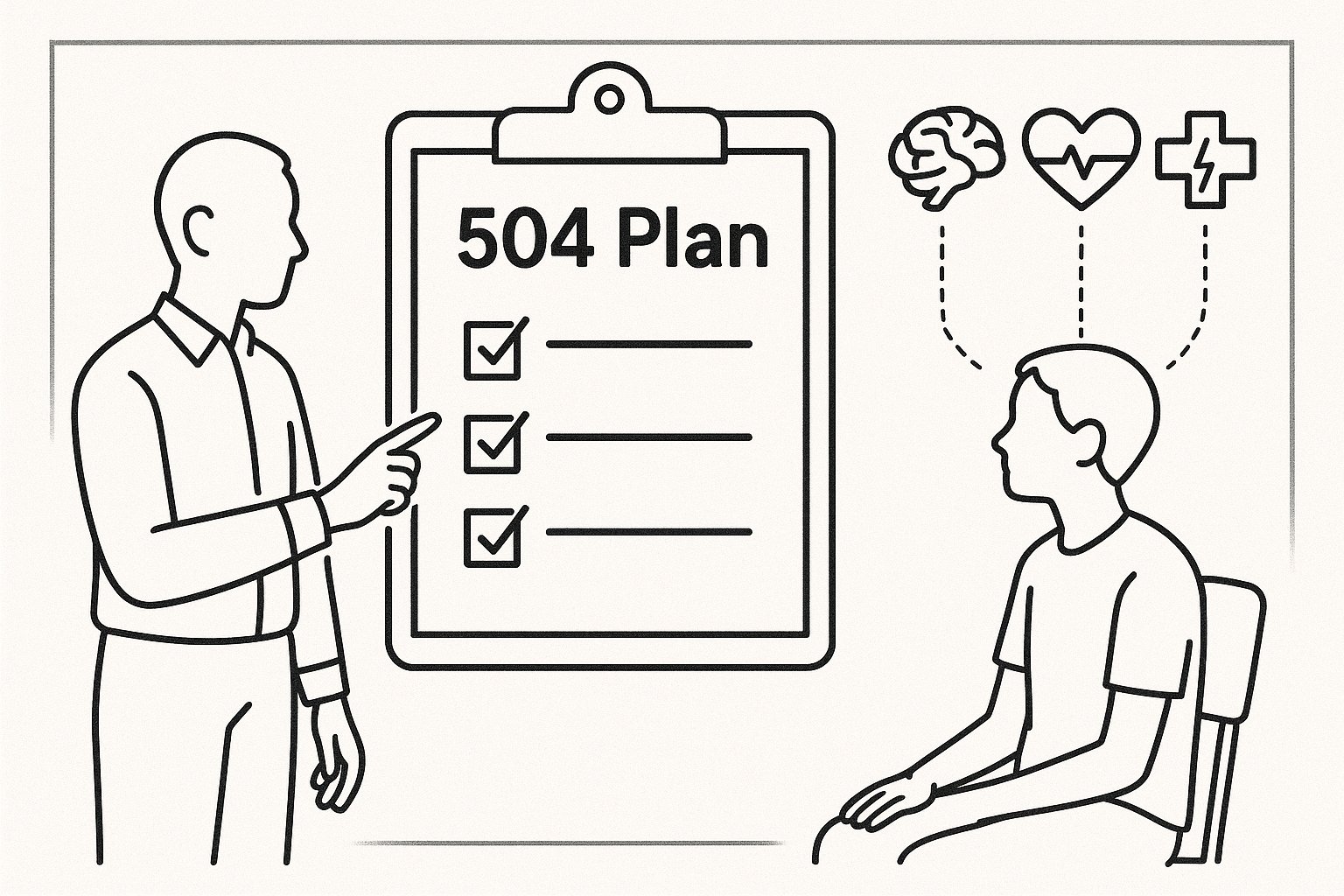
Section 504 of the Rehabilitation Act of 1973 is a federal civil-rights law that prohibits disability-based discrimination in programs receiving federal funds, including public schools. A 504 plan is the school’s written agreement that a student with a disability will receive reasonable accommodations so they have equal access to education. Unlike special education services under the Individuals with Disabilities Education Act (IDEA), a 504 plan focuses on removing barriers rather than providing specialized instruction.
Behavior is covered under Section 504 when it stems from a physical or mental impairment that substantially limits one or more major life activities, learning, thinking, concentrating, interacting with others, or behavior itself. That means behaviors caused or significantly influenced by conditions such as ADHD, anxiety disorders, certain medical conditions (e.g., epilepsy, traumatic brain injury), or mental-health diagnoses can be addressed through a 504 plan. The plan’s purpose is practical: to adapt the environment and supports so the student can participate safely, meaningfully, and with dignity in school activities.
We should note: a 504 plan does not label misconduct that’s purely disciplinary in nature. If behavior is simply willful misconduct without an underlying disability affecting learning or behavior, Section 504 is typically not the remedy. But when behavior is a manifestation of a disability, the school has an obligation to evaluate and, if eligible, provide reasonable accommodations and related services.
Who Qualifies: Eligibility Criteria For Behavioral 504 Plans
Eligibility for a 504 plan centers on three questions: Does the student have a physical or mental impairment? Does the impairment substantially limit one or more major life activities? And does the limitation affect the student’s ability to access the school program? For behavior-focused plans, we look specifically at whether the impairment affects behavior, self-regulation, social interaction, attention, or other skills essential to learning.
Schools use multiple data sources when deciding eligibility: teacher observations, behavior records, academic performance, medical or psychological evaluations, disciplinary history, and parent reports. A single source rarely suffices. For example, repeated office discipline referrals alone don’t establish a disability: but when referrals coincide with a clinical diagnosis (like ADHD or an anxiety disorder) and documented functional impairments at school, a 504 evaluation is likely warranted.
Parents and educators both have roles. Parents can request a 504 evaluation in writing: schools must respond and either evaluate or provide prior notice explaining why they won’t. If the team finds the student eligible, the 504 team drafts accommodations tailored to the behavior, think anticipatory supports, environmental changes, and crisis plans, not just punitive measures.
One more thing: eligibility determinations should be individualized and avoid broad assumptions. Two students with the same diagnosis might have very different needs. That’s why documentation and collaborative problem-solving matter.
How A 504 Plan Differs From An IEP And Other Supports
Both 504 plans and Individualized Education Programs (IEPs) aim to support students with disabilities, but they operate under different laws and offer different remedies. An IEP, under IDEA, provides specially designed instruction and related services to meet unique educational needs and requires that the student qualify for special education. A 504 plan, by contrast, ensures equal access through reasonable accommodations and may include related services but does not provide specialized instruction by statute.
Practical differences we see in schools:
- Team composition: IEP teams include specific IDEA-required members like a special education teacher: 504 teams are more flexible and often consist of general educators, the school 504 coordinator, and parents.
- Procedural safeguards: IDEA provides more formal procedural protections (e.g., formal mediation and due process hearing rights). Section 504 also provides procedural protections, but they vary by district and rely on civil-rights enforcement (OCR) and Section 504 grievance procedures.
- Types of supports: An IEP can change curriculum or provide specialized instruction. A 504 plan typically changes how the student accesses instruction, preferential seating, extended time, behavior intervention plans, or communication supports.
We often advise parents to evaluate both pathways. If a student needs instructional modifications plus to accommodations for behavior, an IEP may be the better fit. If the primary barrier is behavior rooted in a disability but academic instruction remains appropriate, a 504 plan may be quicker and less stigmatizing.
How Schools Develop And Implement A Behavioral 504 Plan
A successful behavioral 504 plan is collaborative, evidence-based, and reviewable. The school typically convenes a 504 team that reviews evaluation data, outlines the functional impacts of the student’s impairment, and identifies reasonable accommodations and supports. Implementation requires clear roles, timelines, and documentation so teachers and staff know what to do and how to measure progress.
Key elements of implementation include: ongoing staff training on the plan, a communication protocol between school and family, clear behavioral expectations and supports in the classroom, and emergency/crisis response steps if the student escalates. Importantly, accommodations should be practical and measurable, for instance, providing a student a daily check-in with a trusted adult to pre-teach coping strategies, rather than vague objectives.
Steps To Request, Evaluate, And Document A 504 Plan (Practical Checklist)
We suggest this step-by-step checklist for parents and educators to move from concern to documented plan:
- Document concerns: Keep a log of behavioral incidents, dates, triggers, and attempted strategies for at least a few weeks. Concrete examples help build a case.
- Make a written request: Parents should send a dated written request for a 504 evaluation to the school principal or 504 coordinator and keep a copy.
- Consent and evaluation: The school should obtain parental consent for evaluation. The team gathers classroom data, medical/clinical reports, teacher input, and any standardized assessments.
- 504 meeting and decision: The 504 team meets to decide eligibility. If eligible, they draft the 504 plan with specific accommodations, responsible staff, and timelines.
- Implementation and training: Ensure staff receive the plan and any needed training. Confirm when the plan starts and how progress will be measured.
- Review and revision: Schedule regular reviews (commonly every semester or sooner). Update the plan if supports aren’t working.
- If disputes arise: Use the district’s Section 504 grievance procedure. Keep records of communications, and consider requesting mediation or reaching out to an advocate or attorney familiar with 504 law if necessary.
We recommend keeping all documents in a single folder, emails, evaluations, meeting notes, so you can track the school’s compliance and the student’s progress.
Examples Of Behavior-Focused Accommodations And Interventions
Behavior-focused accommodations are practical, individualized, and aimed at preventing escalation or improving access. Common examples include:
- Preferential seating near the teacher and away from distractions
- Scheduled breaks or movement opportunities during transitions
- A daily or weekly check-in/check-out with a mentor to set goals and reinforce expectations
- Visual schedules, social stories, or cue cards to support transitions and expected behaviors
- Modified assignment formats or reduced workload during periods of high stress
- Positive behavior support plans that outline clear incentives and restorative strategies
- Crisis de-escalation plans and staff training on safe intervention techniques
Related services like counseling, behavioral consultation, or school-based mental-health supports can be part of a 504 plan when they’re necessary to enable access. We stress that punitive measures alone aren’t appropriate when behavior is disability-related: instead, plans should prioritize teaching replacement behaviors and reducing triggers.
Monitoring, Enforcement, And Legal Protections For Students And Families
Section 504 provides civil-rights protections: schools must not discriminate and must reasonably accommodate qualified students. Monitoring and enforcement happen through local grievance procedures, state education agencies, and the U.S. Department of Education’s Office for Civil Rights (OCR). If a family believes the school has violated Section 504, by denying an evaluation, failing to carry out accommodations, or disciplining a student without considering disability-related behavior, they can file a complaint with OCR or pursue due process where available.
Documentation is critical when enforcing rights. We advise families to keep detailed records of requests, meetings, plans, and incidents. If informal resolution fails, written complaints to the district and OCR are next steps. In some cases, legal counsel can help navigate complex disputes, especially where disciplinary exclusion (suspension, expulsion) is involved or when the school refuses to evaluate.
At Chelle Law, we work with professionals to clarify rights and process options in employment and credentialing contexts: similarly, parents sometimes benefit from legal guidance when schools misapply regulations. Our general recommendation: try collaborative problem-solving first, clear communication often resolves misunderstandings, but don’t hesitate to escalate if a student’s access or safety is at stake.
Finally, remember that 504 plans are living documents. Regular monitoring and objective data help schools and families adjust supports before problems become crises, and that proactive stance is usually the most effective way to protect a student’s rights and success.
Frequently Asked Questions About 504 Plans for Behavior
What is a 504 plan for behavior in schools?
A 504 plan for behavior is a school’s written agreement to provide reasonable accommodations for a student whose behavior is affected by a disability, ensuring they have equal access to education by removing barriers related to their behavioral challenges.
Who qualifies for a behavior-focused 504 plan?
Students qualify if they have a physical or mental impairment that substantially limits major life activities such as learning or behavior, causing behavioral challenges. Eligibility is determined through evaluations including teacher input, medical diagnoses, and behavior records.
How does a 504 plan differ from an Individualized Education Program (IEP)?
While an IEP provides specialized instruction under IDEA, a 504 plan ensures equal access through accommodations without changing curriculum. IEP teams include special educators; 504 teams usually involve general educators and focus on accommodation rather than specialized teaching.
What types of behavior accommodations are included in a 504 plan?
Accommodations may include preferential seating, scheduled breaks, check-ins with a mentor, visual supports, modified assignments, positive behavior plans, and crisis de-escalation strategies aimed at preventing escalation and improving access.
How can parents request a 504 evaluation for their child’s behavior?
Parents should submit a dated written request to the school principal or 504 coordinator. The school must respond by evaluating the student or explaining why evaluation won’t occur, ensuring a collaborative approach to determine eligibility and accommodations.
What legal protections do students with behavioral 504 plans have?
Section 504 prohibits disability-based discrimination and requires schools to provide reasonable accommodations. Families can file complaints with the Office for Civil Rights if schools fail to evaluate, implement accommodations, or improperly discipline due to disability-related behavior.