
Last Updated on October 16, 2026 by Jennifer Hanson
Dyslexia is common, affecting reading, spelling, and sometimes working memory, yet students with dyslexia can thrive when schools provide the right supports. A 504 plan is one of the primary tools in public schools for removing barriers created by dyslexia without altering curricular standards. In this guide we’ll explain how a 504 plan works, who qualifies under Section 504, typical accommodations, how to request and carry out a plan, and how 504 plans compare with IEPs. Our goal is practical: give parents and educators clear next steps and realistic expectations so students get what they need to learn.
In this guide, What Is a 504 Plan for Dyslexia A Practical Guide For Parents And Educators 2026 is explained with clear steps and tips.
Key Takeaways — What Is a 504 Plan for Dyslexia A Practical Guide For Parents And Educators 2026
- A 504 plan offers students with dyslexia legal protections and accommodations that ensure equal access to education without changing academic standards.
- Eligibility for a 504 plan requires that dyslexia substantially limits a student’s ability to read or learn compared to peers, confirmed through evaluations and documented struggles.
- Common accommodations include extended test time, assistive technology, preferential seating, and tailored instructional methods to address dyslexia challenges.
- Requesting a 504 plan involves a written application, evaluation, team meetings, and clear, measurable accommodation plans with assigned responsibilities.
- 504 plans focus on access accommodations under civil rights law, while IEPs provide specialized instruction under education law; the choice depends on the student’s needs.
- Monitoring and revising the 504 plan ensures effectiveness, and families have legal recourse if schools fail to implement agreed accommodations.
How A 504 Plan Works And Why It Matters For Dyslexia
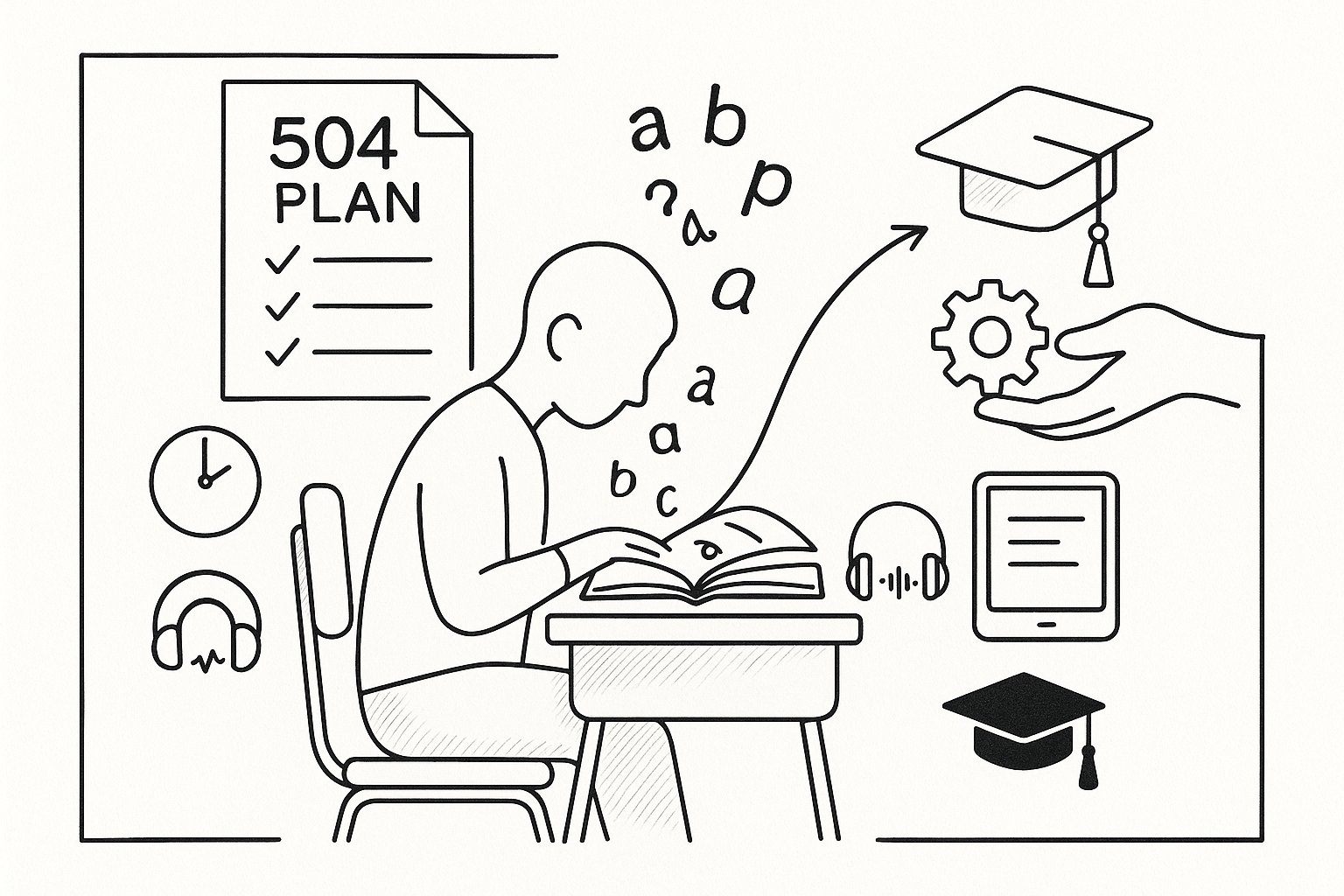
Section 504 of the Rehabilitation Act of 1973 is a federal civil-rights law that prohibits disability-based discrimination in programs receiving federal funds, including public schools. A 504 plan is the written set of accommodations and supports a school provides when a student has a qualifying disability that substantially limits one or more major life activities, like reading or learning. For students with dyslexia, a 504 plan levels the playing field by addressing how instruction is delivered and how performance is measured, while keeping the same academic standards.
Why it matters: dyslexia typically affects decoding, fluency, or spelling, which can make classroom tasks disproportionately difficult. With a 504 plan, the student can access reasonable changes, for example, extra time on tests, audio alternatives, or assistive technology, that reduce the impact of dyslexia without lowering expectations. Importantly, a 504 plan protects a student’s right to equal access: if the school fails to provide agreed accommodations, families have legal remedies under Section 504.
We find it helpful to think of a 504 plan like removing friction from a machine: the curriculum stays the same, but we remove predictable obstacles so the student’s abilities, not their disability, determine success.
Who Qualifies: Eligibility Criteria For Dyslexia Under Section 504
Eligibility for a 504 plan centers on whether a student has a disability that substantially limits a major life activity. For dyslexia this means the school team must evaluate whether the student’s reading or related academic skills are significantly impaired compared to peers, and whether that impairment interferes with learning or classroom participation.
Evaluation often includes: school records, teacher observations, classroom work samples, screening or diagnostic tests (reading fluency, phonological processing, decoding), and input from parents. A formal psychoeducational evaluation helps but isn’t always required: schools can rely on multiple sources of data. Importantly, the determination must be individualized, there’s no single cutoff score that automatically triggers eligibility.
We encourage families to document classroom struggles and previous interventions. If prior targeted reading instruction didn’t close the gap, that history supports a finding that dyslexia substantially limits learning. Schools must also consider whether the student’s needs are better addressed through an IEP under IDEA: if the primary issue is an educational disability that requires specialized instruction, an IEP might be the right route.
Typical Accommodations And Supports For Students With Dyslexia
504 plans list specific, measurable accommodations tailored to the student’s needs. Typical supports for dyslexia include:
- Assessment changes: extended time on tests, small-group testing, or alternate formats (oral responses instead of written).
- Instructional access: preferential seating, chunking assignments, pre-teaching vocabulary, and explicit, multisensory directions.
- Materials and technology: audio books, text-to-speech and speech-to-text software, digital organizers, and font/format adjustments (larger type, increased spacing).
- Assignments and grading: modified deadlines, reduced copying requirements, and grading that separates content knowledge from handwriting or spelling when appropriate.
- Organizational supports: daily checklists, visual schedules, and teacher/peer check-ins to track assignments.
Accommodations should be concrete (who will do what, when, and how often). For instance: “Student will receive 50% additional time on all classroom and state assessments: the special education coordinator will arrange a separate testing location.” We advise avoiding vague language such as “as needed”, specificity prevents confusion during implementation.
We also emphasize training: teachers benefit from brief guidance on how to carry out accommodations consistently. A 504 plan works only if adults in the classroom and testing environments understand and follow it.
How To Request, Evaluate, And Implement A 504 Plan At School
Requesting a 504 plan starts with a written request to the school, typically the principal, 504 coordinator, or the student’s teacher. Describe the student’s struggles, include examples, and attach any assessments or medical notes. After the request, the school schedules a 504 eligibility meeting within a reasonable time frame.
The typical steps we follow with families are:
- Gather documentation: work samples, teacher notes, prior interventions, private evaluations, and medical or psychologist reports that reference dyslexia or reading disorder.
- Request an evaluation: schools must evaluate if they suspect a disability. The evaluation should be comprehensive enough to show whether dyslexia substantially limits learning.
- Attend the team meeting: the team usually includes the parent, teacher(s), principal or 504 coordinator, and any specialists. Come prepared with specific accommodation requests and examples of what helps your child.
- Draft the 504 plan: the team writes measurable accommodations, timelines, and assignment of responsibilities. We recommend including a review date and a specific process for resolving disputes.
- Monitor and revise: the 504 plan is not static. Track progress, keep communication logs with teachers, and request reconvening the team if accommodations aren’t effective.
If the school denies the request, families have recourse: file an internal grievance, request mediation, or file a complaint with the Office for Civil Rights (OCR). Formal appeals can be technical, that’s where legal counsel familiar with education law, like those at Chelle Law’s resource network, can help clarify rights and next steps without turning the process adversarial.
504 Plans Versus IEPs: Key Differences, Advantages, And When To Choose Either
Although both 504 plans and Individualized Education Programs (IEPs) support students with disabilities, they serve different legal schemes and offer different remedies.
Key differences:
- Legal basis: 504 plans arise under Section 504 (civil rights), IEPs under IDEA (special education law). IDEA provides more procedural protections and funding tied to special education services.
- Services vs. accommodations: IEPs can provide specially designed instruction and related services (speech, occupational therapy), whereas 504 plans focus on accommodations that provide access to general education.
- Due process: IEPs include detailed procedural safeguards (notice, consent, due process hearings). Section 504 has grievance procedures and OCR complaints but fewer IDEA-like procedural rights.
- Eligibility: IDEA requires that a student has one of the specific disability categories and needs special education to benefit from instruction. Section 504’s standard focuses on substantial limitation of a major life activity.
When to choose which: If dyslexia is severe and the student requires specialized instruction, structured literacy, systematic phonics, or small-group interventions delivered by trained specialists, an IEP is likely appropriate. If the student primarily needs accommodations to access instruction already provided in the general education classroom (extra time, assistive tech), a 504 plan may suffice.
We usually recommend starting with a full evaluation. If the evaluation points to the need for specialized instruction, pursue an IEP. If not, a 504 plan can provide timely supports without the longer IEP process.
Conclusion
A 504 plan can be a powerful, flexible way to support students with dyslexia, protecting their right to equal access while keeping academic expectations intact. We suggest documenting concerns, requesting a thoughtful evaluation, and insisting on clear, measurable accommodations. When the plan is specific and monitored, most students experience immediate, practical gains. If the school denies needed supports or the student needs specialized instruction, explore an IEP or seek advocacy help to ensure the student’s legal rights are honored.
Frequently Asked Questions About 504 Plans for Dyslexia
What is a 504 plan and how does it support students with dyslexia?
A 504 plan is a written set of accommodations provided by public schools under Section 504 of the Rehabilitation Act to help students with dyslexia access education equally without changing academic standards. It removes barriers by adjusting instruction delivery and performance measurement.
Who qualifies for a 504 plan for dyslexia in schools?
Students with dyslexia qualify if their reading or related academic skills are substantially limited compared to peers, interfering with learning. Schools evaluate this using records, observations, tests, and parent input to determine eligibility individually.
What are some typical accommodations included in a 504 plan for dyslexia?
Common accommodations include extra time on tests, preferential seating, audio books, text-to-speech software, chunking assignments, and organizational supports like checklists, all tailored to the student’s specific needs.
How can parents request a 504 plan for their child with dyslexia?
Parents start by submitting a written request to the school, detailing the child’s struggles and attaching any assessments. The school then evaluates eligibility and holds a team meeting to draft accommodations and supports.
How does a 504 plan differ from an Individualized Education Program (IEP) for dyslexia?
A 504 plan provides accommodations under civil rights law without altering curriculum, while an IEP offers specialized instruction and related services under special education law. IEPs involve more procedural protections and are for students needing intensive support.
What should parents do if their school denies a 504 plan for their child with dyslexia?
Parents can file an internal grievance, request mediation, or submit a complaint to the Office for Civil Rights. Seeking legal counsel familiar with education law can help clarify rights and navigate the appeals process.