
Last Updated on October 16, 2026 by Jennifer Hanson
When a student’s disability creates barriers to learning, we want practical steps and clear rights, fast. A 504 plan is a federal civil-rights accommodation plan that public schools in Arizona use to level the playing field for students with disabilities. In this guide we explain what a 504 plan is, who typically qualifies in Arizona, how the process works, and how parents and professionals can request, develop, and enforce an effective plan. We’ll also point out where legal help can make a difference if disputes arise.
In this guide, What Is A 504 Plan In Arizona A Clear Guide For Parents And Professionals 2026 is explained with clear steps and tips.
Key Takeaways — What Is A 504 Plan In Arizona A Clear Guide For Parents And Professionals 2026
- A 504 plan in Arizona schools is a federal civil-rights accommodation plan that ensures students with disabilities have equal access to education by providing necessary supports and accommodations.
- Eligibility for a 504 plan requires the student to have a disability that substantially limits one or more major life activities such as learning or concentration, with common qualifying conditions including chronic medical issues, ADHD, anxiety, and mobility impairments.
- Parents and educators should request evaluations in writing and provide thorough documentation like medical records and teacher observations to support the need for a 504 plan.
- The 504 plan outlines specific accommodations, assigns responsible staff, and includes monitoring and review schedules to ensure effective implementation and accountability.
- If schools deny eligibility or fail to implement accommodations, families can pursue resolutions through school districts, the Arizona Department of Education, or legal channels to protect their child’s rights.
What A 504 Plan Is And Why It Matters In Arizona Schools
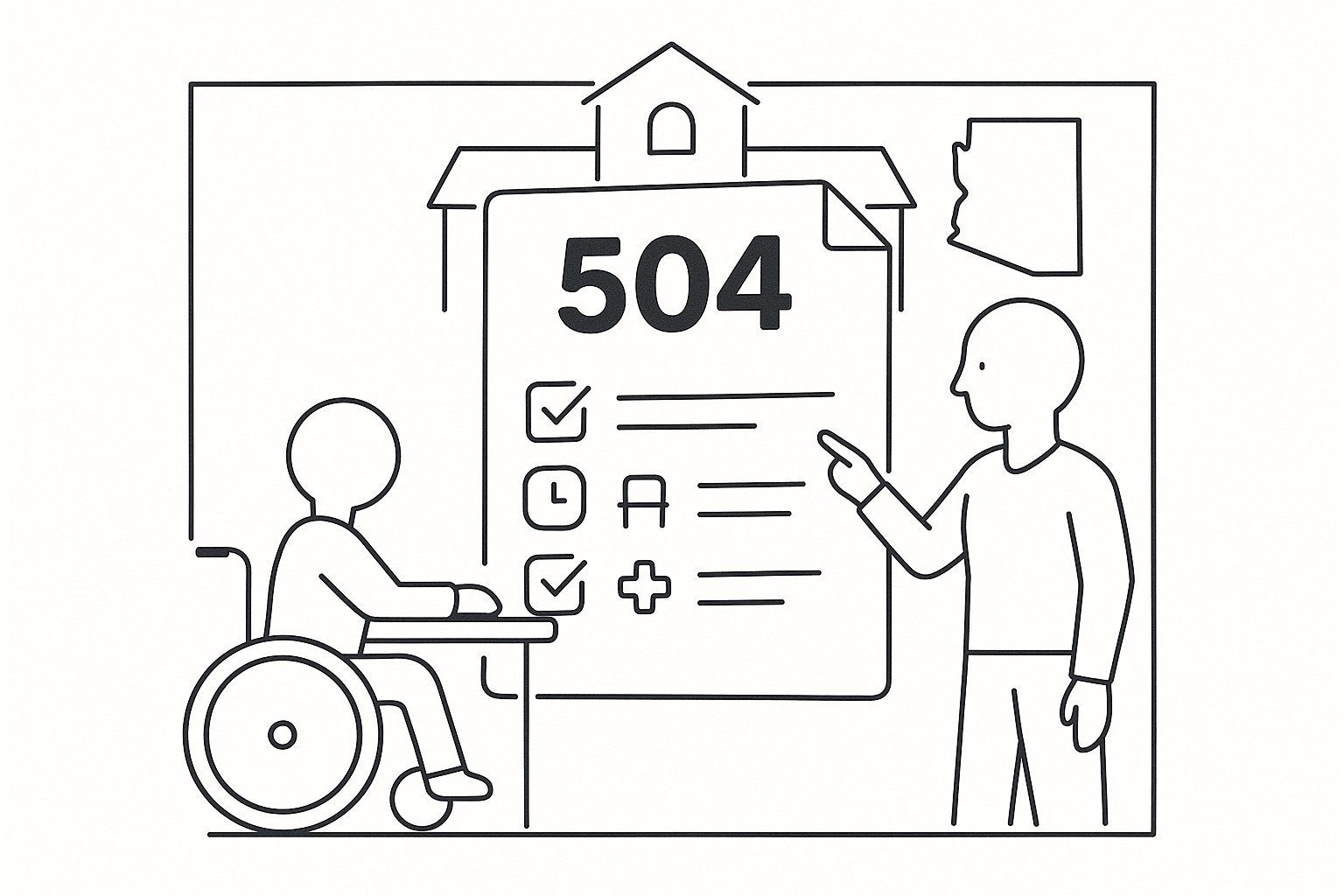
Section 504 of the Rehabilitation Act of 1973 is a federal civil-rights law that prevents disability-based discrimination in programs that receive federal funds, including public schools in Arizona. A 504 plan is the practical document that memorializes the accommodations, services, and supports a school will provide so a student with a disability can access the same educational opportunities as their peers.
Why it matters in Arizona: we see 504 plans used across districts to address a wide range of needs, from chronic medical conditions and mobility impairments to mental-health and attention-related disorders. Unlike an Individualized Education Program (IEP), which is provided under the Individuals with Disabilities Education Act (IDEA) and focuses on special education and specialized instruction, a 504 plan focuses on accommodations and removal of barriers in the general education setting. That distinction matters because eligibility rules, team composition, procedural safeguards, and dispute-resolution routes can differ.
Typical elements of a 504 plan include a clear description of the student’s disability-based limitations, specific accommodations (for example, extra time on tests, preferential seating, modified physical-education expectations), who is responsible for implementing each accommodation, monitoring frequency, and a review date. For many families in Arizona, a well-written 504 plan translates into everyday changes that keep a student engaged and safe, medication administration plans, restroom access, assistive technology, or adjusted deadlines, for example.
While 504 plans are designed to be flexible, our experience in education-related legal matters shows inconsistent implementation across schools. Being informed, knowing what accommodations are reasonable and how to document need, gives families and professionals the best chance of getting support quickly and holding districts accountable when they don’t follow through.
Who Qualifies For A 504 Plan In Arizona Schools
Eligibility under Section 504 requires two basic elements: (1) the student has a qualifying disability (a physical or mental impairment), and (2) the impairment substantially limits one or more major life activities (learning, reading, concentrating, caring for oneself, walking, seeing, etc.). We emphasize “substantially limits” because it’s the legal threshold that distinguishes ordinary classroom struggles from a disability that triggers protections.
Qualification is broader than many people expect. Students who don’t meet IDEA’s criteria for special education may still qualify for a 504 plan if their condition meaningfully restricts access to school. Examples include serious allergies that require emergency medication and avoidance strategies, diabetes needing blood-glucose monitoring and meal-timing plans, chronic migraines that cause frequent class absences, or anxiety disorders that impair concentration and school attendance.
Arizona districts have local procedures for evaluating 504 eligibility, typically involving a team that may include parents, teachers, school nurses, counselors, and administrators. Schools must evaluate students when a parent or teacher requests an evaluation or when the school suspects a disability. While IDEA has more prescriptive timelines, Section 504 evaluations generally must be conducted in a timely manner: what’s “timely” can vary locally, so we advise documenting requests and follow-ups in writing.
Common Conditions That Often Meet 504 Eligibility
Certain diagnoses commonly lead to 504 eligibility because they clearly interfere with major life activities at school. These include:
- Chronic medical conditions: asthma, diabetes, severe food allergies, seizure disorders, conditions that require routine health management or emergency protocols.
- Attention and learning-related conditions: ADHD and specific learning disabilities that substantially limit concentration, organization, or test performance (even when they don’t rise to the level for an IEP).
- Mental-health conditions: anxiety disorders, depression, PTSD, when symptoms impair attendance, concentration, or participation.
- Mobility and sensory impairments: visual or hearing impairments, temporary limitations after surgery or injury, and other physical conditions that require environmental changes.
We caution against assuming a diagnosis automatically leads to a plan: teams look at how the condition affects the student in the school environment and what reasonable accommodations will address those effects.
Documentation, Evaluation, And Timelines For Eligibility In Arizona
Documentation: Effective 504 plans usually rest on clear documentation. That can include medical records, letters from treating clinicians, psychological or neuropsychological evaluations, teacher observations, attendance logs, and work samples showing the student’s struggles.
Evaluation process: A 504 team in Arizona typically gathers existing records, conducts observations in the classroom, solicits input from teachers, and may request parent-provided medical information. Unlike IDEA, 504 does not always require formal testing, but objective documentation helps the team apply the “substantial limitation” standard consistently.
Timelines: Section 504 does not set a single federally mandated deadline for evaluations the way IDEA does: instead, evaluations must be completed within a reasonable time. “Reasonable” is often interpreted locally, many districts use internal timelines (for example, 30–60 school days) to avoid delays. If a parent makes a written request for evaluation, we recommend keeping copies and asking the district in writing for a timeline. If the district stalls, families can file complaints with the Arizona Department of Education (ADE) or the U.S. Department of Education’s Office for Civil Rights (OCR). In certain cases, especially where health or safety is involved, seeking immediate interim accommodations while the evaluation proceeds is appropriate and often necessary.
How To Request, Develop, And Implement A 504 Plan In Arizona (Step‑By‑Step)
Step 1, Request an evaluation: Start by making a written request to the school principal or 504 coordinator. Be specific about the barriers you’re seeing (missed assignments due to seizures, declining grades from anxiety, etc.). Keep a copy and date-stamped proof of delivery.
Step 2, Convene the 504 team: The school should assemble a team that knows the student, can interpret medical information, and can decide on accommodations. We recommend asking for a meeting date within two weeks and asking who will attend.
Step 3, Provide documentation: Share medical letters, recent evaluations, attendance records, and teacher observations. The more precisely you connect a condition to a school-based limitation, the better the team can craft targeted accommodations.
Step 4, Draft the plan: A practical 504 plan names specific accommodations (e.g., extended time on tests, permission to carry and self-administer medication, breaks during long classes, alternative assignment formats), assigns responsibility (which staff will carry out each accommodation), and sets monitoring and review intervals. We advise including a short implementation checklist and communication protocol: who gets notified, how teachers are trained, and how progress will be reported.
Step 5, Carry out and monitor: Once adopted, the school must carry out the plan. Parents should track whether accommodations are being followed, brief weekly check-ins or emailed progress notes help create a record. If an accommodation isn’t working, request a reconvened team meeting to revise the plan.
Step 6, Addressing disputes: If the school denies eligibility, refuses reasonable accommodations, or fails to carry out the plan, Arizona families can pursue informal resolution first: escalate to the district 504 coordinator or superintendent. If that fails, file a grievance with the district, a complaint with ADE’s Exceptional Student Services (for procedural or compliance issues), or a civil-rights complaint with OCR. In complex or contested cases, particularly where the district’s failure threatens health or graduation, legal counsel experienced in education and disability rights can help navigate appeals, administrative hearings, and negotiations. At Chelle Law we assist healthcare professionals and other clients who need help understanding how medical documentation and workplace expectations intersect with school-based plans.
Conclusion
A 504 plan is a powerful, flexible tool to remove school-day barriers for students with disabilities in Arizona. We encourage parents and professionals to document needs clearly, request timely evaluations, and insist on precise, monitored accommodations. When disputes arise, knowing your administrative and legal options preserves your child’s rights and educational progress. If you need help translating medical documentation into effective school accommodations or navigating appeals, consider reaching out for specialized advice.
Frequently Asked Questions About 504 Plans in Arizona
What is a 504 plan in Arizona schools?
A 504 plan in Arizona is a federal accommodation plan under Section 504 of the Rehabilitation Act that ensures students with disabilities receive necessary supports to access equal educational opportunities in public schools.
Who qualifies for a 504 plan in Arizona?
Students with a physical or mental impairment that substantially limits one or more major life activities like learning or concentrating typically qualify for a 504 plan in Arizona, even if they don’t meet special education criteria under IDEA.
How do I request a 504 plan evaluation for my child in Arizona?
To request a 504 evaluation, submit a written request to your child’s school principal or 504 coordinator specifying the barriers your child faces. Keep a dated copy for your records and follow up to ensure timely processing.
What accommodations can a 504 plan include in Arizona schools?
Accommodations in a 504 plan may include extended test time, preferential seating, medication plans, assistive technology, or modified physical education to help students access the general education environment effectively.
How is a 504 plan different from an IEP in Arizona?
Unlike an IEP, which provides specialized instruction under IDEA, a 504 plan focuses on accommodations and removing barriers in general education settings to prevent disability discrimination in schools that receive federal funding.
What should parents do if a school in Arizona refuses to implement a 504 plan?
Parents can seek informal resolution with school officials, file complaints with the Arizona Department of Education or the U.S. Office for Civil Rights, and consider legal assistance if accommodations are denied or not properly provided.