
Last Updated on April 20, 2026 by Jennifer Hanson
When a child struggles at school because of a disability, families and educators need clear, practical answers. In Missouri, a 504 plan is one of the primary tools schools use to ensure students with disabilities receive equal access to education. In this guide we explain what a 504 plan is, how it differs from an IEP, who qualifies in Missouri, how to request and develop a plan, and what rights and enforcement options parents have, grounded in both federal law and the state’s local procedures.
In this guide, 504 Plans In Missouri A Practical Guide For Parents And Educators 2026 is explained with clear steps and tips.
Key Takeaways — 504 Plans In Missouri A Practical Guide For Parents And Educators 2026
- A 504 plan in Missouri provides accommodations to ensure students with disabilities have equal access to education without requiring specialized instruction like an IEP.
- Eligibility for a 504 plan is based on whether a student’s disability substantially limits major life activities, with examples including ADHD, asthma, and diabetes.
- Parents should request a 504 evaluation in writing and provide detailed documentation such as medical records and teacher observations to support eligibility.
- The 504 plan must specify clear accommodations, responsible staff, timelines, and monitoring methods to effectively support the student’s needs.
- Parents have rights to participate in meetings, access records, and use grievance procedures or federal complaints to resolve disputes, with legal counsel recommended if conflicts persist.
- Understanding both federal law and Missouri-specific school district procedures empowers families to secure appropriate 504 accommodations and protect their child’s educational access.
What A 504 Plan Is And How It Differs From An IEP
A 504 plan is a written accommodation plan developed under Section 504 of the Rehabilitation Act of 1973. It’s designed to remove barriers and provide equal access to education for students with disabilities who don’t meet the eligibility criteria for special education under the Individuals with Disabilities Education Act (IDEA). In practical terms, a 504 plan addresses how a student’s disability substantially limits one or more major life activities, learning, reading, concentrating, walking, or seeing, and prescribes accommodations, modifications, or related services so the student can participate fully in school.
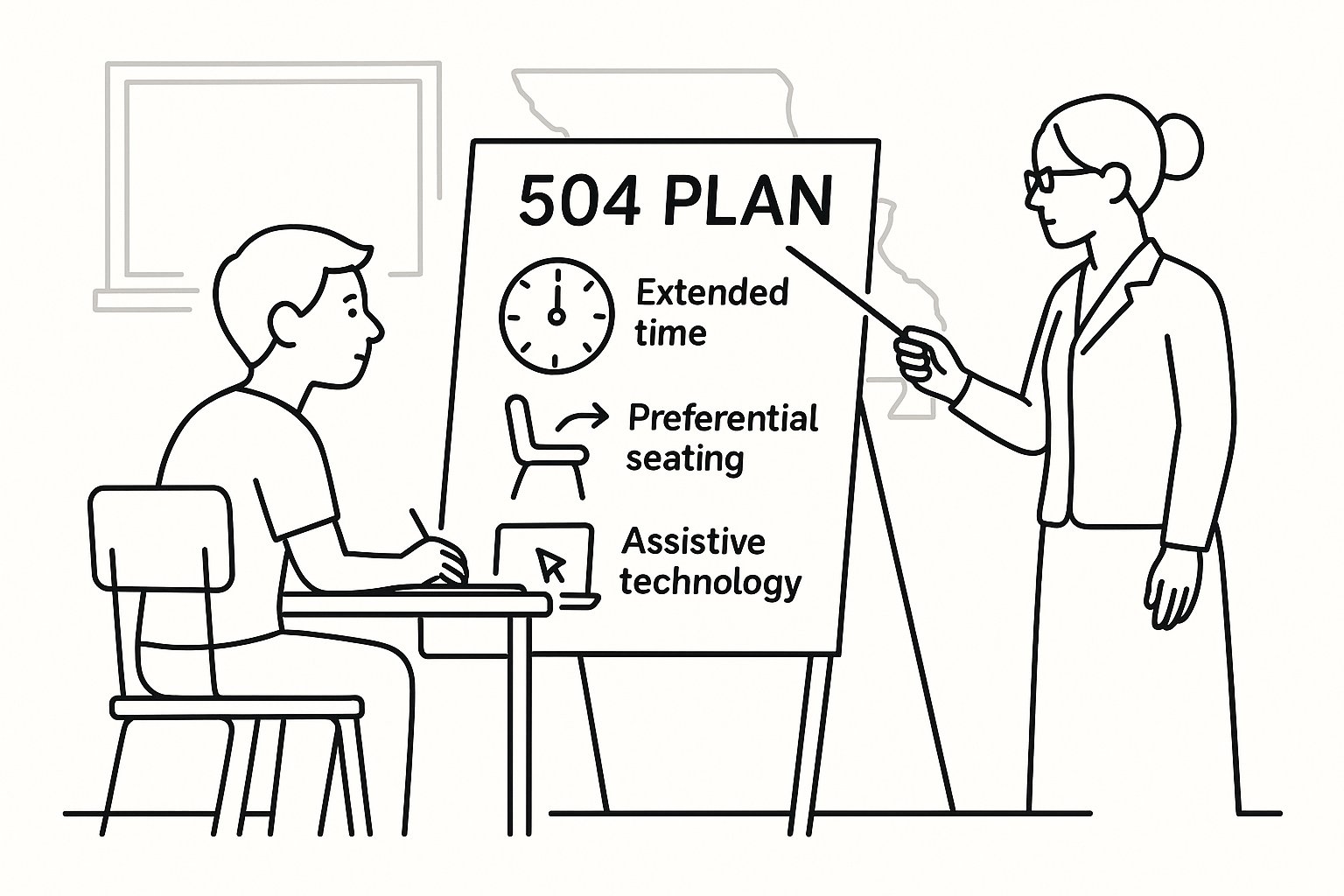
How does that differ from an IEP? An IEP (Individualized Education Program) is an IDEA-created plan for students who qualify for specialized instruction because they have one of the listed disabilities and need special education services. IEPs typically include annual goals, specialized instruction, progress reporting, and often more intensive services than a 504 plan. A 504 plan, by contrast, focuses on accommodations (for example: extended time on tests, preferential seating, assistive technology) and does not usually include individualized special education instruction or the same procedural safeguards as an IEP.
In Missouri schools we find families sometimes ask “what is a 504 plan in Missouri” because state procedures and local school district practices affect how plans are developed and enforced. While federal law sets the baseline, districts in Missouri have local policies outlining timelines, evaluation procedures, and how meetings are conducted, so understanding both federal protections and local practice gives parents and educators the best leverage to secure appropriate supports.
Who Qualifies For A 504 Plan In Missouri
Eligibility for a 504 plan turns on whether a student has a physical or mental impairment that substantially limits a major life activity. Common examples we see in Missouri include attention-deficit/hyperactivity disorder (ADHD), chronic health conditions like diabetes or asthma, mental health disabilities, orthopedic impairments, and temporary but significant medical conditions.
The “substantially limits” standard is broader than many expect: it doesn’t require a diagnosis to be severe, only that it creates a notable barrier to learning or participation without accommodations. Importantly, students taking medication or using assistive devices can still qualify if the impairment would limit a major life activity when untreated. For instance, a student with diabetes may need testing breaks and meal schedule adjustments as reasonable accommodations.
Missouri districts must avoid exclusionary practices, such as denying a 504 evaluation because a student has good grades, since disability can be masked by compensatory strategies. We recommend parents document observable impacts (teacher notes, medical records, incident logs). That documentation helps when districts evaluate whether the student meets 504 criteria and prevents delays that compromise access to education.
How Schools Identify And Evaluate Students For 504 Eligibility
Identification and evaluation typically start with a referral, by a parent, teacher, or other school staff, requesting an assessment for suspected disability. Missouri school districts will often have a standard form or process for 504 referrals: if one isn’t provided, make the request in writing and keep a copy.
The evaluation should draw on multiple sources: medical records, teacher observations, classroom work samples, attendance and discipline data, and standardized test results. Schools do not need to follow the full IDEA evaluation procedures, but they must conduct an individualized assessment that provides sufficient information to determine if a disability substantially limits a major life activity. We advise parents to supply supporting documentation from health care providers and to ask teachers for written observations. If the school refuses to evaluate, parents can request a prior written notice that explains the refusal and the rationale, this creates a record and triggers procedural protections.
Timeline expectations vary by district: in our experience it’s reasonable to ask the district to complete the evaluation within 30 to 60 school days. If the evaluation team finds the student eligible, the team should meet promptly to develop a 504 plan tailored to the student’s needs.
How To Request And Develop A 504 Plan In Missouri
Requesting a 504 plan starts with a clear, written referral to the school’s 504 coordinator, building principal, or special services office. We recommend including: a brief description of the functional limitations, relevant medical documentation, examples of classroom impact, and the accommodations you believe will help.
After the referral, the school will convene an evaluation team. If eligibility is established, a meeting follows to craft the 504 plan. The plan should be specific, describing the student’s impairment, the exact accommodations (who will provide them and where), the duration, and how implementation will be monitored. Examples of concrete accommodations: extended time for tests (time-and-a-half), frequent breaks during lengthy assignments, modified assignments workload, preferential seating, or access to a note-taker.
We encourage parents to propose measurable outcomes and review dates, plans that read like checklists are easier to carry out and enforce. Also ask about staff training: educators responsible for accommodations should understand them. Finally, keep a personal copy of every draft and the final plan: documentation is critical if disputes arise.
What To Expect At The 504 Meeting And How To Build Effective Accommodations
At the 504 meeting expect district representatives (504 coordinator, teacher, school psychologist or counselor), the student’s parents, and sometimes the student. Come prepared: bring medical records, recent teacher comments, samples of work, and a written list of accommodations you request. Be ready to explain how each accommodation addresses a specific limitation, linking need to solution makes plans easier to accept.
When building accommodations, aim for clarity. Instead of “preferential seating,” specify “front row, within two rows of teacher, away from door” and name who enforces it. For testing accommodations, define the environment (separate room? noise reduction?) and monitoring procedures. Include timelines for teacher check-ins and a date to review progress (30–90 days). If assistive technology is proposed, list the device/software, training plans, and how tech problems will be handled.
If consensus is elusive, suggest a trial period with measurable indicators, this often breaks stalemates. Remember: accommodations should remove barriers but not lower academic expectations: they enable access without altering standards unless a modification is explicitly agreed upon.
Parent Rights, Enforcement Options, And Dispute Resolution In Missouri
Parents have important rights under Section 504: to be informed of evaluations and placement decisions, to review records, to participate in meetings, and to receive written notice before significant changes. If parents disagree with the district, several enforcement and dispute-resolution options exist.
Start with informal resolution, request a meeting with the 504 coordinator or principal and present new documentation or proposed revisions. If that fails, ask for the district’s internal grievance procedure: many Missouri districts have a formal 504 complaint process. Parents can also file a complaint with the U.S. Department of Education’s Office for Civil Rights (OCR) alleging discriminatory denial of services, or pursue administrative complaints under Section 504. OCR complaints can prompt investigations and corrective actions.
When disputes become entrenched, mediation or due process-like hearings may be available depending on the district and whether IDEA protections overlap. Given the legal and procedural nuances, families often benefit from consulting an education attorney, especially when implementation lapses or repeated refusals occur. At Chelle Law, for example, we help clients understand procedural options and ensure documentation is crafted to preserve appeals. Acting early and keeping thorough records greatly increases the chance of a successful resolution.
Conclusion
A 504 plan in Missouri is a practical, federally protected way to level the classroom playing field. We recommend parents document functional impacts, insist on clear, measurable accommodations, and use district grievance processes or OCR complaints if necessary. When disputes or complex legal questions arise, seeking experienced counsel helps protect a student’s right to equal educational access, so we encourage families to be proactive, stay organized, and advocate confidently for their children.
Frequently Asked Questions About 504 Plans in Missouri
What is a 504 plan in Missouri?
A 504 plan in Missouri is a federally protected written accommodation plan under Section 504 of the Rehabilitation Act, designed to ensure students with disabilities have equal access to education by providing necessary accommodations without specialized instruction.
How does a 504 plan differ from an IEP in Missouri schools?
Unlike an IEP, which includes specialized instruction and individualized goals under IDEA, a 504 plan focuses on accommodations like extended test time or preferential seating to remove barriers, without providing special education services.
Who qualifies for a 504 plan in Missouri?
Students with physical or mental impairments substantially limiting major life activities like learning or concentrating—such as ADHD, asthma, or diabetes—may qualify for a 504 plan, even if their condition is controlled by medication or assistive devices.
How can parents request a 504 plan evaluation in Missouri?
Parents can submit a written referral to the school’s 504 coordinator or principal, including documentation of the disability’s impact. Schools then conduct an evaluation from multiple sources to determine eligibility under Section 504.
What accommodations might be included in a 504 plan?
Accommodations could include extended time on tests, frequent breaks, modified workloads, preferential seating, or assistive technology, all tailored to remove educational barriers while maintaining academic standards.
What should parents do if they disagree with the 504 plan decisions in Missouri?
Parents can start with informal discussions, then pursue the district’s grievance process. If needed, they may file complaints with the U.S. Department of Education’s Office for Civil Rights or seek mediation and legal counsel to protect their child’s rights.