
Last Updated on April 20, 2026 by Jennifer Hanson
When a child’s behavior interferes with learning, families and schools often ask: what is a BIP in special education and what should we expect? A BIP, short for Behavioral Intervention Plan, is a written, practical roadmap used in schools to reduce behaviors that impede a student’s education and teach alternative, positive skills. In this guide we’ll explain what a BIP actually is, the legal triggers for one, how it’s built from assessments and IEP decisions, and how to make it work in real classrooms. Our focus is clear: practical, legally informed guidance parents and professionals can use now.
In this guide, What Is a BIP in Special Education A Clear Guide for Parents and Professionals 2026 is explained with clear steps and tips.
Key Takeaways — What Is a BIP in Special Education A Clear Guide for Parents and Professionals 2026
- A Behavioral Intervention Plan (BIP) is a legally required, written strategy used in special education to reduce behaviors that interfere with learning by teaching replacement skills and adjusting the environment.
- BIPs are developed based on a Functional Behavioral Assessment (FBA) and decisions made by the IEP team to ensure targeted, measurable, and individualized behavior goals.
- Effective BIPs include clear definitions of target behaviors, function statements, prevention and teaching strategies, consequence plans, data collection methods, and timelines for review.
- Schools must involve parents and multiple educators in BIP development and provide staff training to ensure consistent implementation and fidelity of interventions.
- Regular monitoring and data collection are essential to evaluate BIP effectiveness and prompt revisions, with open communication between families and school teams.
- When behavior is related to a student’s disability, the school must consider or implement a BIP especially before disciplinary actions that affect placement, ensuring supports are educational rather than punitive.
What A Behavioral Intervention Plan (BIP) Actually Is
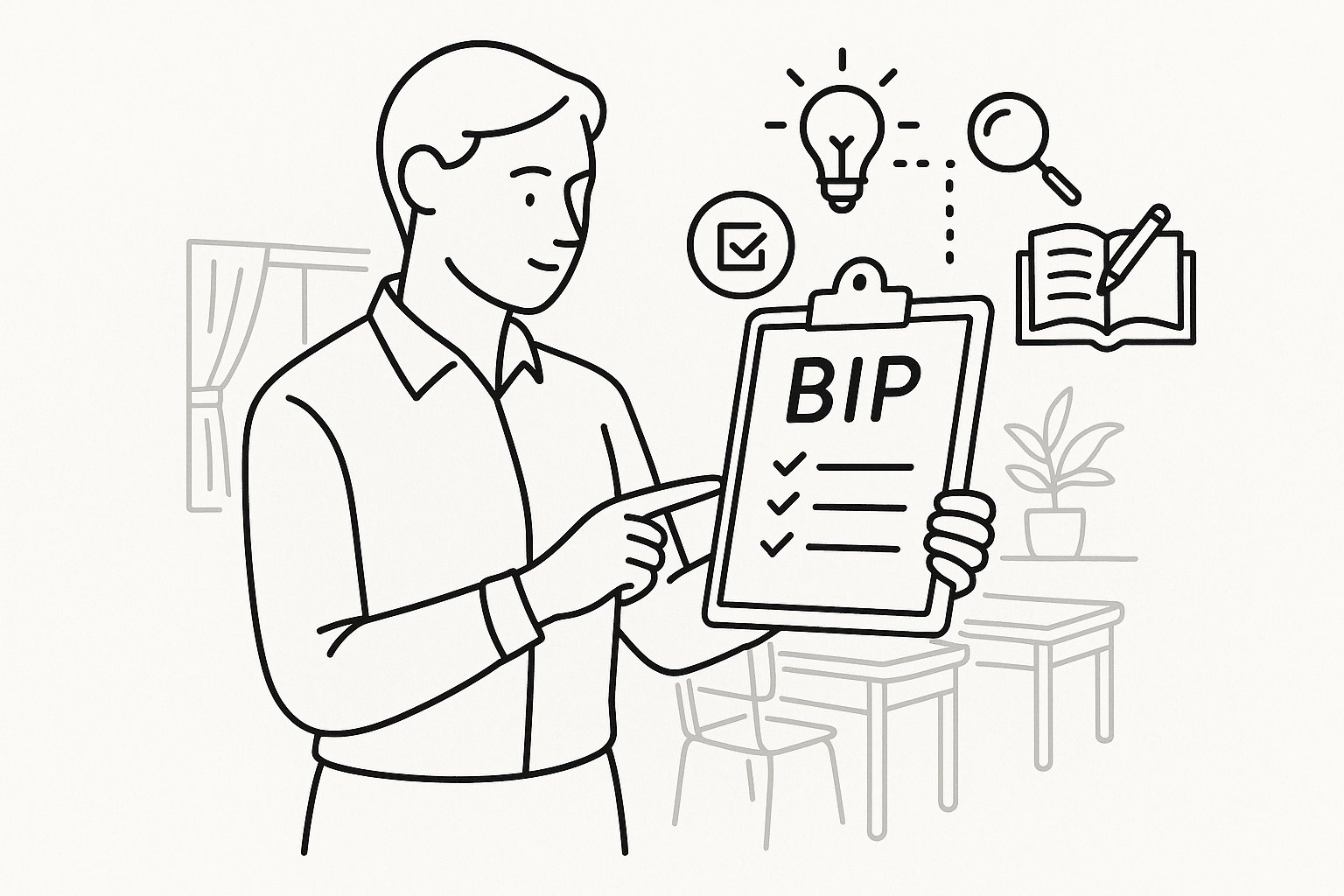
A Behavioral Intervention Plan (BIP) is a specific plan included in a student’s education record when behavior is a barrier to learning. Think of it as a proactive, individualized strategy that replaces punishment with instruction. It lists the target behaviors, explains why they happen, and describes consistent strategies staff will use to prevent and respond to those behaviors.
Legally, BIPs flow from the Individuals with Disabilities Education Act (IDEA): when a student’s behavior relates to their disability, the school must consider positive behavioral interventions and supports. In practice, a BIP is written in plain language so teachers, aides, therapists, and parents can follow the same approach. A strong BIP is measurable, time-bound, and focused on teaching replacement behaviors, not just stopping the problem.
We should emphasize that a BIP is both instructional and environmental: it addresses skill deficits (what the student needs to learn) and context (what in the classroom may be triggering the behavior). That dual focus separates a BIP from simple disciplinary plans and makes it an educational tool rather than a punitive one.
When A BIP Is Required: Legal Basis And Common Triggers
A BIP is required in two main situations. First, when a Functional Behavioral Assessment (FBA) indicates that behavior impedes learning and the team determines supports are necessary. Second, when a student with a disability faces disciplinary actions that might change their placement, for example, suspensions or expulsions totaling 10 school days or more in a school year, the IEP team must consider whether the behavior is a manifestation of the disability and whether a BIP is needed.
Under IDEA, schools must conduct a manifestation determination review if disciplinary action would remove the student from their current placement beyond brief removals. If the behavior is connected to the disability, the school must either carry out the existing BIP or develop one if none exists. Even when behavior isn’t a manifestation, we recommend that teams still consider a BIP: it’s often the most constructive route to support the child and reduce future incidents.
Common triggers that lead to BIPs include: frequent classroom disruptions, self-injury, aggression toward peers or staff, elopement (running away), and persistent refusal to comply with instruction. We also see BIPs when behaviors arise during transitions, unstructured times, or in response to sensory overload. Recognizing typical triggers helps teams design targeted interventions rather than one-size-fits-all responses.
How A Functional Behavioral Assessment (FBA) And The IEP Team Inform A BIP
An FBA is the investigative phase: we gather data to answer why the behavior occurs and what reinforces it. It includes direct observation, interviews with teachers and family, and data collection on frequency, duration, and antecedents. From the FBA we develop hypotheses about function, for example, escape, attention, access to tangibles, or sensory stimulation.
The IEP team then uses the FBA findings to set measurable behavior goals and choose interventions aligned with the function. That team must include the parent, relevant special education staff, and often a behavioral specialist. When we participate in those meetings, we push for clear, data-driven goals (e.g., “Student will use a break card to request time away 4 out of 5 opportunities”) and for team agreement on who does what and when.
A common mistake we advise against is drafting a BIP without ongoing data collection. The FBA should be the beginning, not the end: measurement guides whether strategies work and signals when it’s time to revise the plan.
Core Components Of An Effective BIP
A practical, legally defensible BIP typically includes these core elements:
- Clear definition of the target behavior(s): Observable, measurable language that leaves no room for guesswork.
- Function statement: A concise description of why the behavior occurs, grounded in FBA data.
- Prevention strategies: Environmental or instructional adjustments that reduce triggers (e.g., visual schedules, seat changes, sensory breaks).
- Teaching strategies: Skills to replace the problem behavior, communication alternatives, coping skills, social problem-solving.
- Replacement behaviors: Specific behaviors we expect the student to demonstrate instead of the problem behavior.
- Consequence strategies: Consistent, positive responses that reinforce replacement behaviors and do not rely on exclusion as the first tool.
- Data collection plan: What data will be collected, who collects it, and how often (e.g., daily frequency counts, weekly graphs).
- Crisis plan (if needed): Clear steps for staff safety and de-escalation when behavior poses imminent risk.
- Roles and timelines: Who trains staff, when interventions begin, and review dates.
We stress measurable outcomes and timelines: vague promises like “provide supports” are not enough. A BIP should allow anyone on the team to test whether it’s working by looking at data.
How Schools Develop And Implement A BIP: Roles, Steps, And Timeline
Developing and implementing a BIP is a collaborative, stepwise process. Typical roles include the parent, special education teacher, general education teacher, school psychologist or behavior analyst, and any related service providers. Administrators and safety staff sometimes join when a crisis plan is required.
Steps and a reasonable timeline look like this:
- Referral and data collection (1–2 weeks): Teachers and parents request an FBA after noticing persistent behavior. Initial data are collected.
- Conduct FBA (2–4 weeks): Observations, interviews, and structured assessments produce function hypotheses.
- IEP meeting to draft BIP (1 meeting, scheduled within IDEA timelines): The team reviews FBA results, sets measurable goals, and documents interventions.
- Staff training (1–2 weeks before full implementation): All staff who will carry out the BIP receive training and materials.
- Implementation and monitoring (ongoing): Daily or weekly data are collected: minor adjustments may occur.
- Formal review (30–90 days): Team evaluates data, decides whether to continue, revise, or intensify supports. More frequent reviews are common for high-risk behaviors.
We recommend explicit staff training and written fidelity checks: even excellent plans fail if staff don’t apply strategies consistently. Documentation is also critical if disagreements arise, and our experience suggests clear records smooth conversations between families and schools.
Monitoring, Reviewing, And Revising A BIP — Practical Tips For Success
Monitoring separates good BIPs from ineffective ones. We advise practical habits schools and families can adopt immediately:
- Use simple, actionable data. Frequency counts, momentary time sampling, and brief ratings are often enough to show progress.
- Schedule short weekly check-ins between a parent and a point person at school for the first 6–8 weeks.
- Maintain a visible data chart in the teacher’s planning area (not necessarily public) so trends are obvious.
- Predefine success criteria: e.g., a 50% reduction in target behavior over eight weeks or achieving a replacement skill in 4 of 5 opportunities.
- When data show no progress in 4–8 weeks, reconvene the IEP team. Reassess the FBA, consider more intensive interventions, and check fidelity of implementation.
- Keep parents informed with concise updates: involve them in reinforcing replacement behaviors at home where appropriate.
We also recommend balancing optimism with documentation. If the school’s plan is working but there are disagreements about fidelity or safety, maintaining clear records helps resolve disputes and protects the student’s right to an appropriate education. For legal concerns, especially when removals or restrictive interventions are proposed, seek counsel experienced in special education law. Our background advising professionals in regulated settings makes us particularly mindful of procedural protections and documentation standards.
Conclusion
A BIP is a focused, data-driven plan designed to teach skills and change environments so students can succeed. When built from a thorough FBA, supported by an engaged IEP team, and monitored with simple data, BIPs reduce disruptive incidents and improve learning. We encourage parents and professionals to insist on measurable goals, regular reviews, and clear documentation, and to ask for legal or advocacy advice if procedural protections are unclear. With the right plan and follow-through, behavior support becomes a bridge to better learning, not a barrier.
Frequently Asked Questions About Behavioral Intervention Plans (BIPs) in Special Education
What is a Behavioral Intervention Plan (BIP) in special education?
A BIP is a written, individualized plan used in schools to reduce behaviors that interfere with a student’s learning by teaching positive replacement skills and providing consistent strategies for staff to manage behavior.
When is a BIP required under special education law?
Under IDEA, a BIP is required when a Functional Behavioral Assessment (FBA) shows behavior impedes learning or when disciplinary actions might change a student’s placement, requiring a review to see if behavior is linked to the disability.
How does a Functional Behavioral Assessment (FBA) contribute to creating a BIP?
An FBA gathers data on why behaviors occur, including triggers and consequences, to inform measurable goals and targeted interventions in the BIP developed by the IEP team.
What are the core components of an effective Behavioral Intervention Plan?
Key elements include clearly defined target behaviors, function statements, prevention and teaching strategies, replacement behaviors, consequence plans, data collection methods, crisis plans if needed, and defined roles and timelines.
How is a BIP implemented and monitored in schools?
After drafting the BIP, staff receive training before full implementation; ongoing data is collected regularly, with formal reviews every 30–90 days to track progress and make adjustments as needed.
Can a BIP help with behaviors that occur during classroom transitions or sensory overload?
Yes, BIPs address instructional and environmental factors, including behaviors triggered by transitions or sensory overload, by tailoring prevention and teaching strategies specific to those contexts.