
Last Updated on October 16, 2026 by Jennifer Hanson
Anxiety is one of the most common reasons high school students need formal support, but many families don’t know where to start. A Section 504 plan can remove barriers by documenting accommodations that help a student access learning and school life. In this guide we’ll explain what a 504 plan is, show a practical sample template for anxiety-specific supports, and walk through how to request, develop, and carry out the plan so it actually helps your student. We’ll keep this focused, actionable, and written with school and legal realities in mind.
In this guide, What Is A Sample 504 Plan For Anxiety In High School A Practical Guide To Supports Templates And Next Steps is explained with clear steps and tips.
Key Takeaways — What Is A Sample 504 Plan For Anxiety In High School A Practical Guide To Supports Templates And Next Steps
- A Section 504 plan provides high school students with anxiety accommodations to ensure equal access to education without lowering academic standards.
- Key accommodations for anxiety include preferential seating, extended test time, breaks during class, access to notes, and a quiet space for de-escalation.
- The 504 plan should be specific, measurable, time-bound, and regularly reviewed to effectively address anxiety-related barriers.
- Parents or schools can initiate the 504 plan process by requesting an evaluation based on functional impacts, supported by medical or therapeutic documentation.
- Successful implementation requires clear communication, staff training, and routine monitoring with adjustments made as needed to support the student’s evolving needs.
- If disputes arise, families have legal options and should maintain detailed documentation while striving for collaborative resolution.
What A Section 504 Plan Is And Why It Matters For Students With Anxiety
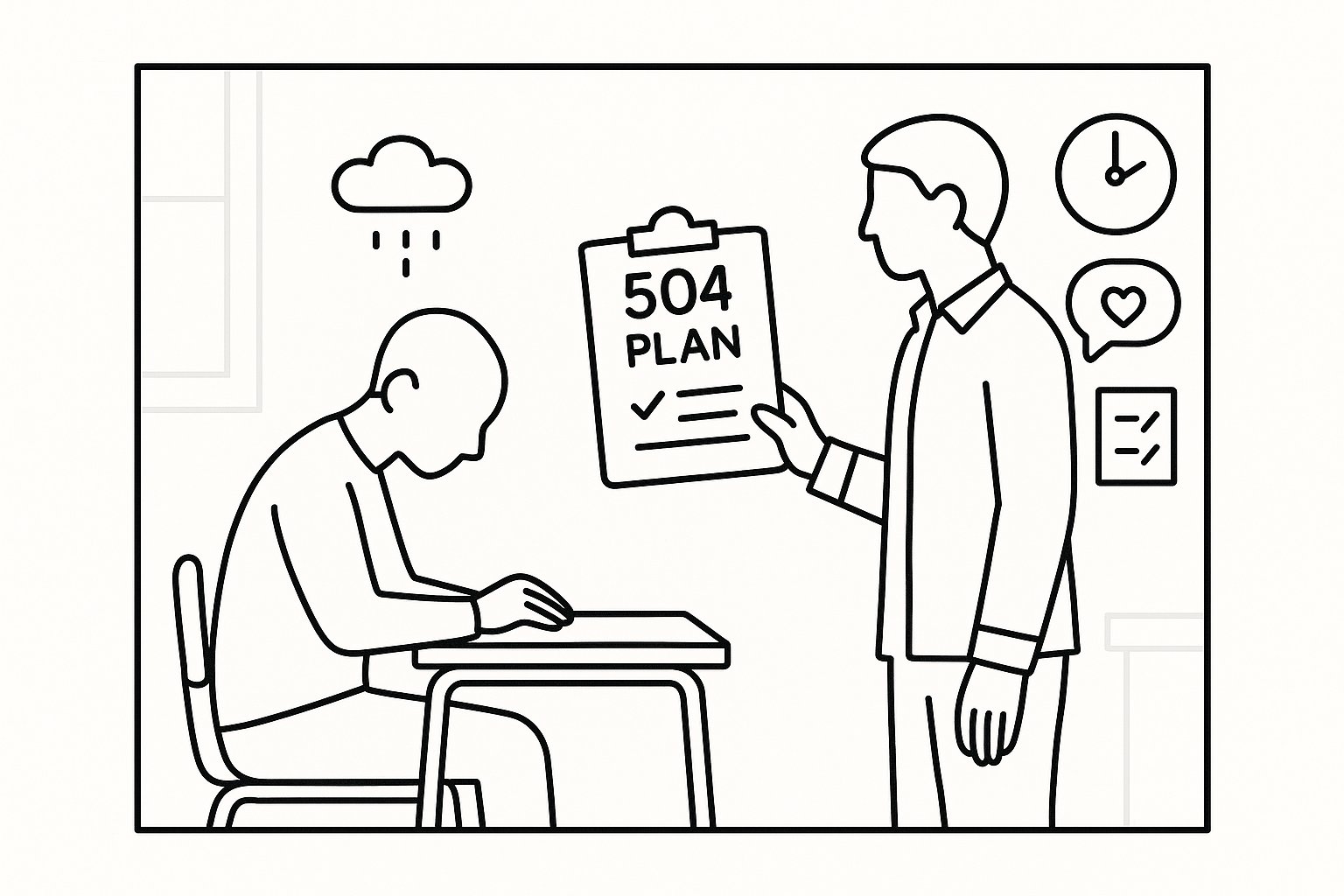
Section 504 of the Rehabilitation Act is a federal civil rights law designed to prevent discrimination against students with disabilities. In school settings a 504 plan documents reasonable accommodations that allow a student with a qualifying disability, including an anxiety disorder that substantially limits a major life activity like learning, concentrating, or interacting with others, to receive equal access to education. Unlike an IEP under IDEA, a 504 plan does not typically provide specialized instruction: it provides modifications and supports to level the playing field.
Why this matters for anxiety: anxiety can show up as chronic worry, panic attacks, school avoidance, difficulty concentrating, or social withdrawal. These symptoms may not be obvious on a grade report, but they affect attendance, participation, and performance. A clear 504 plan reduces the need for repeated advocacy by documenting agreed supports and creating accountability for schools to follow through.
Common legal and practical points we watch for: 1) Eligibility is based on functional impact, not diagnosis alone. 2) Parents or the school can initiate the process. 3) Plans should be individualized, time-bound, and revisited regularly. 4) Schools are required to provide reasonable accommodations but are not required to lower academic standards. Understanding these boundaries helps families negotiate supports that are meaningful without asking for unattainable changes.
From a practical standpoint, a well-drafted 504 plan becomes a working agreement between family and school. It names who will do what, when, and how progress will be measured. That reduces disputes and helps educators respond consistently when anxiety-related issues arise during the school day.
Sample 504 Plan Template: Essential Accommodations, Modifications, And Behavior Supports
Below is a practical sample 504 plan template focused on common, evidence-based accommodations for high school students with anxiety. Use it as a starting point and adapt to the student’s specific needs.
Student: [Name] Grade: [9–12] School year: [2026–2027]
Disability/Primary Impact: Generalized anxiety disorder / Panic disorder, affects attendance, concentration, and ability to participate in high-anxiety settings.
Section A, Goal & Purpose
- Goal: Ensure access to general education curriculum and extracurricu-lar activities by reducing anxiety-related barriers to attendance, test performance, and classroom participation.
Section B, Accommodations (daily supports)
- Preferential seating near teacher and away from high-traffic areas to reduce distraction.
- Extended time for tests and quizzes (time-and-a-half or as documented) in standard classroom or separate reduced-distraction setting if requested.
- Breaks as needed during class and tests (up to X minutes) with a pass or signal agreed in advance.
- Access to notes or a peer note-taker when anxiety impairs concentration and note-taking.
- Modified assignments plan when anxiety significantly increases outside-of-school workload, e.g., staggered deadlines or reduced nightly load with teacher approval.
- Quiet space for de-escalation (counselor’s office or designated room) with clear check-in/check-out procedures.
Section C, Behavioral & Social-Emotional Supports
- Short-term behavior intervention plan (BIP) for school avoidance and refusal with specific steps for escalation and gradual re-entry.
- Scheduled weekly check-ins with school counselor (10–15 minutes) to monitor anxiety and coping strategies.
- Access to cognitive-behavioral informed strategies during check-ins (breathing scripts, grounding techniques) taught by counselor or mental health provider.
Section D, Testing & Attendance
- Allow make-up tests without academic penalty for anxiety-related absences when student completes agreed remediation steps (e.g., check-in with counselor).
- Flexible start time when morning anxiety causes inability to arrive at standard time (documented limitation: start window of up to 45 minutes).
Section E, Communication & Monitoring
- Quarterly data review: attendance, grades, counselor notes, and parent input to evaluate effectiveness.
- Communication plan: weekly brief email or planner note between parent and designated school contact until improvements stabilize.
Section F, Duration & Review
- Effective: [start date] Review date: [90 days from start] Annual review thereafter or sooner if circumstances change.
Implementation tips: be specific about quantities (minutes of extended time, frequency of check-ins) to avoid ambiguity. Avoid vague wording like “as needed” without defining who decides and how decisions are documented. Finally, include measurable success criteria, e.g., attendance at 90% of school days or reduction in panic incidents by documented count, so the team can objectively evaluate progress.
How To Request, Develop, And Implement A 504 Plan For High School Anxiety
Requesting evaluation: Start with a written request to the school’s 504 coordinator or principal. Keep a copy for your records. In the request we recommend describing specific functional impacts (missed classes, panic attacks, inability to complete tests) and attaching medical or therapeutic documentation when available. Schools must respond and evaluate if there’s reasonable suspicion of a qualifying disability.
The evaluation process: Schools will usually gather records, teacher observations, attendance data, and may ask for medical or psychological documentation. We suggest providing any private evaluations you have: they must consider but are not bound by private reports. The multidisciplinary team will meet to determine eligibility and, if eligible, draft the 504 plan.
Drafting the plan: Be collaborative but prepared. Come with specific accommodation requests based on what has worked in the past. Use the sample template above as a checklist. Ask the team to include measurable outcomes and timelines. If the school resists certain accommodations, request written rationale and suggest alternatives or temporary trial periods.
Implementation: Once the 504 plan is finalized, ensure all relevant staff receive copies and understand their responsibilities. Teachers may need quick training on what the accommodations mean day-to-day. We advise scheduling a short orientation with staff and the student so everyone understands triggers, signals (how the student requests a break), and the de-escalation space procedure.
Monitoring and problem-solving: Set an early review, 30 to 90 days, to assess whether accommodations are working. Keep a simple log of attendance, incidents, and assignments/test outcomes to present at reviews. If something isn’t working, ask for modifications rather than starting over. Examples: increase counseling check-ins, change testing location, or alter break duration.
When disputes arise: Try informal resolution first, meet with the 504 coordinator, provide updated documentation, and propose a revised plan. If the school denies evaluation or refuses reasonable accommodations, families have procedural options: file a complaint with the school district, request an impartial hearing, or file with the Office for Civil Rights. While we’re a law firm focused on employment contracts, we often refer clients to or collaborate with special education attorneys when legal advocacy is necessary. Document everything and keep communication professional and evidence-based.
Conclusion: Making A 504 Plan Work — Monitoring, Revising, And Advocating For Your Student
A 504 plan is a practical tool, not a one-time checkbox. To make it effective we recommend ongoing monitoring, clear measurable goals, and open communication between school and family. Revisit the plan when conditions change, new stressors, course load increases, or improved coping skills, and don’t hesitate to request revisions or additional supports. If you hit legal or procedural roadblocks, gather documentation and seek specialized advice. With a precise plan and active follow-through we can help ensure students with anxiety get the consistent, reasonable supports they need to thrive in high school.
Frequently Asked Questions About Sample 504 Plans for Anxiety in High School
What is a Section 504 plan for anxiety in high school?
A Section 504 plan is a federal civil rights accommodation that helps high school students with anxiety disorders by providing supports and modifications to reduce barriers to learning and school participation without changing academic standards.
How does a 504 plan help students with anxiety succeed in high school?
It documents specific accommodations like extended test time, preferential seating, and counseling supports that address anxiety-related challenges such as concentration and attendance, ensuring equal access to education and reducing the need for repeated advocacy.
What accommodations are typically included in a 504 plan for high school students with anxiety?
Common accommodations include preferential seating, extended time on tests, scheduled breaks, access to notes or note-takers, modified assignments, a quiet space for de-escalation, and regular check-ins with a counselor to support social-emotional needs.
How can parents request a 504 plan for their anxious high school student?
Parents should submit a written request to the school’s 504 coordinator or principal, describing how anxiety affects their child’s functioning, and attach any medical or therapeutic documentation to initiate an eligibility evaluation.
Can a 504 plan for anxiety include behavioral supports?
Yes, behavioral supports such as a short-term behavior intervention plan for school avoidance, counseling check-ins, and cognitive-behavioral strategies can be included to help manage anxiety symptoms effectively.
What should families do if their school denies a 504 plan for anxiety accommodations?
Families can seek informal resolution with the school’s 504 coordinator, provide updated documentation, or file a complaint with the school district or Office for Civil Rights. Consulting a special education attorney may be helpful for legal advocacy.