
Last Updated on July 8, 2026 by Jennifer Hanson
Math classrooms should be places where every learner can make measurable progress. Yet students with disabilities often face curricula that assume skills, pacing, or materials they haven’t been taught. In this guide we unpack what a special education math curriculum is, why it matters now (especially as assessments and technology evolve), and how teams, educators, specialists, families, and related service providers, can design instruction that is legally sound, instructionally effective, and truly accessible. Whether you’re an educator, a parent, or an administrator, we’ll give concrete language for building programs that let students reach meaningful, individualized math outcomes.
In this guide, What Is A Special Education Math Curriculum A Practical Guide To Designing Accessible Math Instruction In 2026 is explained with clear steps and tips.
Key Takeaways — What Is A Special Education Math Curriculum A Practical Guide To Designing Accessible Math Instruction In 2026
- A special education math curriculum is a legally grounded, standards-aligned plan designed to make math accessible and meaningful for students with disabilities.
- Effective curricula blend explicit, systematic instruction and strategies like the concrete–representational–abstract (CRA) approach to support diverse learning needs.
- Individualized Education Program (IEP) goals must be specific and measurable, guiding instruction and progress monitoring tailored to each student’s abilities.
- Regular progress monitoring with frequent assessments is essential to adjust teaching methods and ensure measurable student growth in math.
- Collaboration among educators, therapists, and families strengthens instruction coherence and promotes functional math skills for independence.
- Using assistive technology and culturally responsive materials enhances access and engagement, making the math curriculum equitable and inclusive.
Defining A Special Education Math Curriculum: Purpose, Legal Foundations, And Who It Serves
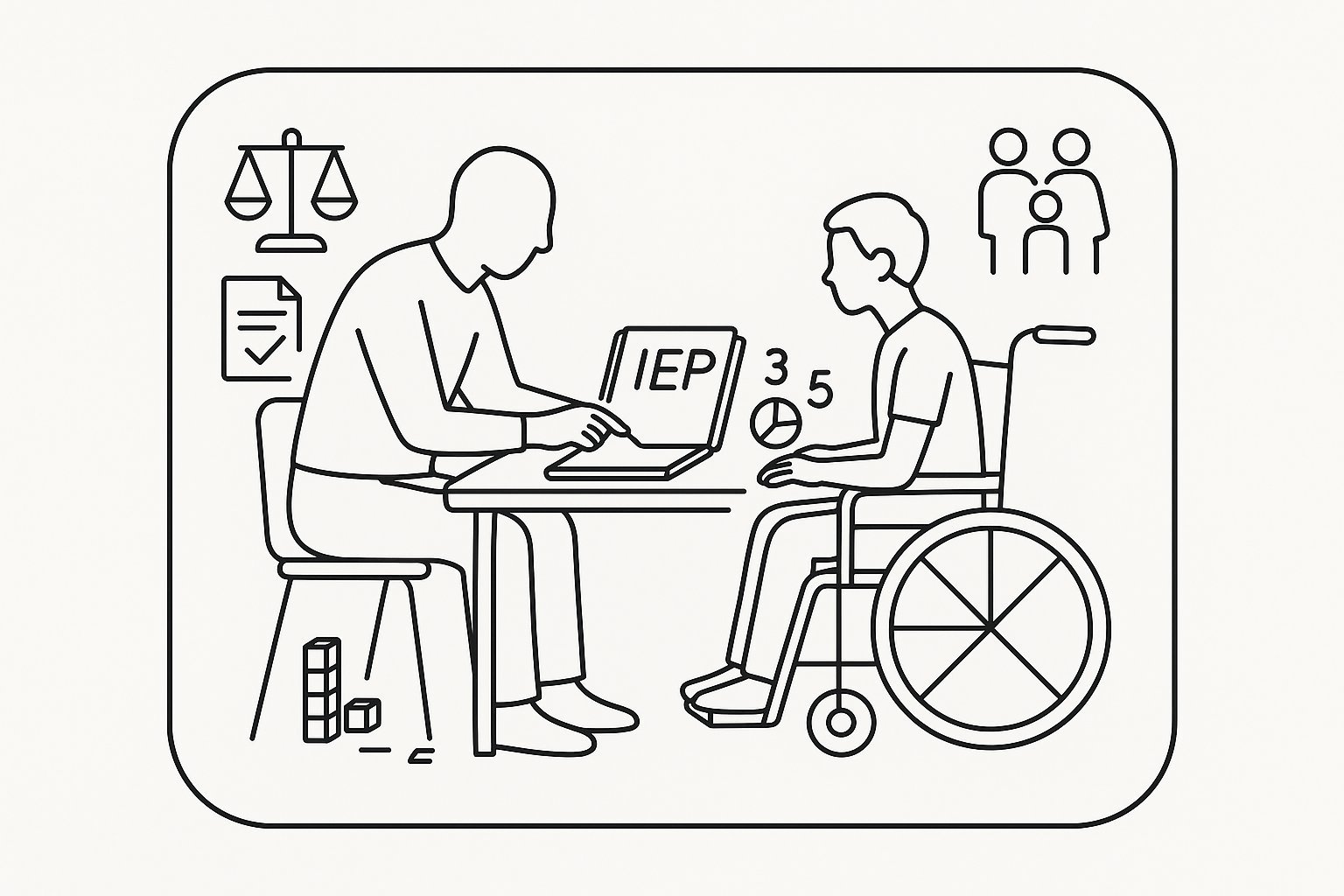
A special education math curriculum is more than a modified textbook. At its core it’s a coherent set of standards-aligned instructional plans, materials, and supports intentionally designed so learners with disabilities can access grade-level concepts or meaningful alternate goals. The purpose is threefold: ensure access to the general curriculum where appropriate, teach functional math skills that increase independence, and provide measurable progress toward individualized education program (IEP) goals.
Legally, special education math curriculum sits within the framework of IDEA (the Individuals with Disabilities Education Act) and Section 504. Those laws require individualization, free appropriate public education (FAPE), and procedural safeguards. In practice that means the curriculum must be documented in the IEP, include accommodations or modifications as needed, and offer specialized instruction provided by qualified personnel. Assessment decisions and placement must reflect each student’s unique needs rather than assumptions about disability labels.
Who does this curriculum serve? A broad range: students with specific learning disabilities in math (dyscalculia), intellectual disabilities, autism, emotional/behavioral disorders, visual or hearing impairments, and multiple disabilities. Some students will access grade-level standards with accommodations or scaffolded supports: others will require alternate achievement standards or functional math curricula emphasizing daily living and vocational math. Importantly, teams must avoid “one-size-fits-all” thinking. Two students with the same diagnosis can require very different instructional paths.
We also need to center equity: culturally responsive materials, translation of math vocabulary, and family partnership strategies are all part of responsible curriculum design. In short, a special education math curriculum defines what students should learn, how we’ll teach it, and how we’ll document progress in ways that satisfy both instructional best practices and legal obligations.
Core Components And Instructional Approaches: Skills, Scaffolds, And Evidence-Based Methods
A practical curriculum blends content (what to teach), pedagogy (how to teach), and supports (how we remove barriers). Core components include standards-aligned learning targets, tiered lesson plans, explicit instruction routines, formative assessment strategies, and a toolkit of scaffolds.
We organize content into three overlapping strands: foundational number sense (counting, magnitude, number relationships), procedural skills (calculation strategies, algorithms), and application/problem solving (word problems, functional tasks). For students with significant cognitive disabilities, the curriculum pivots toward functional math: money, measurement, time, and workplace numeracy tied to real-life routines.
Instructional approaches that consistently show positive outcomes include:
- Explicit, systematic instruction: Clearly modeled steps, guided practice, immediate corrective feedback, and cumulative review. We use worked examples and faded prompts so learners gradually take more responsibility.
- Concrete–representational–abstract (CRA): Start with manipulatives, move to pictorial representations, then to symbols. CRA reduces cognitive load and supports generalization.
- Scaffolded problem solving: Teach a routine to approach word problems (read, visualize, plan, compute, check) and attach graphic organizers to each step.
- Distributed practice and interleaving: Short, spaced review sessions help retention more than one-off lessons.
- Assistive technology: Calculators with display, speech-to-text for written explanations, visual scaffolds, and adaptive software that adjusts difficulty can be game-changers when aligned to IEP goals.
Accommodations and modifications are different but complementary. Accommodations (extra time, alternate setting, read-aloud of test items) preserve the learning target while reducing barriers. Modifications (simplified objectives, reduced item counts) change what’s taught or assessed. We recommend documenting whether a student will engage with grade-level standards or alternate standards and listing specific accommodations/modifications in the IEP.
Finally, collaborative co-teaching and multidisciplinary teams amplify impact. When special educators, general educators, speech/language therapists, and occupational therapists coordinate strategies, for example, consistent vocabulary supports or a shared manipulatives protocol, students experience coherent, reinforced instruction across settings.
Assessment, IEP Goals, And Progress Monitoring: Measuring Success And Guiding Instruction
Assessment in special education math serves diagnostic, instructional, and accountability functions. We use a combination of formal measures (standardized tests, curriculum-based measures), criterion-referenced assessments, and frequent curriculum-based probes to get a full picture.
At intake, diagnostic assessments identify gaps in number sense, working memory, language comprehension, and procedural fluency. For students with significant disabilities, functional assessments map real-world numeracy needs. These results drive IEP goal-writing: goals must be specific, measurable, attainable, relevant, and time-bound (SMART). For example: “Given a set of 10 coins, the student will identify and count currency to $1.00 with 90% accuracy across three consecutive trials.” That specificity clarifies instruction and measurement.
Progress monitoring is non-negotiable. We recommend short probes (1–5 minutes) administered weekly or biweekly for skills taught through explicit instruction, and monthly checks for broader problem-solving goals. Data collected should inform instructional decisions: if a student stalls, we ask whether quality of instruction, fidelity of implementation, intensity, or student factors (attendance, health, behavioral needs) are responsible.
When state or district assessments are required, teams must determine appropriate accommodations or eligibility for alternate assessments. Documentation is crucial: justification for accommodations and evidence linking classroom performance to assessment decisions protect both student rights and district compliance.
We also emphasize family communication. Brief, regular updates (data sent home, short conferences) help families reinforce math routines outside school and keep everyone aligned around priorities. In our experience, progress monitoring that informs instruction and involves families produces the best outcomes.
Conclusion
Designing a special education math curriculum requires blending legal understanding, rigorous instruction, and pragmatism. When we ground curriculum choices in clear learning targets, evidence-based teaching methods, frequent data, and family partnership, students with disabilities make real gains, academically and functionally. If you’re building or revising a program, start with clear IEP-aligned goals, embed scaffolds like CRA and assistive tech, and commit to routine progress monitoring. That approach keeps us compliant, accountable, and focused on the growth that matters most.
Frequently Asked Questions About Special Education Math Curriculum
What is a special education math curriculum?
A special education math curriculum is a set of standards-aligned instructional plans and supports designed to help students with disabilities access grade-level math concepts or alternate meaningful goals, promoting measurable progress toward individualized education program (IEP) objectives.
Why is it important to have a specialized math curriculum for students with disabilities?
Students with disabilities often need customized pacing, materials, and instructional approaches to access math concepts effectively. A special education math curriculum ensures legal compliance, instructional effectiveness, and equitable access to meaningful math learning.
What instructional methods are effective in a special education math curriculum?
Effective methods include explicit, systematic instruction, the concrete–representational–abstract (CRA) approach, scaffolded problem solving, distributed practice, interleaving, and the use of assistive technology aligned to IEP goals.
How do accommodations differ from modifications in special education math?
Accommodations reduce barriers without changing learning targets (e.g., extra time, read-aloud), while modifications change what is taught or assessed, such as simplifying objectives or reducing item counts, both documented in the IEP based on the student’s needs.
How is progress monitored in special education math programs?
Progress is monitored using formal and informal assessments, including weekly or biweekly probes and monthly checks, to ensure skill mastery and guide instructional adjustments aligned with SMART IEP goals.
Who benefits from a special education math curriculum?
Students with specific learning disabilities, intellectual disabilities, autism, emotional/behavioral disorders, sensory impairments, and multiple disabilities all benefit, with curricula tailored to their unique needs, abilities, and goals.