
Last Updated on July 8, 2026 by Jennifer Hanson
An Individualized Education Program (IEP) can feel like a maze the first time you encounter it. For families and educators working with students who have learning disabilities, understanding what an IEP is, and what it does, is essential to securing appropriate instruction and legal protections. In this guide we’ll walk through what an IEP really means, who qualifies, how the team builds one, and how parents can actively participate and advocate. Our goal is practical: give you clear, usable information so you can move confidently from uncertainty to action.
In this guide, What Is an IEP for Learning Disability A Clear Guide for Parents and Educators 2026 is explained with clear steps and tips.
Key Takeaways — What Is an IEP for Learning Disability A Clear Guide for Parents and Educators 2026
- An Individualized Education Program (IEP) is a legally enforceable document that outlines tailored special education services for students with learning disabilities.
- Eligibility for an IEP requires a comprehensive evaluation showing a specific learning disability that adversely affects educational performance and necessitates special education.
- The IEP development process involves a multidisciplinary team setting measurable annual goals, specifying services, accommodations, and placement based on least restrictive environment principles.
- Parents have important rights in the IEP process, including participation, consent, access to records, and advocacy options if disagreements arise.
- Effective advocacy includes preparation for IEP meetings, clear communication, and documenting concerns to ensure the plan is precise and properly implemented.
- For students with learning disabilities, an IEP serves as a roadmap to targeted instruction and legal protections that support academic progress and inclusion.
What An Individualized Education Program (IEP) Really Means
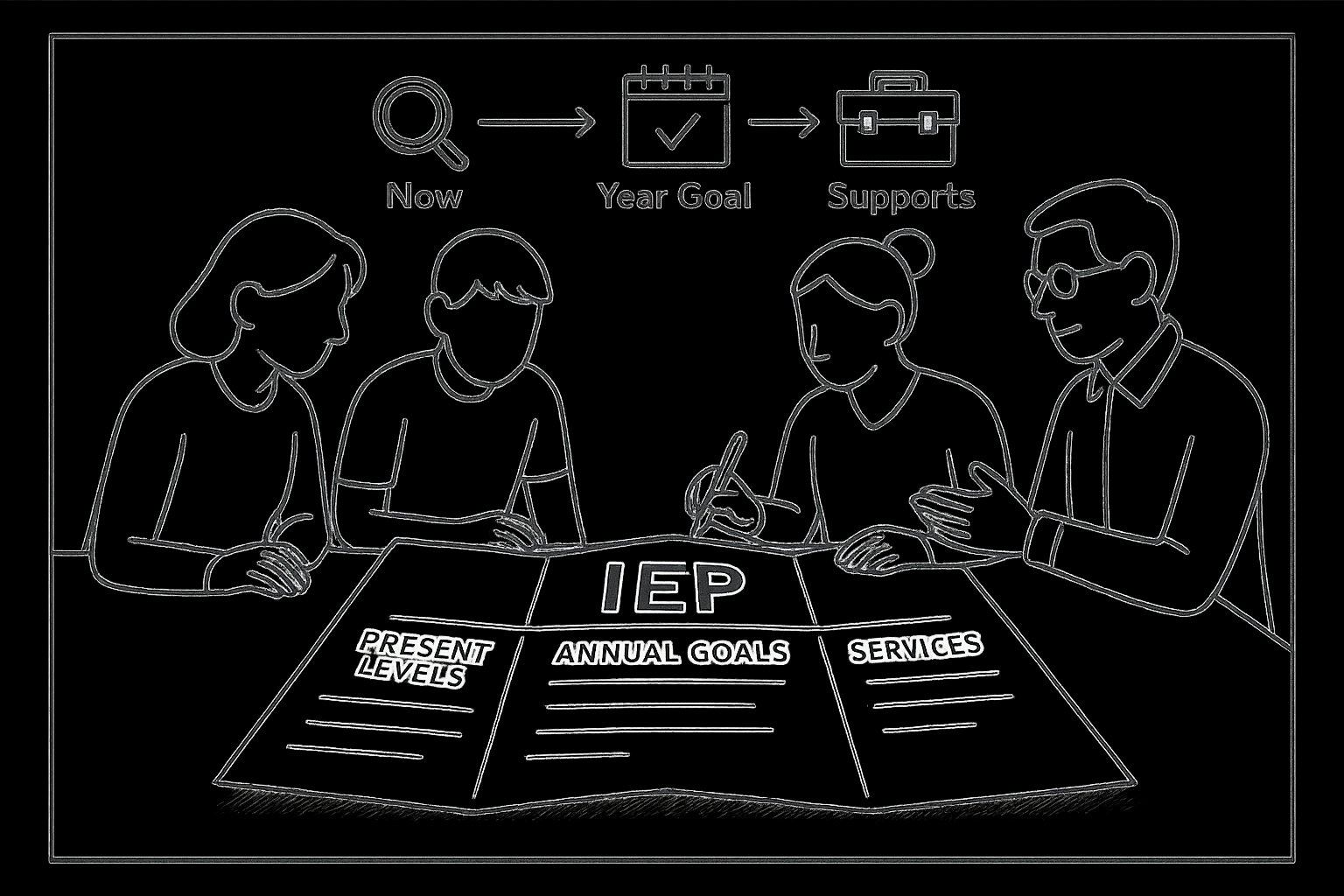
An Individualized Education Program (IEP) is a written plan developed under the Individuals with Disabilities Education Act (IDEA) that describes the special education and related services a child with a disability will receive. For students with learning disabilities, the IEP is both a roadmap and a legal document: it outlines present levels of academic performance, measurable annual goals, specialized instruction, accommodations, and how progress will be measured.
What makes an IEP different from a 504 plan or informal classroom differentiation is the IEP’s legal enforceability and the depth of individualized supports. An IEP is created when a student is found eligible under IDEA categories, such as specific learning disability (SLD), and it guarantees services tailored to that student’s unique needs. The IEP team must include parents, teachers, a special education representative, and when appropriate, the student.
Practically speaking, an IEP should answer three questions: where is the student now, where do we want the student to be in a year, and what supports will get them there. We recommend reading the IEP document with those three questions in mind. Look for measurable goals, clear descriptions of services (frequency, location, duration), and a plan for monitoring progress. If any of these items are vague, ask for clarification, the plan’s enforceability depends on specificity.
Who Qualifies for an IEP for a Learning Disability
Eligibility for an IEP begins with a comprehensive evaluation. For learning disabilities, the most common category is Specific Learning Disability (SLD), which covers problems with reading (dyslexia), writing (dysgraphia), and math (dyscalculia), among others. Eligibility requires two key findings: (1) the student has one of the qualifying disabilities, and (2) that disability adversely affects the student’s educational performance to the point that special education is needed.
Evaluations typically include academic achievement testing, cognitive or processing assessments, classroom observations, teacher input, and developmental or medical history. We should note that states and districts follow slightly different assessment protocols, but federal law requires that evaluations be nondiscriminatory and comprehensive.
Referral paths vary: parents can request an evaluation, teachers can initiate one, or the school may identify a student through response-to-intervention (RTI) data. Once a referral is made, the district must obtain parental consent before conducting formal assessments. If a child doesn’t meet IDEA eligibility but still needs supports, a 504 plan or other intervention may be appropriate, an important distinction when navigating options.
The IEP Development Process
The IEP process is structured but collaborative. Here’s how it unfolds and what to expect at each stage.
Assessments, Eligibility Determination, and the Multidisciplinary Team
After a referral and parental consent, the school conducts assessments. These can include standardized academic tests, phonological processing measures, cognitive testing, speech/language evaluations, and occupational therapy screens if needed. The multidisciplinary team, which includes general and special educators, a school psychologist or evaluator, related service providers where relevant, and the parents, reviews results to determine eligibility.
The eligibility decision should be documented and explained in writing. If the team determines the student is eligible, the school schedules an IEP meeting to create the plan. If the student is not eligible but needs supports, the team must explain alternative options.
Writing Measurable Goals, Accommodations, and Specialized Instruction
At the IEP meeting the team writes measurable annual goals that connect to the student’s present levels of performance. Good goals are specific, measurable, achievable, results-oriented, and time-bound (SMART). For example: “By June, given a multisensory phonics program, Sam will decode grade-level multisyllabic words with 85% accuracy in three out of four trials.
The IEP also lists special education services (direct instruction, resource-room time), related services (speech therapy, counseling), and accommodations (extended time, preferential seating, assistive technology). It must specify where and how often services occur, who provides them, and how progress will be reported, typically through progress reports that align with report card cycles.
Placement decisions follow the Least Restrictive Environment (LRE) principle: students should be educated with peers without disabilities to the greatest extent appropriate. The team should document why any removal from general education is necessary and how the school will support inclusion. We encourage parents to request examples of the instruction and to observe sessions where possible so they know how services look in practice.
Parental Rights, Meetings, and How to Advocate Effectively
Parents are core members of the IEP team and have rights under IDEA that protect their role. These rights include notice before meetings or evaluations, the right to consent (or refuse) evaluations and services, access to educational records, and the right to participate in decision-making. If we don’t agree with the school, we can request mediation, file a state complaint, or pursue a due process hearing.
Preparation before meetings makes a major difference. Bring recent samples of your child’s work, notes from teachers, any outside evaluations, and a list of questions or concerns. Start the meeting with the outcomes you want, academic skills, functional independence, social goals, and ask the team to translate those outcomes into measurable goals.
Communication strategies that work: keep a concise email log of conversations, request written clarifications when decisions are verbal, and ask for timelines in writing. If you suspect the IEP is being implemented inconsistently, document dates and examples. We also recommend involving an advocate or attorney familiar with special education when needed: firms like ours consult on procedural safeguards, help interpret legal language in IEPs, and can represent families in disputes. That said, many disagreements are resolved through clear communication and follow-up meetings.
Conclusion
An IEP is a powerful tool when it’s precise, collaboratively developed, and actively monitored. For students with learning disabilities, the IEP translates evaluation data into targeted instruction and legal protections that support progress and access to the curriculum. We encourage families and educators to approach the process prepared, focused on measurable outcomes, and ready to advocate when clarity or fidelity is missing. When you’re equipped with knowledge and documentation, the IEP becomes less intimidating and far more effective for the student it’s meant to serve.
Frequently Asked Questions about IEPs for Learning Disabilities
What is an IEP for a learning disability?
An IEP, or Individualized Education Program, is a legal plan developed under IDEA that outlines specialized instruction, accommodations, and services tailored to a student’s unique learning disability to support their educational progress.
Who qualifies for an IEP for a learning disability?
A student qualifies for an IEP if a comprehensive evaluation finds they have a specific learning disability that adversely affects their educational performance and requires special education services under IDEA.
How is an IEP developed for a student with a learning disability?
An IEP is developed by a multidisciplinary team including parents and educators who review assessments, set measurable goals, specify accommodations and services, and decide the least restrictive educational placement for the student.
What are the key components included in an IEP?
An IEP includes present levels of academic performance, measurable annual goals, specialized instruction, accommodations, related services, and methods for monitoring the student’s progress.
Can parents participate and advocate during the IEP process?
Yes, parents are core members of the IEP team with rights to participate in meetings, consent to evaluations and services, review records, and advocate for clear, measurable goals and appropriate supports.
What is the difference between an IEP and a 504 plan for students with learning disabilities?
An IEP is a legally enforceable plan under IDEA with individualized special education services, while a 504 plan provides accommodations under civil rights law but does not guarantee specialized instruction.