
Last Updated on July 8, 2026 by Jennifer Hanson
When a child struggles to communicate, read social cues, or articulate sounds, families and schools often turn to speech therapy within the special education framework. We wrote this guide to explain what speech-language services in schools are, who qualifies, and how the process works so you can make informed choices for a student’s education plan. Whether you’re a parent meeting with an IEP team for the first time or an educator coordinating services, our goal is to demystify evaluations, eligibility, service delivery, and the legal responsibilities that shape effective interventions.
In this guide, What Is Speech Therapy In Special Education A Practical Guide For Families And Educators 2026 is explained with clear steps and tips.
Key Takeaways — What Is Speech Therapy In Special Education A Practical Guide For Families And Educators 2026
- Speech therapy in special education addresses communication challenges that impact a student’s educational performance and requires a formal referral and multidisciplinary assessment to determine eligibility.
- Effective Individualized Education Program (IEP) goals for speech therapy should be SMART: specific, measurable, achievable, relevant, and time-limited, ensuring clear progress monitoring and parental involvement.
- Common speech and language disorders in schools include articulation, language, fluency, voice, social communication disorders, and AAC needs, each requiring tailored intervention strategies.
- Service delivery models for speech therapy vary from pull-out to push-in and consultative approaches, with collaboration between SLPs, teachers, and parents key to integrating therapy into the classroom.
- Parents, teachers, and speech-language pathologists each have defined roles and legal responsibilities under IDEA to support timely evaluations, service provision, and dispute resolution if needed.
- Documentation and communication are essential throughout the speech therapy process to track progress, adjust interventions, and uphold the student’s rights to free appropriate public education (FAPE).
Who Qualifies And How Evaluations Work
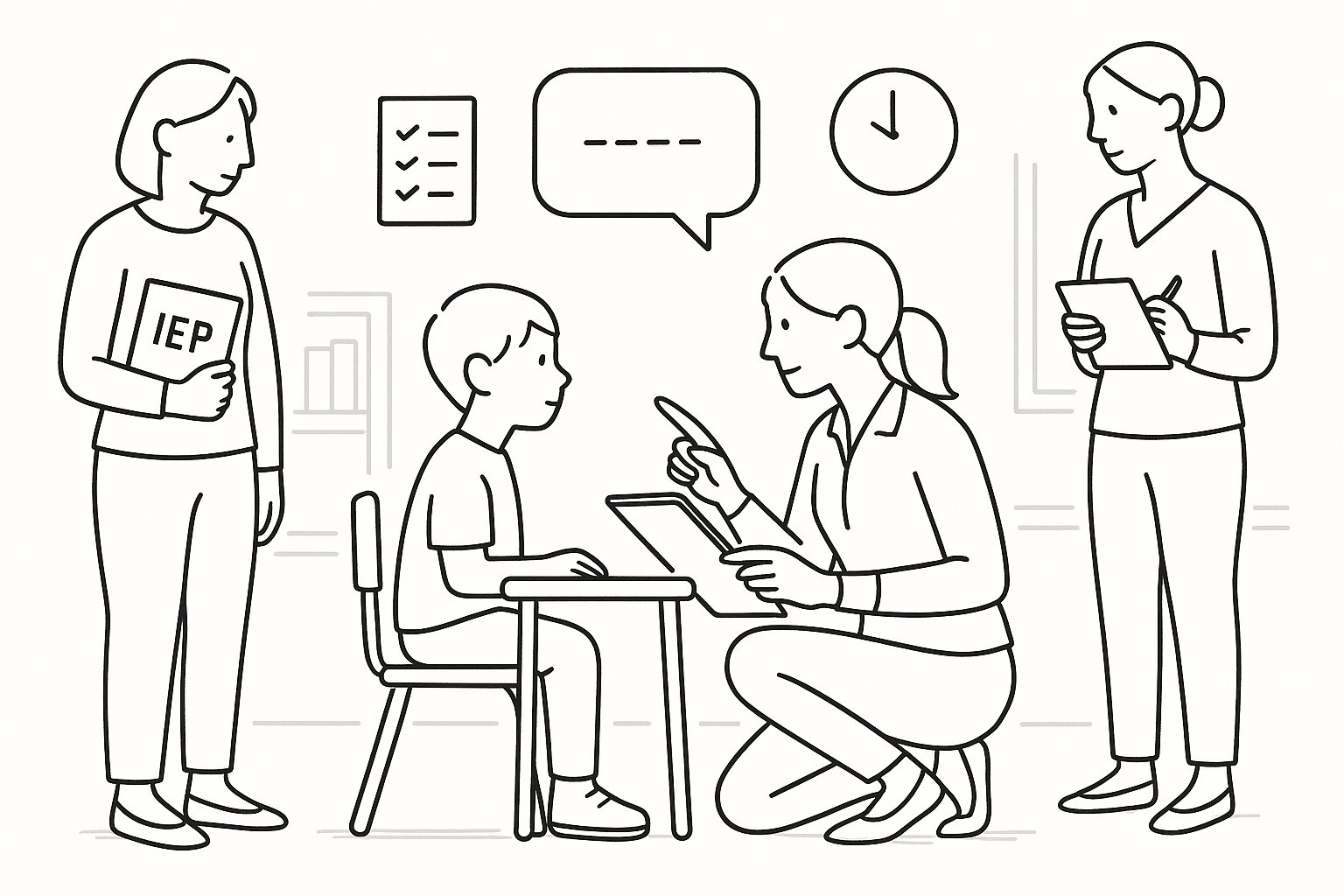
Schools provide speech-language services to students whose communication needs adversely affect educational performance. Determining who qualifies begins with a referral and a comprehensive assessment that looks at the student’s functional communication in school settings.
Referral And Assessment Process
Referrals can come from parents, teachers, or other school staff. Once a referral is made, the school typically secures parental consent to evaluate. Assessments are multidisciplinary: a school-based speech-language pathologist (SLP) conducts standardized tests and informal language sampling, teachers contribute classroom observations, and parents provide developmental history. We emphasize functional assessment, how speech and language challenges affect the child’s ability to participate in lessons, follow directions, socialize, and access the curriculum. Some evaluations also include hearing screenings, cognitive or academic testing, and observations across settings (classroom, lunchroom, playground).
Timing matters. Federal and state timelines require schools to act within set windows after a referral: delays should be documented and questioned. We recommend families come prepared with examples of communication breakdowns at home and school, recent medical or developmental reports, and questions about the evaluation tools used.
Eligibility Criteria And Setting Measurable IEP Goals
Eligibility hinges on whether the student’s speech-language impairment adversely affects educational performance. Every state has specific criteria, but the essential step is connecting evaluation results to classroom impact. If eligible, the team develops an Individualized Education Program (IEP) with measurable, time-bound goals. We advise ensuring goals are SMART: specific, measurable, achievable, relevant, and time-limited. For example, rather than “improve articulation,” an IEP goal might read: “By December, when presented with target consonant blends in structured activities, the student will produce the blends correctly in 8 out of 10 trials across three consecutive sessions.”
We also urge clarity on progress monitoring: which data the SLP will collect, how frequently parents will be updated, and how goal mastery will be measured in classroom contexts. Clear documentation prevents misunderstandings later and is especially important if families need to consult an attorney about services or dispute resolution.
Common Speech And Language Disorders Schools Address
Schools encounter a range of communication disorders. Understanding these helps families and teams target interventions.
- Articulation and Phonological Disorders: Difficulty producing specific sounds or patterns of sounds. Children may substitute or omit sounds, which can hinder intelligibility in the classroom.
- Language Disorders (Receptive and Expressive): Challenges understanding language (receptive) or using language to express needs, ideas, and narratives (expressive). These often affect reading comprehension, following multi-step directions, and participating in discussions.
- Fluency Disorders (Stuttering): Interruptions in the flow of speech that can affect participation and social engagement.
- Voice Disorders: Problems with pitch, volume, or quality of voice that affect classroom communication.
- Social (Pragmatic) Communication Disorder and Autism-Related Communication Challenges: Difficulty using language for social purposes, understanding nonliteral language, or maintaining back-and-forth conversation. These issues can dramatically affect school relationships and group learning.
- Augmentative and Alternative Communication (AAC) Needs: Some students require technology or communication boards to supplement or replace speech. Schools must assess, provide appropriate AAC devices, and train staff and peers in their use.
Each disorder presents differently in school. Our practical recommendation: document specific classroom examples (missed instructions, reluctance to answer, social withdrawal) so interventions target real barriers to learning.
How Services Are Delivered, Documented, And Integrated In School
Service delivery varies based on student need, resources, and IEP decisions. Common models include pull-out, push-in, consultative, and classroom-based instruction.
- Pull-Out Services: The student leaves the classroom for focused therapy with the SLP. This allows targeted practice but risks missing core instruction.
- Push-In Services: The SLP works inside the classroom alongside the teacher, supporting skill application in natural contexts and minimizing missed instruction.
- Consultative Model: The SLP trains teachers and provides strategies rather than direct, frequent sessions. This model is efficient for coaching generalization of skills.
- Group vs. Individual Sessions: Teams decide based on goals and severity. Group work promotes social communication skills: individual sessions focus on specific targets.
Documentation is crucial. The IEP specifies frequency, duration, location, service provider, and progress monitoring methods. Progress notes, session data, and periodic reports should be maintained in the student’s file. We recommend parents ask for clear monthly or quarterly updates and sample data so they can see progress trends.
Integration with classroom instruction is a best practice. SLPs should collaborate with teachers to embed language goals into lesson plans, modify classroom language demands, and adapt materials. For students using AAC, coordination ensures devices accompany the student across settings and that paraprofessionals know how to support use.
When services aren’t working, the team must reconvene to revise goals, change delivery models, or consider additional evaluations. Keep conversations documented, that record helps if families seek mediation or legal advice later.
Roles Of Parents, Teachers, And Speech‑Language Pathologists (SLPs) — Including Legal Responsibilities
Clear role definition promotes consistent support.
- Parents: We encourage active participation. Parents provide developmental history, consent for evaluations, and daily carryover by practicing strategies at home. They should attend IEP meetings, request clarifications, and keep communications in writing. If there’s disagreement about services, parents can request mediation, file a due process complaint, or consult an attorney experienced in special education law.
- Teachers: Classroom teachers identify concerns, carry out classroom-based strategies, and participate in IEP development. They document instructional impact and collaborate with SLPs to embed goals into lessons.
- Speech‑Language Pathologists (SLPs): SLPs evaluate, set goals, deliver therapy, train staff, and monitor progress. They also document services and provide data for IEP reviews. School SLPs must adhere to state licensure and district policies, and they often balance caseloads that affect service delivery decisions.
Legal Responsibilities: Under the Individuals with Disabilities Education Act (IDEA), schools must provide a free appropriate public education (FAPE) in the least restrictive environment. That means necessary speech-language services must be provided if they’re required for the student to benefit from education. Schools are obligated to evaluate suspected disabilities, obtain informed parental consent, and ensure services are provided as written in the IEP.
From our experience working with healthcare and education professionals, documentation and timely communication are central. When disputes arise, missed services, insufficient progress, or disagreements about eligibility, families should first use school-level remedies and, if unresolved, consider formal dispute resolution. In some situations, legal counsel familiar with educational and healthcare contexts (like contracts and professional obligations) can clarify rights and next steps.
Conclusion
Speech therapy in special education is a partnership: accurate evaluation, clear IEP goals, practical service delivery, and coordinated roles between families, teachers, and SLPs produce the best outcomes. We encourage families to stay engaged, request clear data, and document communications. If service gaps persist, know there are procedural protections and professionals who can help navigate disputes. With the right plan and collaboration, students gain the communication skills they need to access learning and connect with peers.
Frequently Asked Questions About Speech Therapy in Special Education
What is speech therapy in special education?
Speech therapy in special education involves specialized services provided by speech-language pathologists to help students with communication challenges that affect their educational performance. It aims to improve speech, language, social communication, and use of augmentative communication as needed within the school environment.
Who qualifies for speech-language services in schools?
Students qualify for speech-language services if their communication difficulties adversely affect their educational performance. Eligibility is determined through referrals, comprehensive evaluations, and assessments that connect speech-language impairments to classroom impact, following federal and state criteria.
How are speech therapy goals determined and measured in an IEP?
IEP goals for speech therapy are specific, measurable, achievable, relevant, and time-bound (SMART). They clearly define expected skills, such as articulation or fluency targets, and include progress monitoring plans using data collected by the SLP to ensure measurable student improvement in educational settings.
What types of speech and language disorders are commonly addressed in schools?
Schools address various disorders including articulation and phonological disorders, language disorders (receptive and expressive), fluency disorders like stuttering, voice disorders, social communication challenges, and needs for augmentative and alternative communication (AAC) devices to support students’ communication.
What are the common methods of delivering speech therapy services in schools?
Speech therapy services may be delivered through pull-out sessions, push-in support within the classroom, consultative coaching for teachers, or a combination. Services can be individual or group based, and are integrated with classroom instruction to support real-world communication skills.
How can parents and teachers collaborate with speech-language pathologists?
Parents provide developmental history, consent evaluations, and practice strategies at home; teachers identify concerns, implement classroom strategies, and support IEP goals. SLPs evaluate, deliver therapy, and monitor progress. Effective communication and collaboration among these roles enhance the student’s success.