
Last Updated on April 20, 2026 by Jennifer Hanson
Navigating school-based supports can feel overwhelming, especially when a child has a medical condition or impairment that affects learning. In Michigan, a Section 504 plan under the Rehabilitation Act can secure accommodations that level the playing field without the more intensive services provided by an IEP. We wrote this guide to give parents and healthcare professionals a clear, practical overview of what a 504 plan is, who qualifies, and how to obtain one in Michigan schools. Throughout, we’ll highlight typical accommodations, the differences versus an IEP, and when to involve legal or advocacy help.
In this guide, 504 Plans In Michigan A Practical Guide For Parents And Healthcare Professionals 2026 Edition is explained with clear steps and tips.
Key Takeaways — 504 Plans In Michigan A Practical Guide For Parents And Healthcare Professionals 2026 Edition
- A 504 Plan in Michigan provides civil-rights accommodations to students with disabilities, ensuring equal access to education without specialized instruction like an IEP.
- Students qualify for a 504 Plan if they have a physical or mental impairment that substantially limits major life activities, verified through a team evaluation including medical and school records.
- Parents should request a 504 Plan in writing, provide thorough medical documentation, participate in evaluation meetings, and monitor the plan’s implementation for effectiveness.
- Common 504 Plan accommodations include extended test time, medical management during school, preferential seating, and breaks tailored to the student’s specific medical or learning needs.
- A 504 Plan addresses access barriers, while an IEP offers specialized instruction; families should consider both options depending on the student’s educational requirements.
- If a 504 Plan is denied or not properly implemented, families in Michigan can seek resolution through school appeals, complaints to education authorities, or legal assistance when necessary.
What A 504 Plan Is And How It Protects Students
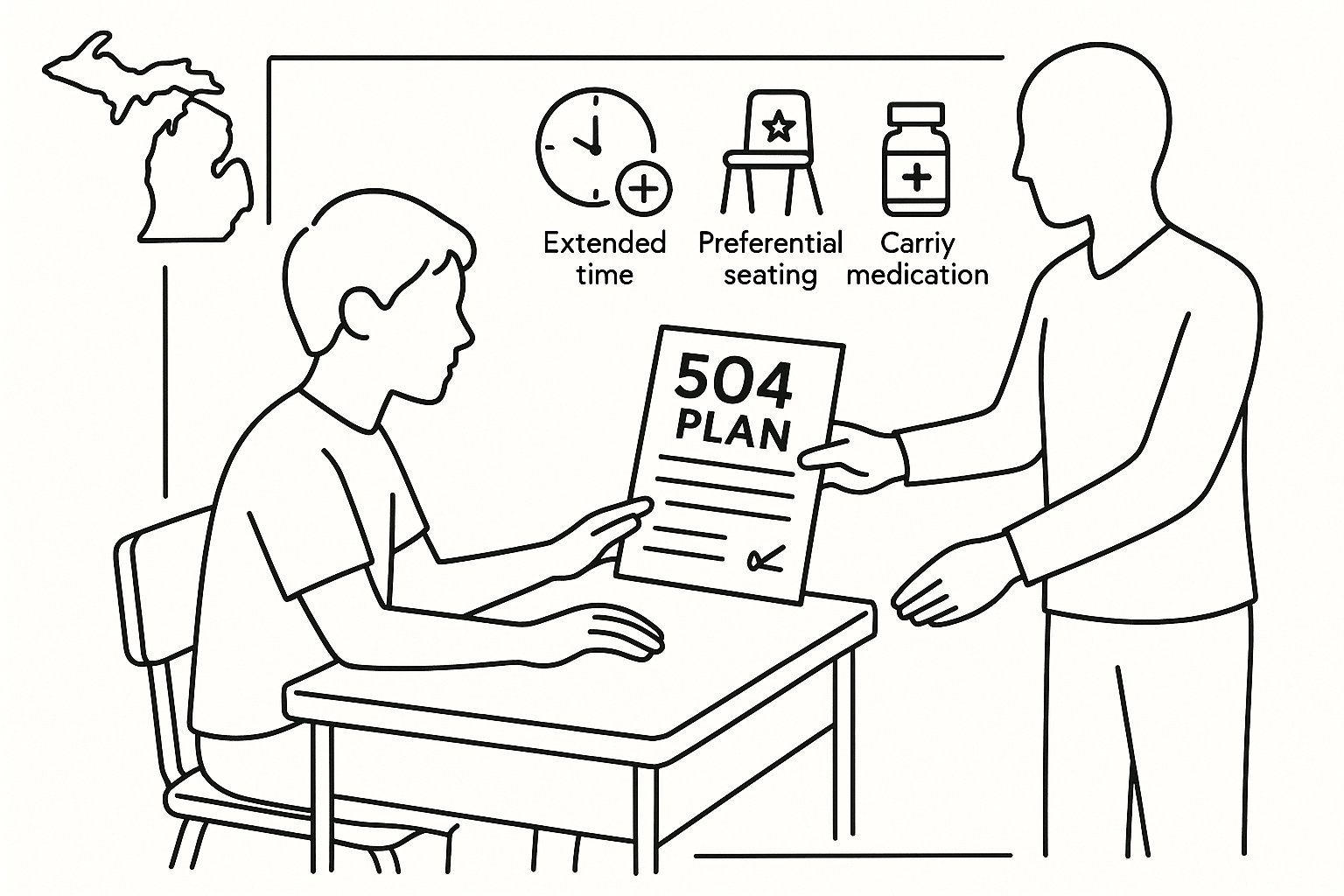
A 504 plan is a formal, written plan developed under Section 504 of the federal Rehabilitation Act of 1973. It ensures that students with disabilities, defined as any physical or mental impairment that substantially limits one or more major life activities, receive reasonable accommodations so they can access education alongside peers. Unlike special education under IDEA, a 504 plan focuses on removing barriers rather than providing specialized instruction. In practice, that means adjustments like extended test time, preferential seating, or permission to carry medication. In Michigan, public schools and districts must comply with Section 504: private schools receiving federal funds must, too. The protection is civil-rights-based: schools can’t discriminate against a student because of a disability and must provide equal access to programs, extracurriculars, and activities. Documentation typically includes the student’s disability, specific accommodations, responsible staff, and monitoring procedures. For many families, a 504 plan is the faster, less-intensive route to practical supports, especially when a medical condition (like diabetes, asthma, migraines, or anxiety) interferes episodically or chronically with school functioning.
Who Qualifies For A 504 Plan In Michigan Schools
Qualification hinges on two primary determinations: (1) the student has a physical or mental impairment, and (2) that impairment substantially limits a major life activity such as learning, breathing, concentrating, walking, or major bodily functions. Michigan schools use evaluation teams, often including teachers, school nurses, counselors, and parents, to review medical records, teacher observations, and assessment data. We should note that eligibility is broader than IDEA: students who don’t meet the strict criteria for special education can still qualify for a 504 plan. Examples include students with Type 1 diabetes who need blood sugar monitoring, students with severe allergies who require epinephrine access and environmental controls, and students with ADHD whose concentration is substantially impacted. Temporary impairments (like recovery from surgery) may qualify if they meet the “substantial limitation” threshold during the relevant period. Importantly, a medical diagnosis alone doesn’t automatically trigger a plan: the team must document how the condition limits the student in school settings and identify reasonable accommodations to address those limitations.
How To Request And Obtain A 504 Plan — Step-By-Step
Requesting a 504 plan is often straightforward, but documentation and persistence matter. Here’s a practical step-by-step we recommend: 1) Start with a written request: Email or send a letter to the school principal or 504 coordinator asking for a 504 evaluation. Keep a copy. 2) Gather documentation: Provide recent medical records, a physician’s letter describing the diagnosis and functional limitations, and teacher observations or grades that show the impact at school. 3) Attend the evaluation meeting: The school will assemble a team to review records and may request assessments. Come prepared, bring detailed notes about when problems occur and what has helped. 4) Develop the plan: If eligible, the team drafts a written 504 plan listing accommodations, responsible staff, and monitoring. Don’t sign until you’ve read it carefully. 5) Implementation and follow-up: The school must carry out the accommodations and monitor effectiveness. Request regular updates and keep copies of communications. 6) If denied: You have the right to an impartial hearing and to file a complaint with the U.S. Department of Education’s Office for Civil Rights (OCR). We often advise families to document each step and to involve their child’s healthcare providers early, clear medical notes can make eligibility and accommodation selection smoother.
Common Accommodations And Examples For Medical And Learning Needs
504 plans are highly individualized, but common accommodations cluster around medically necessary actions, scheduling, environment, and instructional adjustments. For medical needs, examples include permission for in-class blood glucose testing and insulin administration for students with diabetes, a trained staff member to administer epinephrine for severe allergies, or access to water and restroom breaks for gastrointestinal conditions. For chronic pain or migraines, accommodations might include reduced assignments load on symptom days or a rest pass to go to the nurse. For learning-related functional limitations, like attention issues tied to ADHD, typical supports are extended time on tests, frequent breaks, preferential seating, or written instructions to supplement oral directions. We advise specifying triggers, thresholds, and response plans: e.g., “If student’s blood glucose <70 mg/dL, school nurse will follow documented diabetic care plan.” Clear, measurable language prevents confusion and helps staff apply accommodations consistently. Including training requirements for staff and emergency protocols in the plan is prudent when medical intervention might be needed.
504 Plan Versus IEP: Key Differences And Which Is Right
Choosing between a 504 plan and an Individualized Education Program (IEP) under IDEA depends on the student’s needs. We like to think of the 504 as civil-rights accommodations and the IEP as a specialized instructional program. Key differences: eligibility criteria (504 covers any substantial limitation: IDEA requires specific categories and educational impact), services (IEP can include specialized instruction and related services like speech therapy), legal procedural safeguards (IEP has more formal procedural protections and funding implications), and documentation detail (IEPs follow a standardized format and must include measurable goals). When is an IEP appropriate? If the student needs specialized instruction or related services to make progress academically, an IEP is likely the better route. When is a 504 plan sufficient? If the student’s needs are met by accommodations, adjustments that remove barriers but don’t change the curriculum, a 504 plan often fits. We recommend starting with the evaluation process: parents should request consideration for both pathways if unsure, and providers can supply assessments that clarify whether the functional impact meets IDEA’s standard.
Working With Schools, Due Process, And When To Seek Legal Help
Most 504 issues can be resolved collaboratively, but sometimes disputes arise around eligibility, implementation, or timeliness. We encourage clear communication: document requests, track meetings, and ask for the name of the district’s 504 coordinator. If the school denies eligibility or refuses accommodations, families can file a complaint with the Michigan Department of Education or the U.S. Department of Education’s Office for Civil Rights. For contested cases, an impartial hearing is available: procedural protections are more limited under Section 504 than under IDEA, so legal advice can be valuable when stakes are high. Given our practice at Chelle Law advising healthcare professionals and organizations, we often see overlap between employment-related disability accommodation principles and school-based 504 advocacy, knowing those legal frameworks helps when negotiating or escalating. Seek legal help when delays or denials materially affect the student’s education or health, when the district repeatedly fails to carry out agreed accommodations, or when you suspect discrimination. A lawyer can advise on administrative appeals, OCR complaints, and, where appropriate, litigation.
Conclusion
A 504 plan is a powerful, rights-based tool to ensure students with medical or functional impairments can participate fully in Michigan’s schools. We recommend documenting needs carefully, partnering with healthcare providers to supply clear medical guidance, and keeping detailed records of communications with the school. When simple collaboration isn’t enough, Michigan families have administrative and legal options to enforce rights. If you’re a healthcare professional, include precise functional limitations and recommended accommodations in your notes, those details materially improve a family’s chance of getting timely, appropriate school support.
Frequently Asked Questions About 504 Plans in Michigan
What is a 504 plan in Michigan schools?
A 504 plan in Michigan is a written plan under Section 504 of the Rehabilitation Act that provides students with disabilities reasonable accommodations to ensure equal access to education without specialized instruction.
Who qualifies for a 504 plan in Michigan?
Students with physical or mental impairments that substantially limit major life activities, like learning or concentrating, qualify. Eligibility is broader than IDEA and includes conditions like diabetes, severe allergies, and ADHD.
How do I request a 504 plan for my child in Michigan?
Begin by submitting a written request to the school principal or 504 coordinator, provide medical documentation, attend the evaluation meeting, and collaborate to develop and implement the plan if eligible.
What types of accommodations can a 504 plan include?
Common accommodations include extended test time, preferential seating, medication administration, rest breaks, and environmental adjustments tailored to medical or learning needs.
How is a 504 plan different from an IEP in Michigan?
A 504 plan provides accommodations to remove barriers, while an IEP offers specialized instruction and related services. Eligibility and procedural safeguards differ, with IEPs targeting students needing more intensive educational support.
When should parents seek legal help regarding a 504 plan in Michigan?
Legal help is advisable if the school denies eligibility, fails to implement accommodations, causes delays affecting education or health, or when discrimination is suspected. Legal advice can guide appeals and enforcement.