
Last Updated on October 7, 2026 by Jennifer Hanson
A therapist letter for a 504 plan can be the single most practical document that connects a student’s clinical needs to school-based accommodations. In this text we’ll explain what that letter is, who should write it, and the specific information schools expect in 2026. We’ll also provide a concise, fillable sample therapist letter you can adapt. Our goal is to make this process straightforward so families and providers can secure supports that meaningfully reduce barriers to learning.
In this guide, What Is a Therapist Letter For a 504 Plan How To Write One That Works In 2026 is explained with clear steps and tips.
Key Takeaways — What Is a Therapist Letter For a 504 Plan How To Write One That Works In 2026
- A therapist letter for a 504 plan is a critical document connecting a student’s clinical needs to school accommodations under Section 504 of the Rehabilitation Act.
- The letter must be written by licensed providers currently treating the student and include clear, functional descriptions of how the disability impacts school performance.
- Specific, actionable accommodation recommendations tied to observed functional limitations increase the likelihood of plan approval and effective support.
- The letter should be concise, use plain language, and include provider credentials, treatment relationship, and duration or prognosis of the disability.
- Coordinating with the school’s 504 coordinator and tailoring the letter to district-specific requirements helps streamline the approval process.
- A well-prepared therapist letter in 2026 must link clinical findings to measurable accommodations to meet increased standardization and scrutiny.
What A Therapist Letter For A 504 Plan Is And Why It Matters
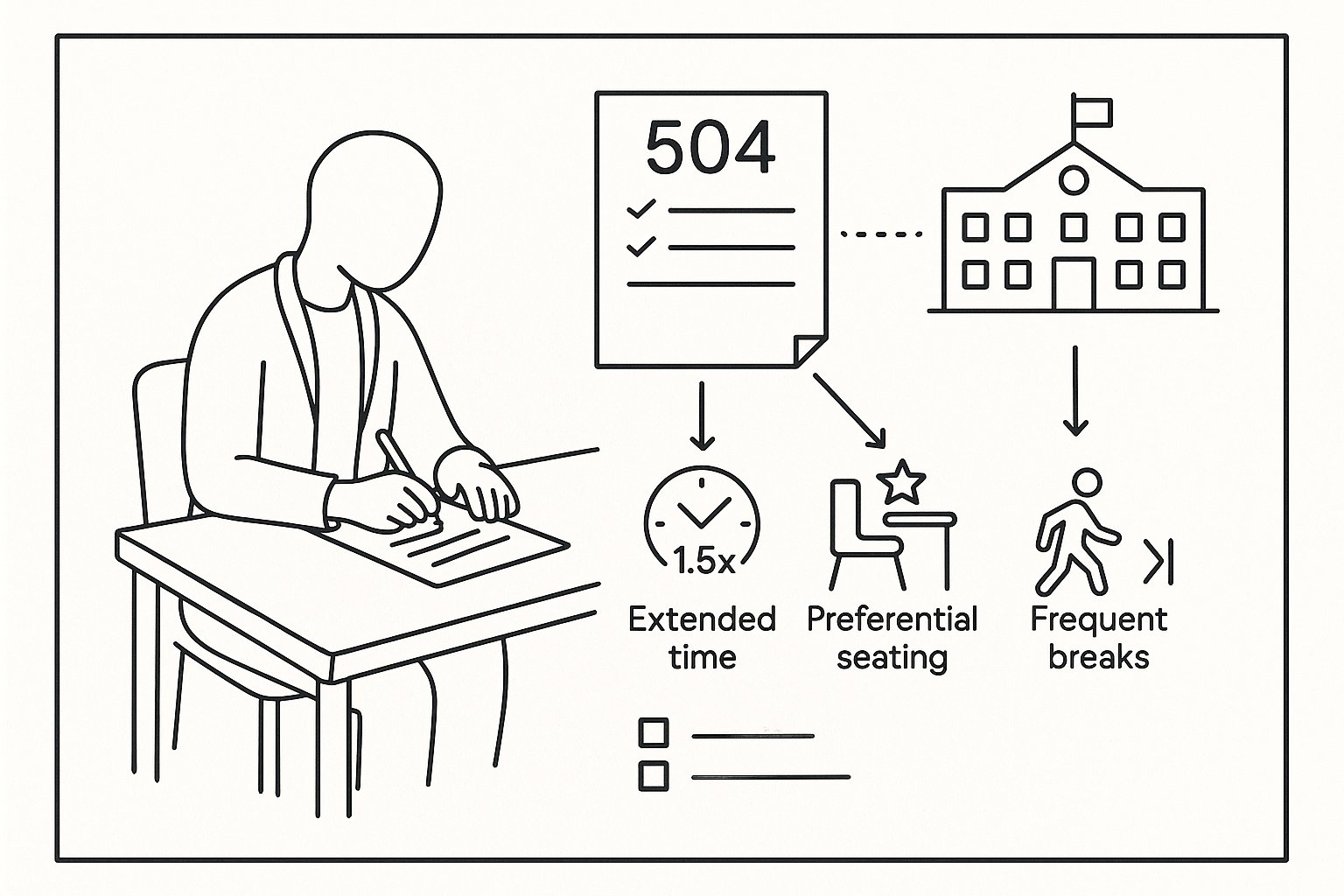
A therapist letter for a 504 plan is a clinical statement written by a licensed mental health or medical provider that documents a student’s disability and explains why reasonable accommodations at school are necessary. Under Section 504 of the Rehabilitation Act, schools must provide students with disabilities equal access to educational programs. But schools don’t decide accommodations in a vacuum, they rely heavily on documentation from clinicians to understand functional limitations and recommended supports.
Why the letter matters now (2026):
- Increased scrutiny and standardization. School districts have tightened intake procedures and often require clear, functional descriptions of how a condition affects access to learning, classroom behavior, or participation in activities. A vague note won’t cut it.
- Interdisciplinary expectations. Schools expect that the letter ties clinical findings to concrete accommodations (e.g., extra time, preferential seating, modified deadlines, frequent breaks). The trend is to favor evidence-based, measurable supports.
- Legal weight. While a therapist letter alone doesn’t create a 504 plan, it is frequently the catalyst for a Section 504 meeting. Strong, precise documentation reduces back-and-forth and speeds up implementation.
What schools typically look for in the letter:
- Provider credentials and relationship to the student (who is writing and how we know the child).
- Diagnosis or functional description of the disability (avoid jargon: focus on observable effects).
- Specific examples of how the disability interferes with school tasks (concentrating during lessons, transitioning between classes, completing timed tests).
- Concrete recommendations for accommodations tied to those limitations.
- Duration and prognosis: is this temporary, intermittent, chronic?
We recommend that letters frame recommendations in a way schools can operationalize: state the accommodation, the reason, and the expected outcome. For example: “Allowing extended time for quizzes (time and a half) will reduce performance variance caused by processing speed deficits, permitting the student to demonstrate mastered content.” That sentence links limitation to accommodation and expected result, exactly what a 504 team needs to make a decision.
Who Should Write The Letter And What Key Information To Include
Who should write the letter?
- Licensed mental health clinicians (psychologists, clinical social workers, licensed professional counselors) who currently treat the child for conditions that affect learning or school participation.
- Medical providers (pediatricians, psychiatrists, neurologists) when the primary limitation is medical or neurodevelopmental.
- Occupational therapists or speech-language pathologists when the functional limitation relates specifically to motor skills, sensory processing, or communication and those limits impact education.
We advise parents and school teams to prioritize providers who have recent, direct contact with the student. Schools place more weight on contemporaneous evaluations and treatment notes than on historical summaries.
Key information the letter must include (we recommend using a clear structure or headings):
- Provider identification and credentials
- Full name, license type and number, professional title, practice name, contact information, and dates of service with the student.
- Statement of relationship and basis for findings
- Document how long and in what context the provider has worked with the student (e.g., weekly therapy since August 2024, neurodevelopmental evaluation completed March 2026).
- Functional diagnosis or description
- Use diagnostic codes when relevant but prioritize functional descriptions: attention regulation, executive functioning delays, sensory dysregulation, anxiety limiting test performance, etc.
- Specific functional limitations in the school environment
- Concrete examples: difficulty sustaining attention for 15–20 minutes, requires verbal cueing to return to task, physical fatigue after 30 minutes of standing, panic episodes that require brief removal from class.
- Recommended accommodations and rationale
- Pair each recommended accommodation with why it’s necessary and how it will help. Examples: extended time (time and a half for timed tests), reduced-distraction testing environment, scheduled sensory breaks, preferential seating, check-ins with a counselor, flexible deadlines for missed work due to medical flare-ups.
- Duration and monitoring
- State whether supports are likely needed short-term, intermittently, or long-term. Suggest how the school can monitor effectiveness (data collection, periodic team reviews, trial periods).
- Signature and date
- Signed and dated on official letterhead when possible. Electronic signatures are acceptable in many districts, but local rules vary: we encourage providers to use secure, verifiable formats.
Practical tips when we prepare or request the letter:
- Be concise but specific. One to two pages is typically ideal, long enough to cover essentials, short enough for school teams to review quickly.
- Avoid unnecessary clinical narrative. Focus on school-relevant function and recommendations.
- Use plain language. School staff appreciate statements they can act on without needing to decode clinical terms.
- Coordinate with the school’s 504 coordinator when possible to confirm any district-specific requirements (some districts provide intake forms or ask for certain headings).
Sample Therapist Letter Template (Short, Fillable Example)
Below is a concise, fillable example you can adapt. We’ve written this so clinicians and parents can quickly edit details and submit the letter to a school.
[Clinician Letterhead]
Date: ______________________
To: 504 Coordinator / School Team
School: ______________________
Student: ______________________
DOB: ______________________
From: ______________________, License: __________, Title: __________
Practice: ______________________
Contact: ______________________
Dates of service: ______________________
Re: Functional impact and recommended accommodations
- Statement of relationship: I have been treating/evaluating [Student] since [date] for [condition/concern]. I have met with the student [frequency] and conducted [assessments/observations].
- Functional description: Based on clinical interviews, observation, and standardized measures, [Student] demonstrates the following school-relevant functional limitations: [brief bullet list, e.g., significant difficulty sustaining attention for longer than 15 minutes: pronounced test anxiety leading to panic symptoms: sensory sensitivity to classroom noise].
- Impact on education: These limitations currently interfere with [list specific school activities, e.g., taking timed tests, completing assignments on schedule, participating in classroom group work, maintaining attention during lecture].
- Recommended accommodations (rationale):
- Extended time for timed assessments (time and a half). Rationale: Processing speed and attention variability hinder efficient demonstration of knowledge.
- Reduced-distraction testing environment. Rationale: Decreases sensory triggers and anxiety that lead to performance decline.
- Scheduled short sensory/calm breaks (2–5 minutes) as needed. Rationale: Helps regulate arousal and sustain attention across the school day.
- Flexible deadlines for assignments missed due to medical/mental health flare-ups (up to X days). Rationale: Reduces academic penalty for symptoms outside the student’s control.
- Duration and monitoring: We recommend implementing these accommodations for the current school year with a review at the 504 meeting in [month/year] or earlier if concerns arise. Progress can be monitored by collecting assignment completion rates, test scores with accommodations, and behavioral observations.
Please contact me at [phone/email] for clarification or to discuss implementation. Thank you for considering these recommendations to support [Student]’s equal access to education.
Sincerely,
[Signature]
[Printed name, license number]
Notes on adapting this template: Use diagnostic terms sparingly and always link recommendations to observable school tasks. If a provider is part of a multidisciplinary team, note that context and include relevant objective assessment results when space allows.
Conclusion
A well-written therapist letter for a 504 plan bridges clinical insight and practical school action. By keeping the letter recent, concise, function-focused, and specific about accommodations and rationale, we increase the likelihood that a school team will accept and carry out needed supports. If navigating documentation or school response becomes contentious, families may consider consulting an attorney experienced in education law, especially when health care providers or employer-related issues intersect with a student’s supports. At Chelle Law we often advise clients on procedural rights: reach out if you need help understanding the next steps.
Frequently Asked Questions About Therapist Letters for 504 Plans
What is a therapist letter for a 504 plan and why is it important?
A therapist letter for a 504 plan is a clinical document from a licensed provider explaining a student’s disability and why school accommodations are necessary. It connects clinical needs to educational supports, helping schools implement reasonable accommodations under Section 504 of the Rehabilitation Act.
Who is qualified to write a therapist letter for a 504 plan?
Licensed mental health clinicians, medical providers, occupational therapists, or speech-language pathologists who have recent and direct contact with the student can write the letter. The writer should treat or assess conditions affecting the student’s learning or school participation.
What key information should a therapist letter for a 504 plan include in 2026?
The letter should have provider credentials, relationship to the student, a functional diagnosis, specific school-related limitations, recommended accommodations with rationale, duration and monitoring plans, and it should be signed and dated—ideally on official letterhead.
How can a therapist letter effectively recommend accommodations for a 504 plan?
Effective letters link each recommended accommodation to a specific functional limitation, explaining why the support is necessary and how it will improve the student’s ability to access learning, such as extended time for tests due to processing speed deficits.
Why do schools require detailed functional descriptions in therapist letters for 504 plans?
Schools need clear, measurable descriptions of how disabilities affect learning or behavior to grant accommodations. Detailed functional information ensures that supports are evidence-based and tailored to reduce barriers in the educational environment.
What practical tips help when preparing a therapist letter for a 504 plan?
Keep the letter concise (1-2 pages), avoid unnecessary clinical jargon, use plain language, focus on school-relevant functions and recommendations, and coordinate with the school’s 504 coordinator to meet any specific district requirements.