
Last Updated on October 16, 2026 by Jennifer Hanson
When we talk about special education, the phrase least restrictive environment, or LRE, comes up constantly, but it can feel abstract. LRE is a legal and practical commitment: students with disabilities should learn alongside their non-disabled peers to the maximum extent appropriate. In this guide we’ll explain what LRE means under IDEA, how courts interpret it, who makes placement decisions, and what real classroom practice looks like. Our goal is to give parents and educators clear, usable guidance so they can advocate effectively for students’ rights and supports.
In this guide, Least Restrictive Environment Explained A Practical Guide for Parents and Educators 2026 is explained with clear steps and tips.
Key Takeaways — Least Restrictive Environment Explained A Practical Guide for Parents and Educators 2026
- The Least Restrictive Environment (LRE) principle under IDEA ensures students with disabilities learn alongside non-disabled peers to the maximum extent appropriate, starting from general education settings complemented by necessary supports.
- LRE placement decisions are individualized based on a student’s unique needs and progress, balancing inclusion with specialized instruction when needed for meaningful educational benefit.
- IEP teams, including parents, school staff, and specialists, collaborate to decide placement, emphasizing parental rights and requiring schools to justify any more restrictive settings beyond general education.
- Courts assess LRE compliance by reviewing whether schools offered inclusion with supports first, documented educational rationale, and followed proper procedural safeguards under IDEA.
- Effective LRE practice relies on comprehensive assessments, targeted supports like co-teaching and assistive technology, and ongoing progress monitoring to guide placement along a continuum from general to specialized settings.
- Examples across disabilities show LRE flexibility, promoting inclusion with accommodations or specialized settings only when necessary, always with plans for regular re-evaluation and measurable goals.
What Least Restrictive Environment (LRE) Actually Means Under IDEA
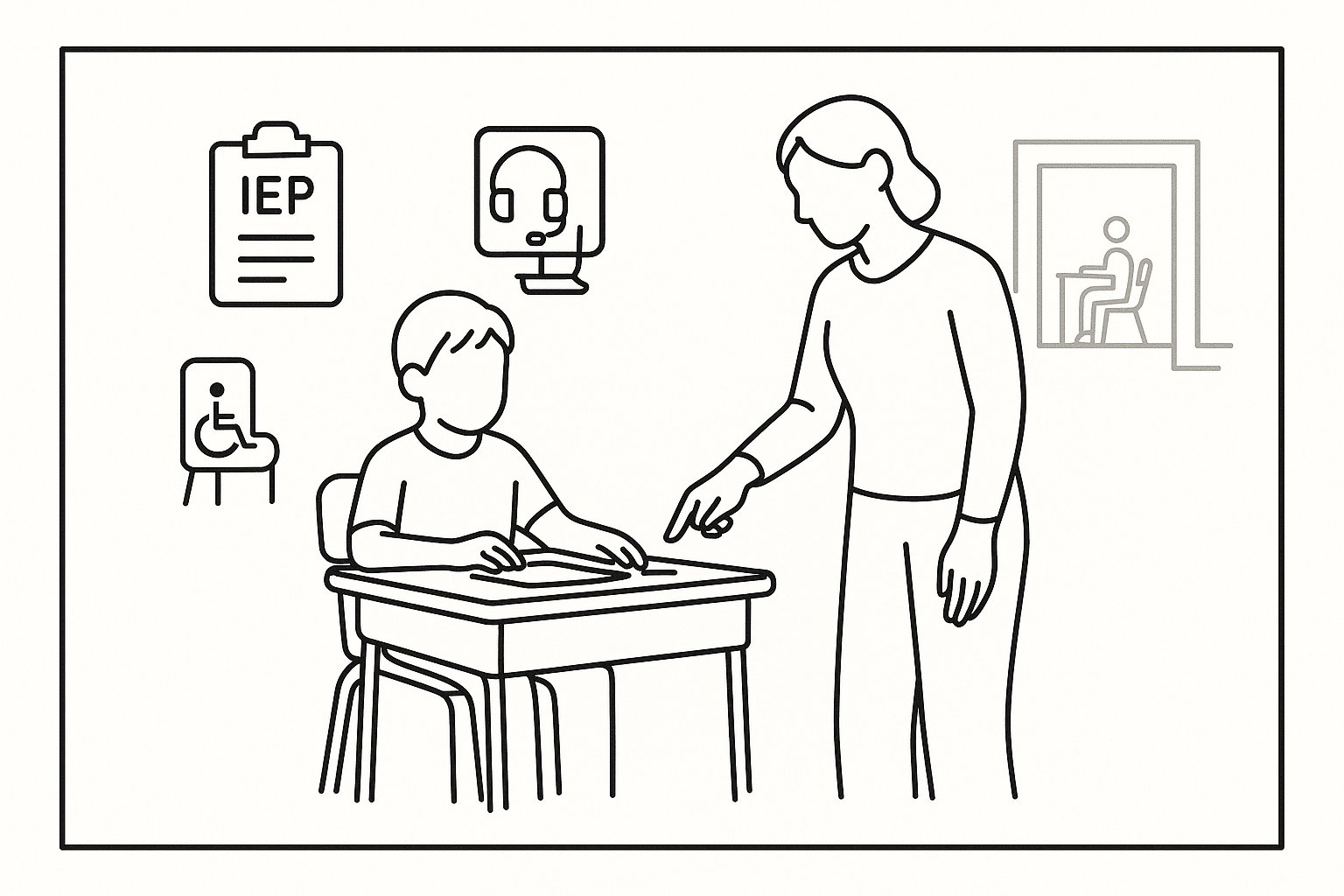
The Individuals with Disabilities Education Act (IDEA) requires that students eligible for special education be educated with children who are not disabled “to the maximum extent appropriate.” That phrase is the heart of LRE. LRE is not a single place or program, it’s a principle that guides placement decisions. We must start from the presumption that general education settings are the default, and then consider whether supplementary aids, related services, or specialized instruction can allow the child to succeed there. Only when those supports are insufficient should more restrictive options be considered.
LRE balances inclusion with individual needs. For instance, a student with mild learning differences may remain in a general classroom with accommodations (preferential seating, extended time, co-teaching). Another student with intensive behavioral or medical needs may require a specialized class or separate facility for part or all of the day. Importantly, LRE decisions are individualized, based on the student’s present levels of performance, goals, and documented needs, not on categorical labels or convenience for the school.
We should also note IDEA’s procedural protections: families have a right to participate in placement decisions, to receive notice, and to challenge placements through due process if necessary. That combination of substantive and procedural rights is what makes LRE enforceable rather than merely aspirational.
Legal Framework And How Courts Interpret LRE
Understanding how courts interpret LRE helps us see how the law works in practice. Courts look for whether the school offered placement in the general education setting with appropriate supports, whether the student’s needs justified a more restrictive setting, and whether the IEP was reasonably calculated to provide educational benefit.
IDEA doesn’t demand inclusion at all costs: courts apply a fact-specific standard. That means outcomes depend on documentation, IEP team deliberations, and whether the school attempted less restrictive alternatives first. When teams can show they considered options and documented why a restrictive placement was necessary, courts are more likely to defer to the school, unless the placement denies meaningful educational benefit or excludes the child without justification.
Procedural safeguards matter too. If the school fails to follow required procedures (for example, not including parents or failing to evaluate properly), courts may find the placement unlawful regardless of the substantive arguments. So we need both a sound educational rationale and a clear record of following IDEA’s processes.
Key Court Decisions And The ‘Appropriate’ Standard
Two cases shape much of LRE law. First, Board of Education v. Rowley (1982) established that an IEP must be “reasonably calculated to enable the child to receive educational benefits.” That remains the baseline for appropriateness. Later cases, such as Endrew F. v. Douglas County School District (2017), tightened that standard: an IEP must be reasonably calculated to enable progress appropriate considering the child’s circumstances, not merely more than trivial progress.
As for LRE specifically, courts often weigh whether the school evaluated less restrictive options and provided necessary supports in general education. In some rulings courts have emphasized placement in the least restrictive setting unless doing so would prevent the child from achieving meaningful progress or would produce harm to others. The lesson we draw is practical: document the educational rationale, show efforts to support inclusion, and set measurable goals so that progress (or lack of it) is clear.
Who Decides: The IEP Team, School District, And Parental Rights
Decisions about LRE are made by the IEP team, which must include the parents, at least one regular education teacher (if the child is or may be in regular education), a special education teacher, a district representative with authority to commit resources, and others with expertise. Parents are equal participants, they have a voice, and their insights about their child’s strengths and needs are essential.
We often see tension when districts push specific placements for logistical reasons. Legally, the district must propose an educationally appropriate placement: it cannot rely on convenience alone. Parents can request evaluations, propose alternative placements, and insist on inclusion of professionals (e.g., behavior analysts, therapists) at meetings. If disagreements persist, mediation and due process hearings are available. From our experience advising clients in related administrative matters, a clear, well-documented case from parents increases the likelihood of a favourable resolution without litigation.
Remember: participation, documentation, and timely requests for evaluations or revisions are the parents’ best tools when they believe the proposed placement is more restrictive than necessary.
Putting LRE Into Practice: Assessment, Placement, And Examples
Putting LRE into practice starts with a thorough, multidisciplinary assessment. Evaluations should identify academic, social, communication, and behavioral needs as well as strengths. We then translate assessment findings into an IEP that explains how supports will enable access to the general curriculum, or, if necessary, why a more specialized setting is required temporarily or permanently.
An effective IEP ties accommodations and services directly to goals and to how progress will be measured. For placement, teams should consider the continuum of services and whether supports (co-teaching, paraprofessional assistance, classroom modifications, assistive technology) have been trialed and documented. We encourage teams to include a plan for gradual reintegration into less restrictive settings when appropriate, and to set timelines for regular review.
Continuum Of Placements And Typical Classroom Supports
The continuum of placements ranges from full-time general education with supports, to general ed with pull-out resource instruction, to specialized self-contained classes, to separate schools or residential facilities for the most intensive needs. Typical supports used to keep students in less restrictive settings include:
- Co-teaching and collaborative planning between general and special educators
- Differentiated instruction and scaffolded materials
- Related services (speech, occupational therapy, physical therapy) delivered in or out of class
- Positive behavioral interventions and supports (PBIS) and individualized behavior plans
- Assistive technology (text-to-speech, alternative keyboards, communication devices)
- Paraeducator assistance with fading plans to promote independence
We recommend teams document attempts to use these supports before moving to more restrictive placements, and to review whether adaptations are producing measurable gains.
Sample Scenarios: How LRE Looks For Different Disabilities
Scenario 1, Specific Learning Disability: A child with dyslexia receives explicit reading intervention from a special educator for 30 minutes daily in a resource room, but remains in general classroom for the rest of the day with accommodations (audiobooks, extra time). This reflects LRE: general education is the primary setting, supplemented by targeted instruction.
Scenario 2, Autism Spectrum Disorder: A student with social communication challenges participates in general education with a social skills group and in-class support for transitions: during times requiring intense instruction (e.g., math concept introduction), the student receives brief small-group instruction in a nearby resource room. The placement blends inclusion with targeted supports to maximize access.
Scenario 3, Significant Medical/Behavioral Needs: For a student whose medical or behavioral needs threaten safety or impede learning, a more restrictive placement (specialized classroom or treatment facility) may be necessary. Even here, LRE encourages as much inclusion as possible: shared academic classes, supervised recess with peers, or mainstreaming for electives when feasible.
These scenarios show that LRE is flexible and practical. We should focus on supports and measurable goals rather than labels, and always plan for regular re-evaluation so placements reflect current needs rather than past assumptions.
Least Restrictive Environment (LRE) Principle Frequently Asked Questions
What does the Least Restrictive Environment (LRE) principle mean under IDEA?
Under IDEA, LRE means students with disabilities should be educated alongside their non-disabled peers to the maximum extent appropriate, with supports provided to help them succeed in general education settings whenever possible.
Who decides the placement of a student under the LRE principle?
An Individualized Education Program (IEP) team, including parents, regular and special education teachers, and a district representative, collaborates to determine the most appropriate placement based on the student’s needs and goals.
How do courts interpret the Least Restrictive Environment principle?
Courts assess whether schools offered general education with proper supports first, whether a restrictive setting was necessary for meaningful progress, and if procedural safeguards were followed, deferring to educational decisions when justified.
What types of supports help maintain students in less restrictive environments?
Supports include co-teaching, classroom accommodations, related services like speech therapy, positive behavioral interventions, assistive technology, and paraeducator assistance aimed at promoting independence.
Why is parental participation important in LRE placement decisions?
Parents are equal participants with rights to be involved in placement decisions, to receive notice, request evaluations, propose alternatives, and challenge placements through due process if necessary, ensuring educational appropriateness.
When is a more restrictive placement appropriate under the LRE principle?
A more restrictive placement is considered when a student’s needs cannot be met in general education despite supports, especially if safety concerns or meaningful educational progress require specialized instruction or settings.