
Last Updated on April 20, 2026 by Jennifer Hanson
As parents and educators, we know math goals on an Individualized Education Program (IEP) feel intimidating at first: legal language, measurable objectives, and the pressure to get supports right for a child who learns differently. In this guide we’ll demystify what IEP math goals are, why they matter, and how to write and monitor goals that actually drive progress. Whether you’re new to special education or reviewing an annual IEP, we’ll give practical language, examples by grade band, and clear guidance on progress monitoring and accommodations.
In this guide, What Are IEP Math Goals A Practical Guide For Parents And Educators 2026 is explained with clear steps and tips.
Key Takeaways — What Are IEP Math Goals A Practical Guide For Parents And Educators 2026
- IEP math goals specify measurable, individualized skills students will work on during the IEP period, ensuring focused and legally compliant instruction.
- Using a SMART framework helps craft strong math goals that are Specific, Measurable, Achievable, Relevant, and Time-bound, improving clarity and progress tracking.
- IEP math goals cover a range of skills from number sense to complex problem solving and should be tailored to the student’s grade and needs.
- Regular progress monitoring and appropriate accommodations are essential to support student success and enable data-driven adjustments to instruction.
- Clear baseline data, defined assessment methods, and detailed goal components prevent ambiguity and support effective communication among educators, parents, and service providers.
What IEP Math Goals Cover And Why They Matter
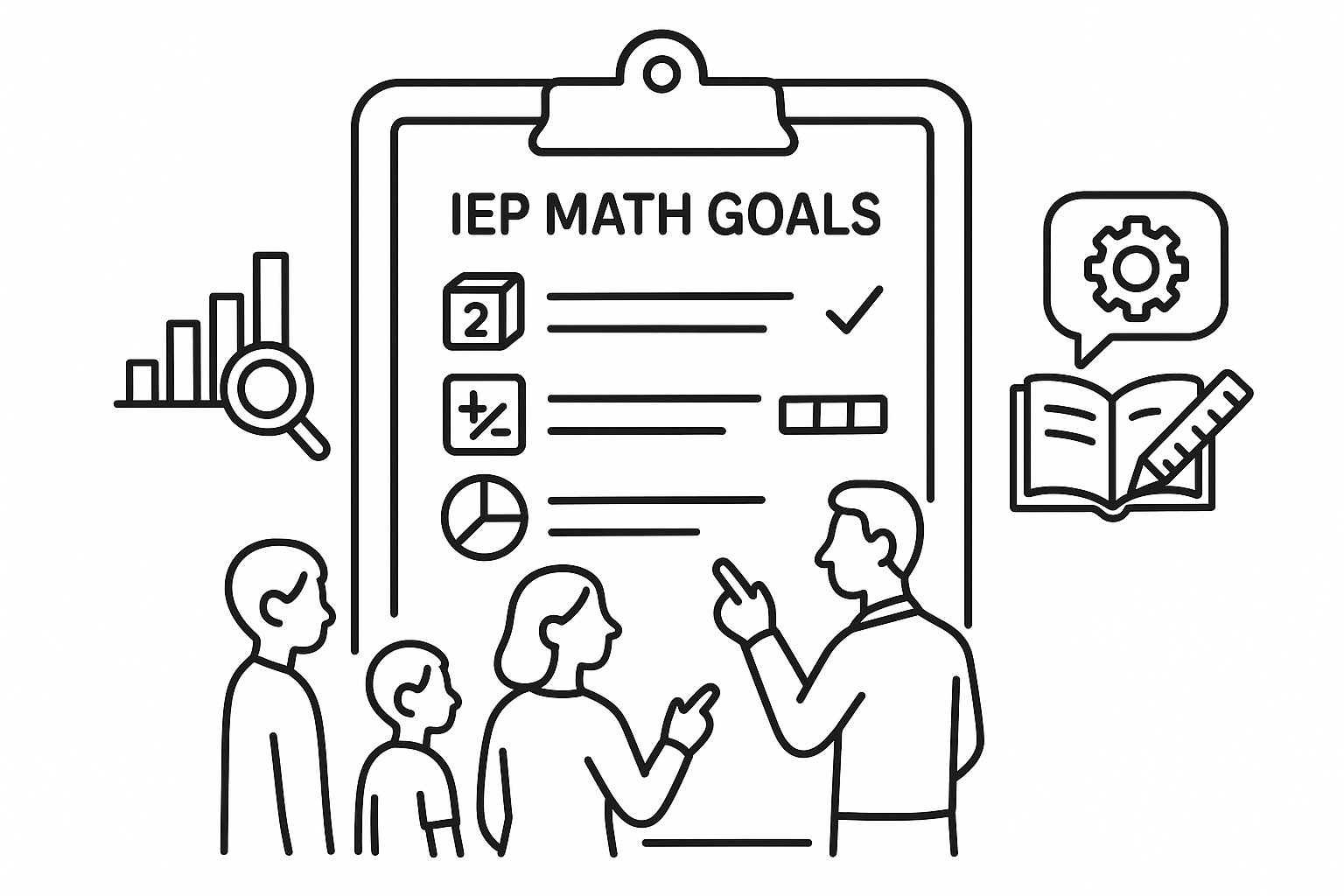
IEP math goals define the specific skills a student with a disability will work on during the IEP period (usually a year). They tie classroom expectations to individualized instruction, describe what mastery looks like, and create a measurable plan we can all agree on. Math goals cover a range of skills: number sense and counting, basic operations (addition, subtraction, multiplication, division), place value and decimals, fractions, problem solving, math reasoning, fluency and automaticity, and sometimes higher-level topics like algebraic thinking or geometry depending on grade level.
Why they matter: a good math goal keeps instruction focused and legally defensible. For parents, goals clarify what their child will learn and how progress will be shown. For educators and service providers, measurable goals inform lesson planning, interventions, and resource allocation. From a compliance perspective, an IEP must include measurable annual goals tied to the student’s needs. Practically, math goals let us answer two questions quickly: “What is the student working toward?” and “How will we know if instruction is working?”.
Well-written goals also guide related services (like specialized math instruction or math-focused speech-language support) and accommodations (extended time, manipulatives, alternate assessments). When goals are specific and measurable, they support collaborative decision-making at IEP meetings and make progress monitoring meaningful rather than speculative.
Components Of A Strong, Measurable Math Goal (SMART For IEPs)
We recommend using a SMART framework tailored to IEPs: Specific, Measurable, Achievable, Relevant, and Time-bound. Translating that into IEP language produces goals that are both educationally useful and legally sound.
Specific: The goal must state the target skill clearly. Instead of “improve math skills,” use “improve single-digit addition fluency.” Include the context (with/without prompts), materials (flash cards, curriculum problems), and any supports allowed.
Measurable: Define the measurement method and criteria. Use percent correct, correct digits per minute, or accuracy over a set of problems. For example: “Given 20 single-digit addition problems, the student will compute sums with 90% accuracy in 4 of 5 trials.” Avoid vague verbs like “understand.”
Achievable: Goals should be ambitious but realistic, based on baseline data and instructional time. We look at current performance, rate of prior progress, and available supports when setting the criterion.
Relevant: Tie the goal to the student’s needs and access to the curriculum. A middle-schooler who struggles with fractions should have goals that support grade-level tasks such as scaling recipes or solving proportion problems.
Time-bound: State the reporting period, commonly one year, and interim checkpoints. Specify how often progress will be reported and by what method (percent mastery, running records, curriculum-based measurement).
Other critical components: a clear baseline (current performance), conditions (with calculator, manipulatives, or verbal prompts), the criterion for mastery, and the assessment method (teacher-made probe, standardized measure, or CBM). Including these avoids ambiguity at reevaluation or when disputes arise.
Common IEP Math Goal Examples By Skill Area
Below are practical, grade-band examples organized by typical skill needs. These are templates: teams should customize wording, baseline, and mastery criteria to the student.
Example Goals: Early Elementary (Grades K–2)
- Number sense and counting: “Given a mixed set of 0–20 number cards, the student will sequence numbers 0–20 independently with 95% accuracy in 4 of 5 trials.” Baseline: sequences to 10 with prompts.
- Basic operations (addition/subtraction): “Given 20 single-digit addition problems presented horizontally, the student will solve with 85% accuracy in 4 of 5 probe sessions without manipulatives.” Baseline: 65% accuracy with manipulatives.
- Counting fluency: “The student will orally count by 1s to 100 with no more than two prompts in 3 of 4 weekly observations.” This supports classroom routines and transitions.
These early goals emphasize concrete materials and observable performance: progress monitoring can use quick probes or teacher checklists.
Example Goals: Upper Elementary And Middle School (Grades 3–8)
- Multiplication and division fluency: “Given 25 mixed single- and double-digit multiplication problems, the student will achieve 90% accuracy in 4 of 5 timed probes (5 minutes) without calculator assistance.” Baseline: 70% accuracy with calculator.
- Fractions and decimals: “When presented with real-world word problems involving fractions and decimals, the student will set up and solve the equation correctly and explain steps in writing in 4 of 5 problems.” This includes scaffolds like fraction strips during instruction but not during the probe.
- Problem solving and multi-step tasks: “The student will independently solve multi-step word problems requiring at least two operations and justify the steps in writing with 80% accuracy across 4 of 5 assessments.” Baseline: requires teacher prompts for sequencing steps.
Upper elementary and middle-school goals should prepare students for grade-level demands, incorporate reasoning and explanation, and specify whether calculators or formula sheets are permitted during assessment. For students on alternate assessments, goals focus on functional math skills relevant to daily living and community participation.
Progress Monitoring, Accommodations, And Instructional Supports
A goal without monitoring is just wishful thinking. We should determine progress-monitoring frequency (weekly, biweekly, or monthly) based on the skill and intensity of services. Curriculum-based measurement (CBM) probes, timed fluency checks, and performance tasks are common, and teams should agree on the exact probe so data are comparable over time.
Accommodations: These remove barriers without changing the learning target. Examples: extended time, untimed testing sessions, use of manipulatives, visual supports, or alternate input methods. Include when and how accommodations apply, during instruction only, during assessments, or both.
Instructional supports: These are targeted teaching strategies and services: small-group instruction, special education pull-out, math intervention programs (e.g., concrete–representational–abstract sequence), co-teaching, or assistive technology (calculator, speech-to-text). Specify service minutes, provider (special ed teacher, math specialist), and setting (resource room, general education class).
Data-driven decisions: Use progress data to adjust instruction, if a student isn’t making expected gains over two to three data points, reconvene the team to revise interventions, increase intensity, or modify the goal. Good documentation of trials and outcomes helps parents and districts when discussing changes in placement or services.
Finally, make reporting to parents routine and concrete: attach sample probes to the IEP, include graphs in progress reports, and explain what each data point means for instruction.
Conclusion
IEP math goals turn broad concerns into clear, measurable plans we can carry out and evaluate. By using SMART language, grounding goals in baseline data, and committing to consistent progress monitoring and appropriate supports, teams give students the best chance to access grade-level math. If you’re reviewing an IEP, ask for baseline data, the measurement method, and how accommodations will be used: those questions protect both progress and legal clarity. At Chelle Law we help families and professionals understand rights and documentation, if you need assistance interpreting IEP language in the context of legal or administrative processes, reach out for guidance.
Frequently Asked Questions About IEP Math Goals
What are IEP math goals and why are they important?
IEP math goals specify the skills a student with disabilities will work on during the IEP period, creating measurable objectives aligned to classroom expectations. They focus instruction, clarify progress for parents, support educators, and ensure legal compliance.
What components make a strong, measurable IEP math goal?
A strong IEP math goal is SMART: Specific about the skill, Measurable with clear criteria, Achievable based on baseline data, Relevant to the student’s needs, and Time-bound with a set reporting period and progress checkpoints.
How do IEP math goals support different grade levels?
IEP math goals are customized by grade; for early elementary, they target number sense and basic operations, while upper elementary and middle school goals include fluency, fractions, problem solving, and reasoning to match curriculum demands.
What role do progress monitoring and accommodations play in IEP math goals?
Progress monitoring uses consistent assessments to track student growth over time, while accommodations remove learning barriers without changing goals—examples include extended time or manipulatives—to support instruction and testing.
How can parents ensure IEP math goals are effective?
Parents should review goals for clear baseline data, measurable criteria, and specified accommodations. They can ask how progress will be tracked and understand the supports provided, ensuring the plan drives real growth and legal clarity.
Can IEP math goals include higher-level topics like algebra and geometry?
Yes, depending on the student’s grade level and needs, IEP math goals can address higher-level concepts such as algebraic thinking and geometry to prepare for grade-level math tasks and standards.