
Last Updated on April 24, 2026 by Jennifer Hanson
Reading fluency is often the difference between a child who decodes words and a child who truly comprehends text. When a student has an Individualized Education Program (IEP), fluency goals give the team concrete targets to improve speed, accuracy, and prosody so comprehension can follow. In this guide we explain what reading fluency means in an IEP context, how teams assess it, and how to write measurable, meaningful goals that drive progress. Our aim is practical: to help educators and parents collaborate on goals that are fair, trackable, and tied to real classroom performance.
In this guide, What Are IEP Reading Fluency Goals A Practical Guide For Educators And Parents 2026 is explained with clear steps and tips.
Key Takeaways — What Are IEP Reading Fluency Goals A Practical Guide For Educators And Parents 2026
- IEP reading fluency goals focus on improving speed, accuracy, and prosody to enable effective text comprehension for students with disabilities.
- Assessment for these goals combines standardized tests and curriculum-based measures to track progress in words correct per minute, accuracy, and expressive reading.
- Effective goals are individualized, measurable, linked to classroom tasks, and include specific baselines, targets, conditions, measurement methods, and timelines.
- Fluency goals should target functional outcomes like timely completion of assignments and participation in oral activities to support real-world reading independence.
- Regular data collection and frequent communication between educators and parents help adjust instruction and ensure progress toward fluency goals.
- Writing SMART IEP reading fluency goals with clear benchmarks bridges decoding skills and comprehension for student success.
What Reading Fluency Means In An IEP Context
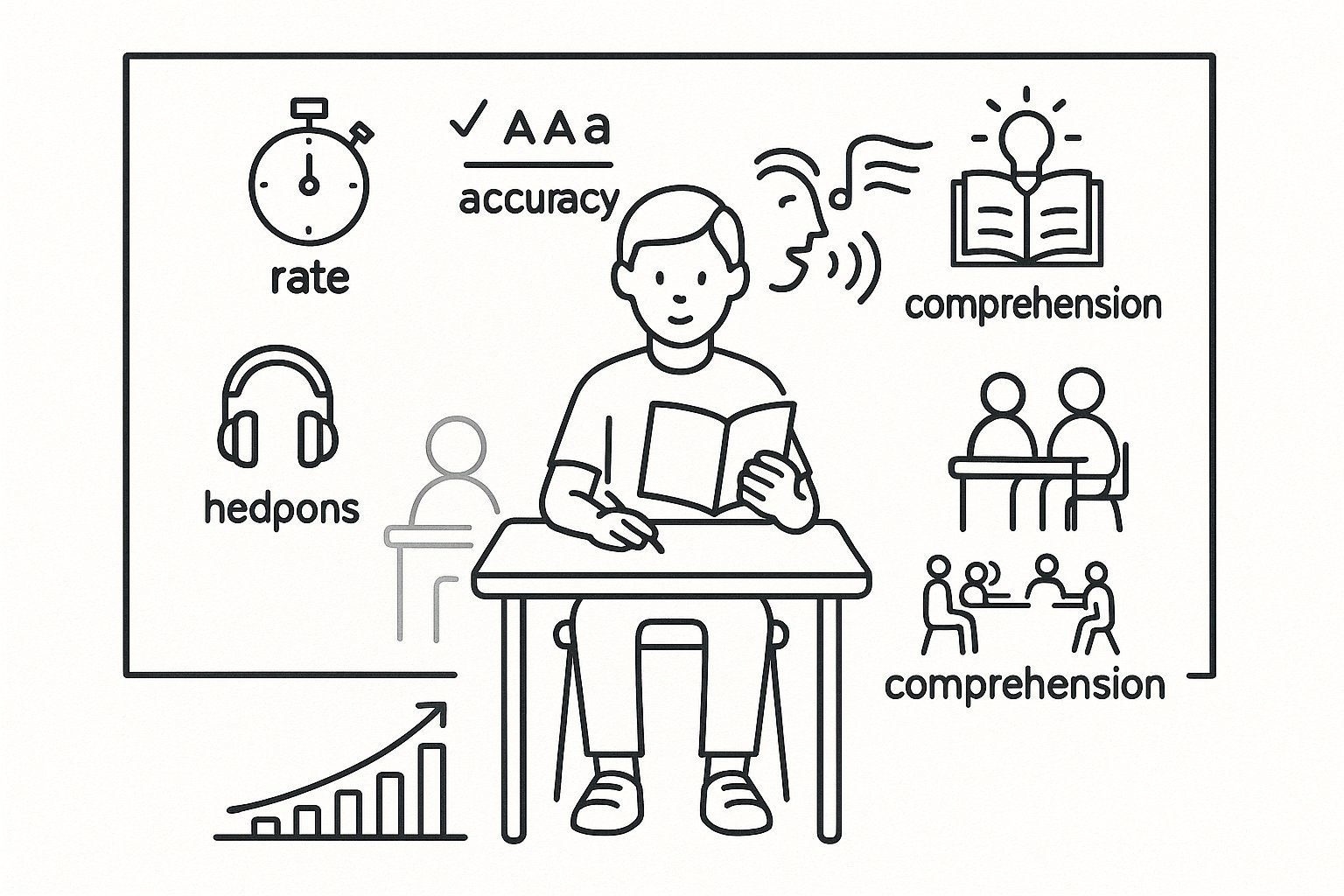
Reading fluency in an IEP context is more than reading faster. We define fluency as the combined ability to read text with appropriate speed (rate), correctness (accuracy), and expression (prosody), so that comprehension becomes possible and reliable. For students with disabilities, fluency deficits may stem from decoding skill gaps, language processing issues, attention differences, or oral-motor challenges. That means a fluency goal must address the root cause, not just the symptom.
In practice, fluency goals tie directly to functional outcomes: finishing grade-level assignments in a reasonable time, participating in class discussions, or independently reading instructions during clinical rotations or workplace training (important for older students heading into healthcare careers). When teams write IEP fluency goals, we consider the student’s baseline performance, the curriculum demands, and the supports that will be provided (e.g., repeated reading, audiobooks, or small-group instruction).
IEP teams also need to balance ambition with realism. A goal that triples a student’s words-per-minute overnight isn’t helpful. Instead we aim for incremental improvements that produce visible gains in comprehension and classroom independence. That approach keeps parents and educators aligned and helps measure whether interventions are working.
How Reading Fluency Is Assessed For IEP Goals
Assessment for IEP fluency goals starts with reliable baseline measures and continues with regular probes that reflect classroom tasks. We typically combine standardized assessments with curriculum-based measures (CBMs) so we capture both normative standing and functional performance.
Standardized tests (like oral reading fluency subtests of broad reading batteries) show how a student compares to peers and can suggest eligibility and severity. But CBMs, brief, repeated timed readings of grade-appropriate passages, are often the backbone of goal setting because they’re sensitive to small changes and easy to administer weekly or biweekly.
When assessing fluency, we disentangle rate, accuracy, and prosody. Rate is commonly reported in words correct per minute (WCPM). Accuracy is percent of words read correctly. Prosody is more subjective but can be measured with rubrics that rate expression, phrasing, and intonation. Importantly, comprehension checks should accompany fluency probes, because fast, inaccurate reading isn’t functional. We advocate for at least two types of measures: one standardized for eligibility and progress summary, and one curriculum-based for frequent monitoring.
Writing Effective IEP Reading Fluency Goals
A well-crafted fluency goal has four visible traits: it’s individualized, measurable, tied to classroom tasks, and accompanied by supports and data collection plans. We recommend drafting goals that specify the baseline, target behavior, conditions, measurement method, and timeline.
Here are key elements to include:
- Baseline: The student currently reads X WCPM with Y% accuracy on grade-level passage Z.
- Target: Student will read X+N WCPM with at least Y+M% accuracy and a prosody rubric score of Z within a specified timeframe (typically one year or marking period).
- Condition: Given 1:1 instruction, small-group intervention, or assistive technology as described.
- Measurement: Weekly CBM probes averaged across three passages: monthly data review at IEP meetings.
We try to link the goal to functional classroom expectations, for instance, reading independently to complete timed tests or oral reading during group discussions. That keeps the goal relevant to teachers, parents, and future employers or educators the student will encounter.
Conclusion
Effective IEP reading fluency goals are measurable bridges between decoding and comprehension. By grounding goals in clear baselines, using frequent CBM probes, and writing SMART objectives tied to classroom tasks, teams give students the best chance to become independent readers. We encourage educators and parents to keep communication frequent, focus on functional outcomes, and be ready to adjust instruction based on data. If your team needs help translating classroom performance into legally sound IEP language, firms with education and employment expertise can offer targeted support to ensure goals are both instructional and defensible.
Frequently Asked Questions About IEP Reading Fluency Goals
What are IEP reading fluency goals?
IEP reading fluency goals are specific objectives designed to improve a student’s reading speed, accuracy, and expression to support better comprehension and classroom performance.
How is reading fluency assessed for IEP goals?
Reading fluency for IEP goals is assessed using standardized tests and curriculum-based measures, focusing on words correct per minute, accuracy, and prosody, along with comprehension checks to ensure functional reading.
Why are reading fluency goals important in an IEP?
Fluency goals help bridge decoding skills with comprehension, allowing students to complete grade-level tasks independently and participate effectively in classroom activities.
How do educators write measurable IEP reading fluency goals?
Effective goals specify a baseline reading rate, target improvements in words per minute and accuracy, include conditions like instruction type, and detail measurement methods with a timeline for progress.
Can reading fluency goals help older students in workplace training?
Yes, fluency goals assist older students in reading instructions accurately in clinical rotations or job training, fostering independence in healthcare careers or other work settings.