
Last Updated on April 22, 2026 by Jennifer Hanson
As healthcare professionals we increasingly see adults who need workplace supports tied to disabilities, chronic conditions, or episodic impairments. A “504 plan” is a familiar term in K–12 education, but its workplace equivalents and protections under Section 504 of the Rehabilitation Act matter for clinicians, administrators, and employees in healthcare settings. In this guide we explain what a 504 plan actually means for adults at work in 2026, who qualifies, how it differs from ADA and FMLA protections, how to request accommodations, and practical employer responsibilities, all with an eye toward real-world healthcare workplaces.
In this guide, What Is A 504 Plan For Adults At Work A Practical Guide For Healthcare Professionals In 2026 is explained with clear steps and tips.
Key Takeaways — What Is A 504 Plan For Adults At Work A Practical Guide For Healthcare Professionals In 2026
- A 504 plan in the workplace refers to accommodations provided under Section 504 of the Rehabilitation Act, protecting qualified employees with disabilities at federally funded employers.
- Section 504 applies specifically to federally funded workplaces, differing from ADA and FMLA which have broader or different scopes and protections.
- Employees should request 504 accommodations by providing clear requests with medical documentation, engaging in an interactive process with their employer.
- Common accommodations include modified schedules, duty adjustments, assistive technology, and ergonomic setups tailored to healthcare or office roles.
- Employers must avoid discrimination, engage in good-faith interactive processes, and provide reasonable accommodations unless they cause undue burden or compromise safety.
- Noncompliance risks include legal actions, loss of federal funding, and licensure issues, making early legal consultation and thorough documentation essential.
What A 504 Plan Actually Is And When It Applies To Adults In The Workplace
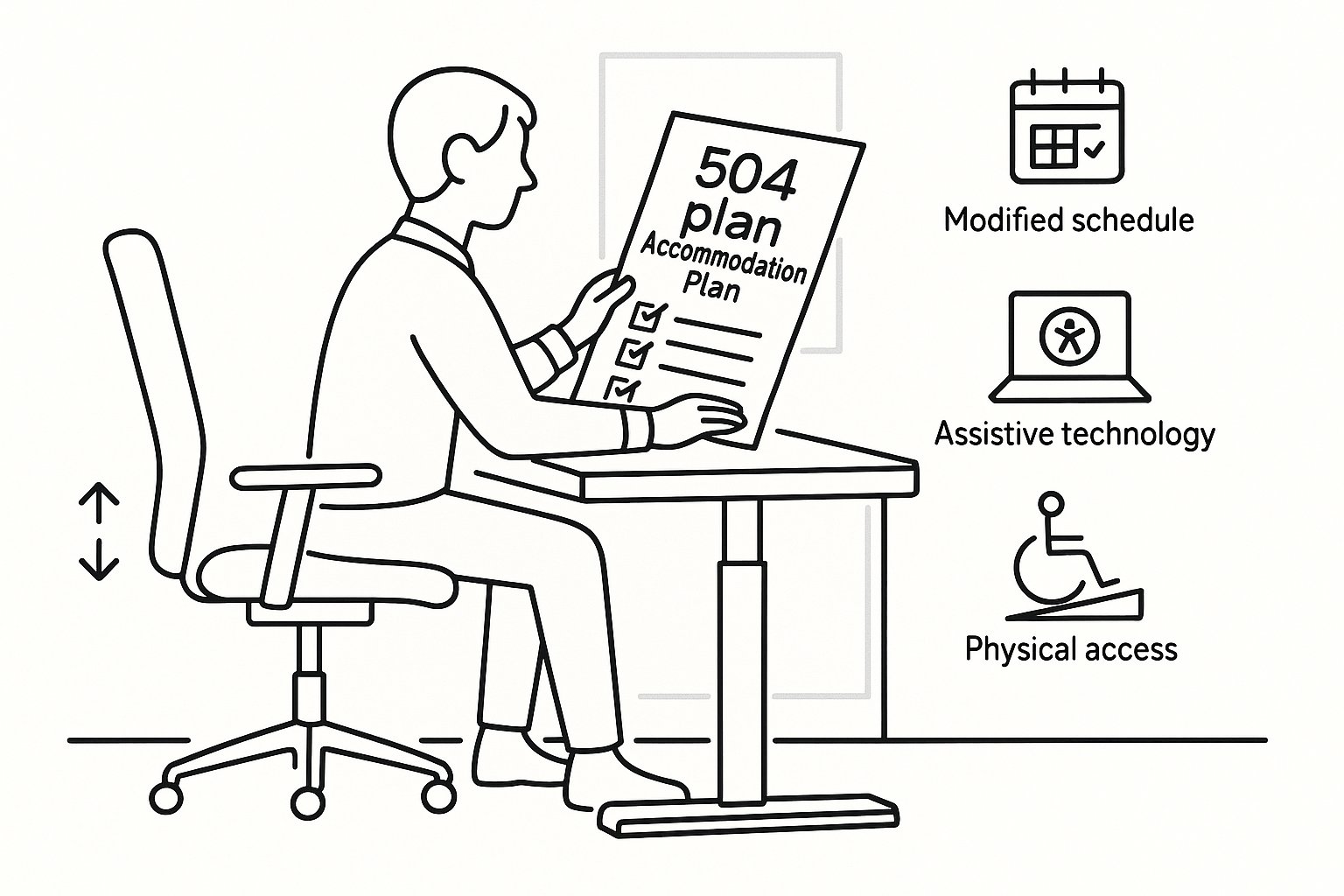
Section 504 of the Rehabilitation Act of 1973 prohibits disability-based discrimination in programs receiving federal financial assistance. Commonly called a “504 plan” in schools, the term refers broadly to plans or accommodations that remove barriers to equal access. For adults at work, the underlying legal protection is the same: employers that receive federal funds, including many hospitals and clinics, must not exclude, deny benefits to, or otherwise discriminate against qualified individuals with disabilities.
In practice, a 504-style workplace accommodation is a written arrangement that describes workplace adjustments an employer will provide so an employee can perform essential job functions. Examples include modified schedules, adjusted duties, assistive technology, or physical changes to the workspace. Although not every employer labels documents “504 plans,” the obligation to provide reasonable modifications when the employer is a recipient of federal funds remains.
Importantly, Section 504 applies only where the employer gets federal money. Many private-sector healthcare employers are covered through Medicare/Medicaid participation, federal grants, or federal contracts, so it’s common in our field. If an employer isn’t a federal funding recipient, other laws (like the Americans with Disabilities Act) will generally govern accommodations instead.
Who Qualifies For Protections Under Section 504 Versus Other Laws
Qualification under Section 504 requires three elements: (1) the individual has a disability (a physical or mental impairment that substantially limits one or more major life activities): (2) the individual is otherwise qualified for the position: and (3) the program or activity receives federal financial assistance.
The ADA uses similar disability definitions but applies more broadly to private employers with 15 or more employees, regardless of federal funding. The key difference is the funding nexus: Section 504 protects employees at federally-funded entities regardless of size, while the ADA sets employer-size thresholds but covers entities without federal funding.
Other statutes intersect, too. The Family and Medical Leave Act (FMLA) provides job-protected unpaid leave for qualifying health conditions and family events. FMLA is about leave: Section 504 and ADA are about removal of barriers and reasonable accommodations. Veterans and certain state laws may provide additional protections. We should evaluate each claimant across statutes, a healthcare worker may qualify for both FMLA leave and Section 504/ADA accommodations simultaneously.
In short: if we work in a federally funded hospital or clinic, Section 504 will likely apply: if we’re in a private practice or nonprofit without federal funds, ADA protections are usually the route.
How A 504 Plan Differs From The ADA And FMLA (And Why That Matters)
Understanding differences between Section 504, ADA, and FMLA changes how we advise clients or design workplace policies.
Scope and Coverage
- Section 504: Applies to federally funded programs and institutions, regardless of employer size. It covers discrimination and requires reasonable modifications unless they cause undue burden or fundamentally alter the program.
- ADA: Applies to private employers with 15+ employees and to state/local governments. It requires reasonable accommodations for qualified individuals and contains detailed accessibility standards.
- FMLA: Applies to employers with 50+ employees (typically) and provides up to 12 weeks of unpaid, job-protected leave for serious health conditions and certain family events.
Nature of Relief
- 504/ADA: Focus on accommodation and nondiscrimination (modifying duties, workplace changes, assistive tech, etc.). Employers must engage in an interactive process to identify reasonable accommodations.
- FMLA: Provides leave: it doesn’t require permanent workplace modifications beyond reinstatement and maintenance of benefits during leave.
Evidence and Process
- ADA and 504 both allow employers to request medical documentation to establish disability and need for accommodation, but the documentation standards differ in practice and context. FMLA has specific certification forms and timing rules.
Why it matters: In healthcare settings we often juggle patient safety, licensing, and staffing. For example, a nurse’s request for reduced night shifts may be an ADA/504 accommodation, while leave for surgery falls under FMLA. Treating these as separate but overlapping frameworks prevents missteps and legal exposure.
How To Request A 504 Accommodation At Work: Documentation And Process
Requesting an accommodation under Section 504 mirrors best practices under the ADA. We recommend the following practical steps.
- Initiate the Request
- The employee or representative should make a clear request to HR or the designated disability coordinator. Oral requests are valid, but a written request creates a record.
- Provide Medical Documentation
- Employers can request reasonable documentation to establish disability and functional limitations. For efficiency, clinicians should supply a succinct statement of diagnosis, how it substantially limits major life activities, and recommended work-related accommodations. We advise avoiding unnecessary clinical detail: focus on work impact.
- Engage in the Interactive Process
- Employers must promptly engage in a timely, good-faith interactive process. That means discussing limitations, considering alternatives, and documenting offers and refusals. We suggest documented meetings and proposals in writing.
- Carry out and Monitor
- Once an accommodation is identified, carry out it and monitor effectiveness. If it’s ineffective, reconvene and consider alternatives.
- Appeal and Enforcement
- If an employer denies a request, employees at federally funded entities can file an internal grievance, contact the federal funding agency, or pursue administrative complaints with the U.S. Department of Education’s Office for Civil Rights (for education programs) or other relevant federal agencies. Civil litigation remains an option. We encourage early legal consultation when disputes are complex or when licensing and patient safety concerns intersect.
Timelines: There’s no fixed statutory timeline for every step, but delays can create liability. Promptness and documentation are our best defenses.
Common Reasonable Accommodations For Adults In Healthcare And Office Settings
Reasonable accommodations should be tailored to the job and the individual. Here are practical examples we see commonly in healthcare and administrative roles.
Clinical/Patient-Facing Roles
- Modified schedules: fixed shifts instead of rotating nights, reduced hours during flare-ups.
- Reassignment of nonessential duties: moving physically demanding tasks to other staff when safe.
- Assistive devices: patient-lifting equipment, ergonomic footwear allowances, or adaptive instruments.
- Duty modifications: limiting exposure to certain chemicals or infectious patients when medically required.
Office and Administrative Roles
- Flexible telework or hybrid schedules for documentation-heavy roles.
- Ergonomic workstations: standing desks, specialized keyboards, or screen-reading software.
- Leave as an accommodation: intermittent or periodic leave to manage episodic conditions.
Cross-cutting Accommodations
- Job restructuring: reallocating marginal job duties that an employee can’t perform due to disability.
- Communication supports: captioning for meetings, amplified devices, or written instructions for auditory limitations.
We emphasize safety and patient care: accommodations shouldn’t jeopardize patient safety or violate licensing standards. Where safety or licensure is implicated, narrow, evidence-based restrictions and alternative roles can often reconcile competing interests.
Employer Responsibilities, The Interactive Process, And Legal Risks For Noncompliance
Employers receiving federal funds have a duty to provide equal access and reasonable accommodations unless doing so would impose an undue burden or fundamentally alter operations. In our practice we stress three employer responsibilities.
- Duty to Avoid Discrimination
- Employers must avoid exclusionary policies and ensure that job standards are job-related and consistent with business necessity. Blanket exclusions of people with particular diagnoses can be unlawful.
- Duty to Engage in the Interactive Process
- The interactive process is not optional. Employers should document requests, medical inquiries, meetings, proposed accommodations, and rationales for denials. Good-faith exploration of alternatives can prevent claims.
- Duty to Provide Reasonable Accommodations
- Reasonableness is context-specific. Cost, resources, patient safety, and overall operational impact factor into whether an accommodation is required. For federally funded healthcare entities, cost-sharing or grant resources may shift feasibility assessments.
Legal Risks for Noncompliance
- Failure to accommodate can trigger administrative investigations, loss of federal funding in extreme cases, and private litigation under Section 504 or ADA. In healthcare, noncompliance can also lead to licensure complaints or malpractice-adjacent issues if staffing decisions compromise care.
Practical tips: involve HR early, consult legal counsel for difficult medical-licensure conflicts, and train supervisors to recognize accommodation requests and avoid retaliatory conduct. At Chelle Law we routinely advise hospitals and clinicians on creating defensible accommodation policies that meet regulatory obligations while preserving patient safety.
Conclusion
Section 504 protections and 504-style plans matter in modern healthcare workplaces because many providers receive federal funds and because accommodations improve retention, safety, and equity. We encourage healthcare employers to build clear processes, document interactive conversations, and prioritize individualized, evidence-based accommodations. For employees, timely, specific medical documentation and good-faith participation in the interactive process usually produces workable solutions. When conflicts arise, early legal counsel, especially from attorneys familiar with healthcare employment law, can preserve careers and patient safety.
Frequently Asked Questions About 504 Plans for Adults at Work
What is a 504 plan for adults at work?
A 504 plan for adults at work refers to workplace accommodations under Section 504 of the Rehabilitation Act. It ensures employees with disabilities at federally funded employers receive reasonable modifications to perform their job without discrimination.
Who qualifies for protections under a 504 plan at work?
To qualify for a 504 plan, an employee must have a disability that substantially limits major life activities, be qualified for their position, and work for an employer receiving federal financial assistance.
How does a 504 plan differ from the ADA and FMLA in the workplace?
Section 504 applies to federally funded employers regardless of size, requiring reasonable accommodations. The ADA covers private employers with 15+ employees, also mandating accommodations. FMLA provides unpaid leave for health-related reasons but does not require workplace modifications.
How can an employee request a 504 accommodation at work?
Employees should make a clear request to HR or a disability coordinator, provide relevant medical documentation, engage in an interactive process to discuss accommodations, and then monitor effectiveness after implementation.
What are common workplace accommodations under a 504 plan in healthcare settings?
Common accommodations include modified schedules, reassignment of duties, assistive devices, ergonomic workstations, flexible telework, and communication supports, all tailored to safety and job requirements.
Why is it important for federally funded healthcare employers to comply with Section 504?
Compliance prevents disability discrimination, supports employee retention and safety, avoids legal risks like loss of federal funding or litigation, and ensures equitable access to employment opportunities.