
Last Updated on October 16, 2026 by Jennifer Hanson
Navigating special education law can feel overwhelming. We’re often asked, “What are IEP laws and regulations?” and why they matter for a child’s education. This guide cuts through the jargon and gives parents and educators a clear map: who qualifies for an IEP, the federal laws that shape services, what happens at IEP meetings, and practical steps for enforcement and dispute resolution. We’ll focus on the legal basics you need in 2026 so you can advocate effectively and partner with schools to secure appropriate services.
In this guide, IEP Laws And Regulations The Practical Guide For Parents And Educators In 2026 is explained with clear steps and tips.
Key Takeaways — IEP Laws And Regulations The Practical Guide For Parents And Educators In 2026
- IEP laws, primarily governed by IDEA, ensure eligible students with disabilities receive a Free Appropriate Public Education (FAPE) tailored to their unique needs.
- Eligibility for an IEP requires a recognized disability under IDEA and a need for special education services to make educational progress, confirmed through a thorough evaluation process.
- Section 504 and the ADA provide broader protections against discrimination and accommodations but differ from IDEA by focusing more on access than specialized instruction.
- IEP meetings are critical for setting individualized goals, services, and placements, involving parents, educators, and specialists to collaboratively plan the student’s education.
- When disputes arise regarding IEP eligibility or services, options include informal resolution, mediation, state complaints, OCR complaints, or due process hearings under IDEA, with legal counsel recommended for complex cases.
- Effective advocacy includes understanding IEP laws, keeping detailed records, requesting evaluations, and ensuring prompt action to secure appropriate educational support.
Who Is Eligible For An IEP And How Eligibility Is Determined
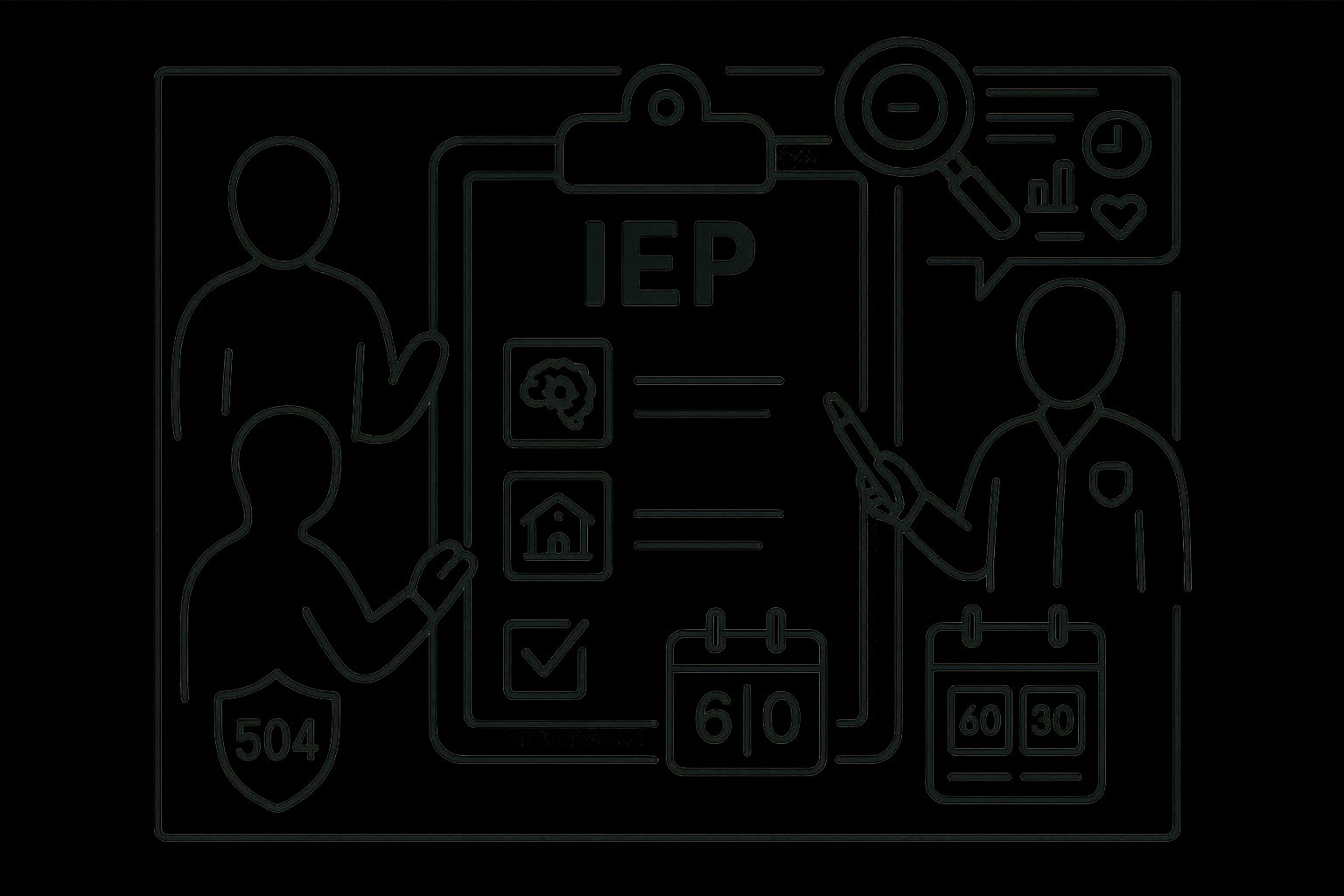
IDEA defines eligibility for an Individualized Education Program (IEP). To qualify, a student must (1) have one or more recognized disability categories under IDEA, such as specific learning disability, autism, intellectual disability, emotional disturbance, or other health impairment, and (2) as a result of that disability, need special education and related services to make progress in school. Eligibility is not automatic, it’s a two-part test: diagnosis plus educational impact.
How the process starts: typically a parent, teacher, or other team member refers a student for evaluation. The school must obtain informed parental consent before conducting a full evaluation. Evaluations are multidisciplinary: they examine academic achievement, cognitive functioning, behavior, communication, and any related health concerns. We should note that states set some timelines for completing evaluations (many use a 60‑day window), but federally the IEP itself must be in place within 30 days of an eligibility determination.
Some students who don’t meet IDEA categories may still be protected under Section 504 if their disability substantially limits a major life activity. That means a child who needs accommodations but not specialized instruction still can get support. Because eligibility rules differ across IDEA and 504, families should ask for written explanations whenever a school decides a child is not eligible.
Federal Laws That Govern IEPs
Three federal statutes form the backbone of special education protections. Together they create a layered system: IDEA focuses on special education and individualized services: Section 504 addresses discrimination and accommodations in programs that receive federal funds: and the ADA extends disability protections more broadly. Understanding how they interrelate helps us choose the right path when advocating for services or filing complaints.
Individuals With Disabilities Education Act (IDEA): Core Requirements
IDEA is the primary law that creates the right to an IEP and to a free appropriate public education (FAPE). Its core principles include:
- Free Appropriate Public Education (FAPE): Schools must provide meaningful educational benefit tailored to the child’s unique needs.
- Least Restrictive Environment (LRE): To the maximum extent appropriate, students are educated with peers without disabilities.
- Individualized planning: The IEP must set measurable goals and list services, accommodations, and progress measurement.
- Procedural safeguards: Parents have rights to notice, access to records, consent requirements, and dispute-resolution mechanisms.
Practically, IDEA sets requirements for evaluation, IEP content, transition planning (by age 16 or younger in some states), and progress reporting. Schools must document decisions and provide parents with clear written notices whenever they propose or refuse services.
Section 504 Versus IDEA: Similarities, Differences, And When Each Applies
Section 504 of the Rehabilitation Act protects students with disabilities from discrimination in any program receiving federal funds. Unlike IDEA, Section 504 does not require an IEP: instead, schools typically create a 504 plan that spells out accommodations such as extra time on tests or preferential seating.
Key differences:
- Eligibility: IDEA uses specific categories and the educational-impact standard. Section 504 uses a broader “substantial limitation” standard tied to major life activities.
- Services: IDEA funds and requires specialized instruction: Section 504 provides accommodations to ensure access but not necessarily specialized instruction.
- Procedural protections: IDEA has detailed procedural safeguards and dispute-resolution pathways. Section 504 has fewer procedural requirements, but enforcement can occur through OCR complaints or litigation.
When to use which: If a child needs specially designed instruction, IDEA is the appropriate vehicle. If the student needs accommodations to access general education but not specialized instruction, Section 504 may be sufficient. We recommend documenting needs clearly and requesting evaluations under both laws if eligibility is unsure.
Americans With Disabilities Act (ADA): Schools’ Broader Obligations
The ADA complements IDEA and Section 504 by prohibiting disability discrimination in public services, including public schools. Title II of the ADA covers state and local education agencies and requires reasonable modifications to policies and practices to avoid discrimination.
In practice, the ADA matters when: a school’s policies exclude a student or when structural barriers prevent access to programs. Unlike IDEA’s individualized educational entitlements, ADA enforcement is often about eliminating discriminatory barriers and ensuring equal opportunity. Remedies under ADA can include policy changes, accessibility upgrades, and sometimes compensatory relief, but courts generally treat IDEA as the exclusive remedy when the claim challenges the provision of educational services, so legal strategy often involves both statutes.
The IEP Meeting: Rights, Timeline, Team Members, And Essential IEP Content
IEP meetings are the heart of special education decision-making. We should come prepared, and schools must follow specific procedural rules.
Who attends: The team typically includes the parent or guardian, at least one regular education teacher (if the child is or may be in regular class), a special education teacher, a school district representative with authority to commit resources, someone who can interpret evaluation results (often a psychologist), and when appropriate, the student and related service providers (speech, occupational therapy). Parents can bring advocates, attorneys, or interpreters.
Timing and notices: After an eligibility determination, the school must develop the IEP within 30 days. Schools must provide prior written notice and obtain consent for initial placement and evaluations. Annual reviews are required and the IEP must be updated when progress or needs change. Parents may also request meetings at any time.
Essential content: A compliant IEP includes present levels of performance, measurable annual goals, how progress will be measured, specific services and frequency, accommodations/modifications, transition planning (as applicable), and placement descriptions tied to LRE. We advise keeping detailed notes during meetings, requesting draft copies, and asking for written explanations for any proposed changes.
Enforcement, Dispute Resolution, And When To Seek Legal Help
When we disagree with a school about eligibility, services, or implementation, several dispute-resolution options exist.
Starting points: Informal resolution, meet with teachers or administrators and request corrective action in writing. Many disputes resolve at this level if we document concerns and propose clear solutions.
Formal options:
- Mediation: Voluntary and confidential, mediation uses a neutral mediator to reach an agreement. It’s often faster and less adversarial than litigation.
- State complaint to the State Education Agency (SEA): We can allege procedural or substantive violations: SEAs investigate and issue findings and corrective actions.
- Office for Civil Rights (OCR) complaint: For 504/ADA discrimination claims, OCR handles pattern or individual complaints about civil rights violations.
- Due process hearing: Under IDEA, parents can request an impartial due process hearing to resolve disputes about identification, evaluation, placement, or FAPE. Due process can lead to binding decisions and remedies like compensatory services.
When to involve an attorney: We recommend seeking legal counsel when the dispute is complex, when compensatory education or reimbursement is at stake, or when the school’s actions pose significant risk to the child’s access to education. A lawyer who understands both education law and procedural advocacy can help craft requests, represent parents at hearings, and negotiate settlements. Firms like ours can advise on strategy while keeping the child’s educational needs central.
Practical tips: keep records of communications, obtain and review all evaluation reports, set specific measurable requests (e.g., hours of therapy), and use timelines to press for prompt action. Early, documented advocacy often prevents escalation to formal proceedings.
Frequently Asked Questions About IEP Laws and Regulations
What are IEP laws and why are they important?
IEP laws, primarily governed by IDEA, ensure students with disabilities receive a Free Appropriate Public Education tailored to their needs. They provide legal protections, individualized planning, and procedural safeguards to support effective special education services.
Who is eligible for an Individualized Education Program (IEP)?
To qualify for an IEP, a student must have one or more disabilities recognized under IDEA and require special education and related services due to the impact of the disability on learning. Eligibility involves both diagnosis and educational need.
How do Section 504 and IDEA differ in supporting students with disabilities?
IDEA provides specialized instruction and an IEP for students needing tailored educational services, while Section 504 offers accommodations through a 504 plan to ensure access without necessarily requiring specialized instruction. Eligibility criteria and procedural protections also differ.
What happens during an IEP meeting and who must attend?
IEP meetings involve parents, regular and special education teachers, a district representative, evaluators, and sometimes the student or service providers. The team sets measurable goals, services, accommodations, and placement within 30 days of eligibility determination, following strict procedural rules.
What options exist if parents disagree with the school’s IEP decisions?
Parents can pursue informal resolution, mediation, file complaints with the State Education Agency or Office for Civil Rights, or request an IDEA due process hearing. Legal counsel is advisable for complex cases or when educational access is at significant risk.
How does the Americans with Disabilities Act (ADA) relate to IEP laws?
The ADA prohibits disability discrimination in public schools and complements IDEA and Section 504 by requiring reasonable modifications to policies and practices. ADA focuses on eliminating barriers and ensuring equal opportunity, beyond individualized educational services.