
Last Updated on April 20, 2026 by Jennifer Hanson
Food allergies are among the most common chronic conditions affecting school-aged children, and they carry real risk when not managed correctly. A 504 plan is a powerful, federally protected tool that helps ensure students with food allergies get the accommodations they need to stay safe and access school programs alongside their peers. In this guide we’ll explain what a 504 plan for food allergies is, how it differs from an IEP, who’s eligible, how to request an evaluation, and the practical accommodations and emergency planning schools should carry out in 2026 and beyond. Our goal is to give parents and school staff clear, actionable information so they can collaborate effectively.
In this guide, What Is A 504 Plan For Food Allergies A Practical Guide For Parents And Schools In 2026 is explained with clear steps and tips.
Key Takeaways — What Is A 504 Plan For Food Allergies A Practical Guide For Parents And Schools In 2026
- A 504 plan for food allergies is a federal accommodation plan that ensures students with food allergies receive necessary protections to safely access school activities.
- Unlike an IEP, a 504 plan focuses on removing discrimination barriers rather than specialized instruction, making it ideal for students whose food allergies affect major life activities.
- Schools implement environmental controls, medication access, participation rights, communication protocols, and emergency response plans as part of a 504 plan to manage food allergy risks.
- Parents can request a 504 evaluation in writing with medical documentation, and schools must respond timely to determine eligibility and accommodations.
- A 504 plan provides legal accountability to enforce accommodations, with options for complaints or appeals if schools fail to comply.
- Collaborating with school staff and legal experts helps families secure and maintain effective 504 plans that protect the health and inclusion of students with food allergies.
What Is A 504 Plan And How It Differs From An IEP
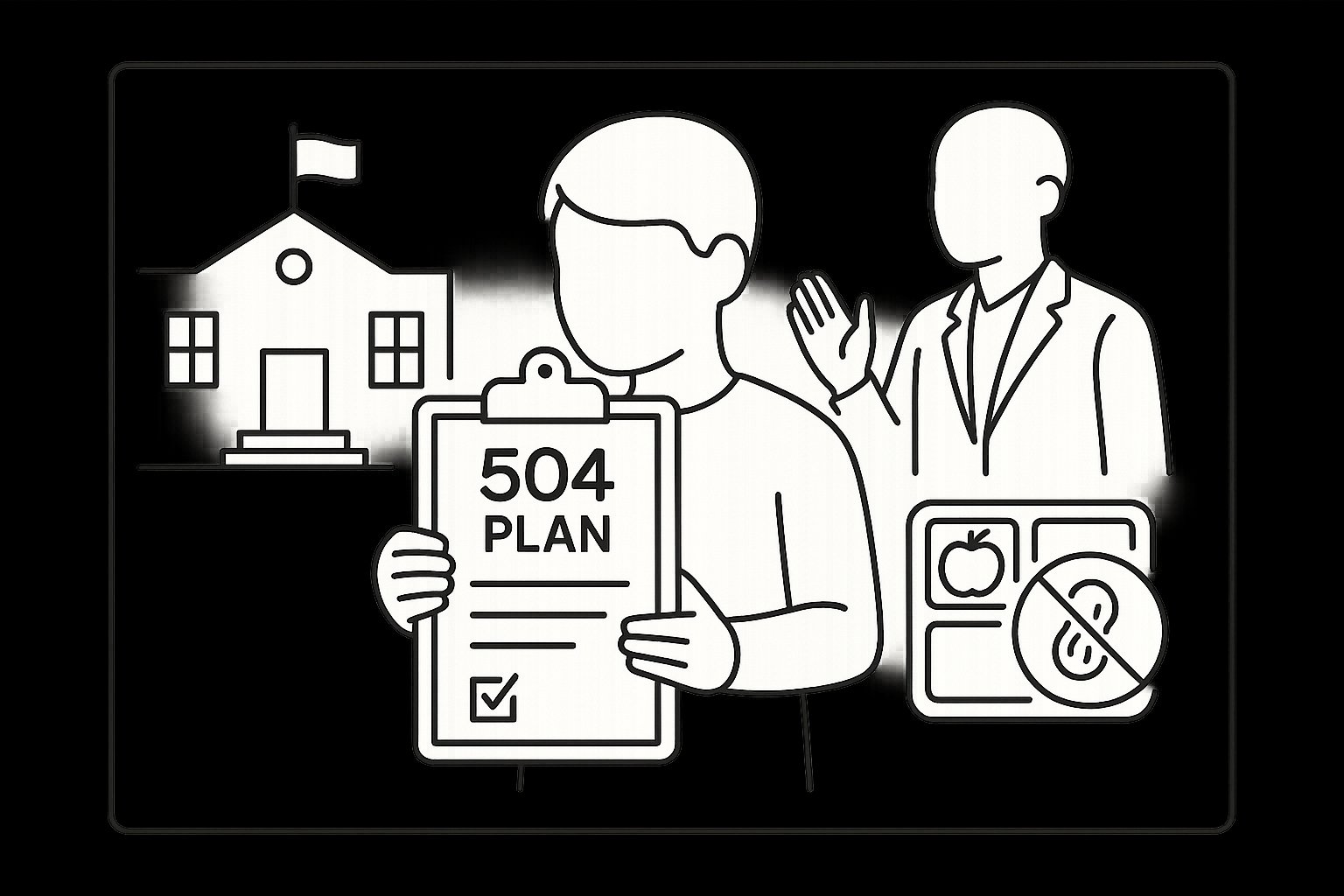
A 504 plan is a written accommodation plan created under Section 504 of the Rehabilitation Act of 1973, a civil rights law that prevents disability-based discrimination in programs receiving federal funds. For students with food allergies that substantially limit one or more major life activities, like breathing, eating, or interacting with others, a 504 plan documents accommodations the school will provide to remove barriers to equal participation.
How it differs from an IEP (Individualized Education Program):
- Purpose: An IEP is provided under the Individuals with Disabilities Education Act (IDEA) and focuses on specialized instruction and related services for students who need educational interventions. A 504 plan focuses on removing discrimination barriers and providing accommodations so the student can access the general education curriculum.
- Eligibility standard: IDEA requires the student have one of the IDEA-identified disability categories and a need for specialized instruction. Section 504 looks broadly at whether a disability (including severe food allergies) substantially limits a major life activity.
- Legal protections and process: Both are legal documents enforceable by federal law, but IEPs include detailed educational goals, progress monitoring, and procedural safeguards specific to IDEA. 504 plans are generally more flexible and often faster to carry out, but still require school compliance and reasonable accommodations.
For food allergies, many students won’t need specialized instruction but do need environmental and procedural supports, making a 504 plan the typical path. We often recommend families consider a 504 plan when the allergy creates risk and requires consistent school-level changes.
How A 504 Plan Protects Students With Food Allergies
A 504 plan protects students with food allergies by establishing legally-binding accommodations and procedures that minimize exposure risk and ensure equal access to school services. Protections typically include:
- Environmental controls: Policies limiting allergen exposure in classrooms, cafeterias, buses, and during extracurriculars. These controls reduce the chance of accidental ingestion or airborne exposure.
- Access to medication: Clear authorization to carry and self-administer epinephrine (when appropriate), or to have medication stored and accessible in the nurse’s office, with staff trained to administer it.
- Participation rights: Ensuring the student can participate in field trips, classroom parties, and school events with reasonable modifications rather than exclusion.
- Communication protocols: Notification systems so substitute teachers, food service staff, and coaches are aware of the student’s allergy and plan.
- Emergency response: A documented, rehearsed plan for responding to allergic reactions, including timelines for calling emergency services and notifying parents.
Beyond safety, a 504 plan also creates accountability. If a school fails to carry out agreed accommodations, families have grounds to file internal complaints, request mediation, or pursue a Section 504 complaint with the U.S. Department of Education’s Office for Civil Rights. That legal backstop is why documenting accommodations in a 504 plan matters: it moves verbal promises into an enforceable framework.
Eligibility Criteria And How To Request A 504 Evaluation
Eligibility under Section 504 requires that the child have a disability, defined as a physical or mental impairment that substantially limits one or more major life activities. Severe food allergies usually meet that test because they can limit breathing, eating, and other daily functions, and carry life-threatening risk.
How to request an evaluation:
- Put the request in writing. We recommend parents submit a written request to the school’s 504 coordinator or principal asking for a 504 evaluation for food allergies. Include medical documentation (allergy specialist notes, epinephrine prescriptions) and specific examples of how the allergy affects the student.
- School response timeline. The school must evaluate the child in a timely manner. While federal law doesn’t specify exact days, most districts have local timelines (often 30 calendar days) to complete evaluations and convene a team.
- The evaluation process. A 504 evaluation is typically less formal than an IDEA evaluation. The school will gather medical records, teacher input, observations, and any nursing assessments to determine whether accommodations are needed.
- 504 plan meeting. If the team determines the student is eligible, the school should draft a 504 plan with specific accommodations. Parents have the right to participate and to request revisions.
- If denied. If the school declines an evaluation or denies eligibility, parents can request reconsideration, file an internal grievance, seek mediation, or file a complaint with the Office for Civil Rights. Legal counsel can help navigate appeals and ensure the student’s rights are protected.
Given the stakes with food allergies, we advise documenting all communications, keeping copies of medical records, and involving the school nurse early in the process to support a timely assessment.
Typical Accommodations And Emergency Planning
A well-drafted 504 plan for food allergies blends daily accommodations with robust emergency planning. The goal is twofold: prevent exposures and ensure rapid, competent response if a reaction occurs. Below we cover common environmental and daily accommodations, then the medical emergency protocols schools should have in place.
Conclusion
A 504 plan for food allergies is a practical, enforceable way to keep students safe and included. By documenting specific accommodations, emergency steps, and training expectations, families and schools create a predictable framework that reduces risk and clarifies responsibility. If you encounter resistance or complex legal questions about implementation, consult your school’s 504 coordinator and consider legal counsel, firms with healthcare and education experience can help protect the student’s rights and ensure compliance. Together we can build plans that protect health without sacrificing participation.
Frequently Asked Questions about 504 Plans for Food Allergies
What is a 504 plan for food allergies?
A 504 plan for food allergies is a federally protected accommodation plan under Section 504 of the Rehabilitation Act that ensures students with food allergies receive necessary supports to stay safe and fully participate in school activities.
How does a 504 plan differ from an Individualized Education Program (IEP)?
A 504 plan focuses on providing accommodations for equal access and preventing discrimination due to disabilities like food allergies, while an IEP provides specialized instruction for students needing educational interventions under IDEA.
Who is eligible for a 504 plan due to food allergies?
Students with food allergies that substantially limit major life activities such as breathing or eating are eligible for a 504 plan as their condition qualifies as a disability under Section 504.
How can parents request a 504 evaluation for their child with food allergies?
Parents should submit a written request to the school’s 504 coordinator or principal, including medical documentation and examples of how the allergy affects the student, prompting the school to evaluate eligibility.
What accommodations are typically included in a 504 plan for food allergies?
Common accommodations include environmental controls to limit allergen exposure, access to emergency medication like epinephrine, participation rights in school events, communication protocols, and detailed emergency response plans.
Can a student with food allergies carry and self-administer medication at school?
Yes, a 504 plan can authorize students to carry and self-administer epinephrine when appropriate, or ensure medication is accessible with trained staff ready to assist in emergencies.