
Last Updated on April 20, 2026 by Jennifer Hanson
Refusing special education services is a choice some families face when navigating the Individuals with Disabilities Education Act (IDEA) and school offers. We often see confusion about what refusal means, how it affects a child’s rights, and when parents can lawfully say no. In this text we’ll explain the legal landscape in 2026, practical steps to make an well-informed choice, and what to expect from schools and the procedural safeguards that protect families. Our goal is to give you clear, usable guidance so you can weigh options confidently.
In this guide, Can You Refuse Special Education Services What Parents Need To Know In 2026 is explained with clear steps and tips.
Key Takeaways — Can You Refuse Special Education Services What Parents Need To Know In 2026
- Parents can lawfully refuse special education services by not consenting at an IEP meeting or providing written notice, but refusal pauses rather than eliminates services or evaluations.
- Under IDEA, parental consent is required for initial evaluations and special education services, and parents have rights to request independent evaluations and use procedural safeguards.
- Schools must provide prior written notice explaining the offer or refusal of services and consequences, and they may seek dispute resolution if refusal endangers the child’s right to free appropriate public education (FAPE).
- Refusing services delays access to supports and related services but does not permanently bar future eligibility; re-evaluation is required when services are later requested.
- Parents should document all communications, review IEP proposals carefully, seek clarifications, and consider mediation or legal advice to make informed decisions about refusing services.
What Refusing Special Education Services Actually Means And When Parents Can Do It
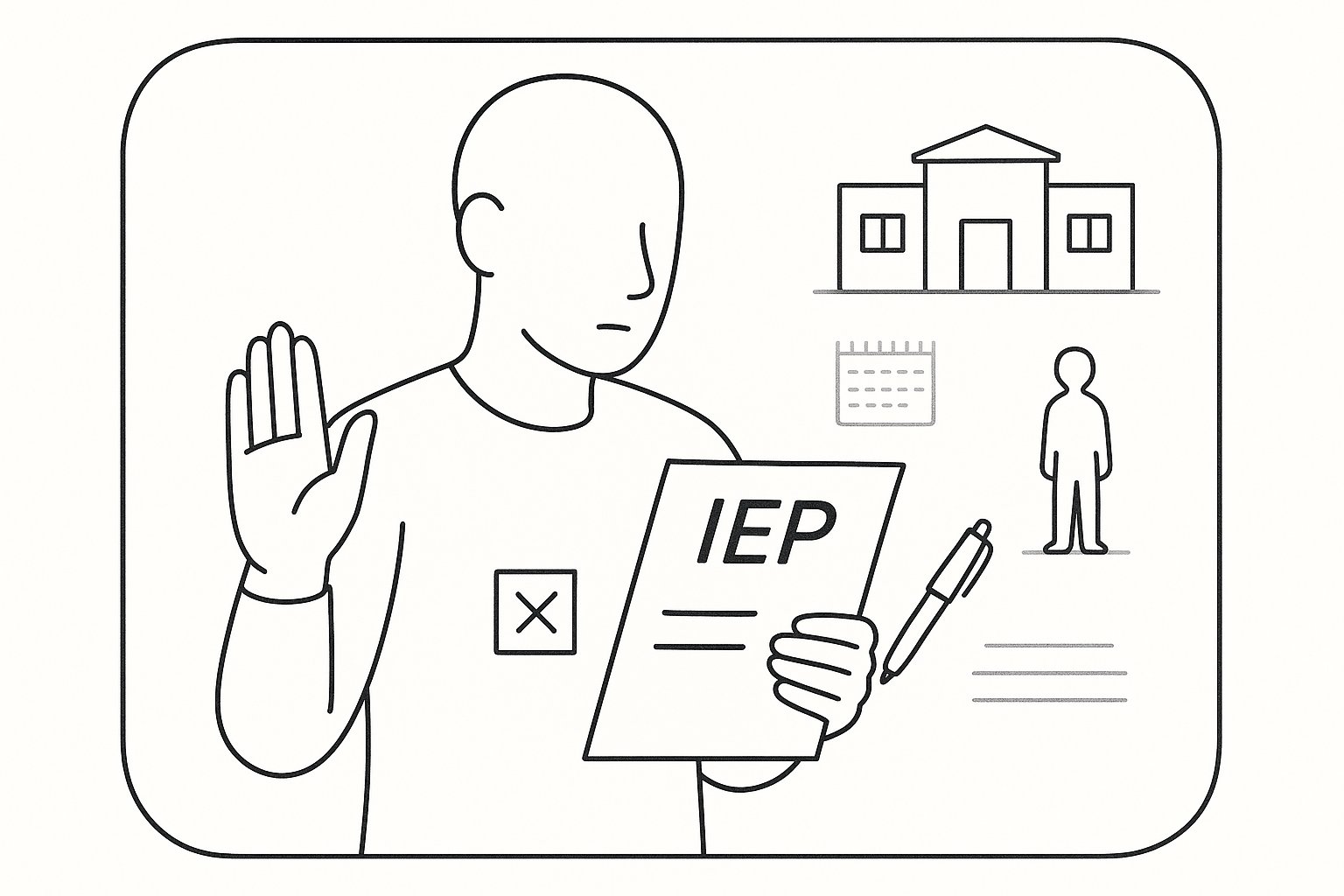
Refusing special education services typically means a parent declines the offer of special education and related services set out in an Individualized Education Program (IEP) or rejects an initial eligibility determination. Under IDEA, parents generally have the right to accept or refuse services offered by the school district. That said, “refusal” isn’t always a one-and-done choice, it can be limited to specific services, certain timelines, or conditional on further evaluation.
When parents can lawfully refuse: we can decline services at the IEP meeting by not signing consent, or we can provide written notice rejecting proposed services. For an initial evaluation, if we withhold consent, the school usually cannot evaluate the child for special education. But, if a child’s needs are evident and the team suspects a disability, districts may pursue evaluation via other procedural routes in some states. Practical point: refusing services doesn’t erase the underlying needs: it pauses the school’s obligation to deliver the offered supports until consent or a dispute resolution outcome changes that status.
Parental Rights Under IDEA: Consent, Notice, And The Scope Of Authority
IDEA centers parental consent and informed participation. We have the right to prior written notice whenever the school proposes or refuses a change in identification, evaluation, or educational placement. Parental consent is required for initial evaluations and for the initial provision of special education services: for ongoing services, IDEA’s consent requirements are more nuanced, many IEP changes proceed with documented attempts to obtain agreement.
Our authority includes refusing specific services while agreeing to others, requesting independent educational evaluations (IEEs) at public expense if we disagree with district evaluations, and exercising procedural safeguards like mediation or due process. That said, consent is not absolute in every scenario: schools must still follow legal mandate to provide FAPE (free appropriate public education), and if a dispute over refusal threatens a child’s right to FAPE, the district or parent may pursue dispute resolution. We should keep written records of notices, consents, and refusals, those documents are often decisive if we later need to negotiate or litigate.
How Schools Typically Respond And The Procedural Safeguards Available To Parents
When we refuse services, schools generally respond in three ways: they accept the refusal and document it, seek to re-engage us through meetings and clarifications, or initiate procedural safeguards to challenge the decision if they believe it jeopardizes FAPE. Districts commonly send prior written notice explaining the educational reasons for the offered services and what will happen if consent is withheld.
Procedural safeguards are the backbone of IDEA when disagreements arise. We can request mediation, file a complaint with the state education agency, or pursue a due process hearing. Mediation is faster and collaborative: due process hearings are formal and often involve attorneys. Importantly, timelines matter: IDEA sets strict deadlines for filing complaints and requesting hearings, and schools must adhere to notice and timeline rules. If we’re unsure, consulting an advocate or attorney early helps preserve rights and often avoids escalation.
Prior Written Notice, Due Process, And Timelines When Services Are Refused
Prior written notice must explain the proposed or refused action, the reasons, evaluation data supporting the decision, and sources for additional information. When we refuse services, the district should provide notice that details the consequences, for instance, that the school won’t carry out the IEP until consent is given.
If the refusal sparks a dispute, due process is the formal path. We typically have a limited window (often one year from the date we knew or should have known about the alleged violation, though state rules vary) to file for a hearing. During due process, both sides present evidence: an impartial hearing officer issues a decision. IDEA also allows us to request expedited hearings in emergent situations (for example, disciplinary removals affecting special education rights). Tracking deadlines and keeping all correspondence is crucial, missing a timeline can forfeit remedies.
Impact Of Refusal On A Child’s Services, Evaluations, And Educational Records
Refusing services affects immediate implementation: schools typically pause the delivery of the IEP’s supports once consent is withheld. Evaluations also stop if we deny permission for an initial or re-evaluation. That pause can have downstream effects on access to accommodations, specialized instruction, and related services like speech or occupational therapy.
From a records standpoint, the refusal and the school’s prior written notice should be added to the student’s educational file. That documentation becomes part of the official record and can influence later decisions about eligibility and services. We should be aware that if we later consent, the timeline for services often begins from the date of consent, not retroactively. In short, refusing may delay or deny supports that could help academic progress, so weighing short-term concerns against long-term needs is essential.
Effects On Eligibility, Future IEPs, And Access To Related Services
A refusal doesn’t permanently bar future eligibility. If we later seek services, the district will re-evaluate eligibility and can develop a new IEP if criteria are met. But, gaps in services can make re-establishing eligibility more complicated, progress or regression during the refusal period may change the team’s recommendations.
Related services (e.g., counseling, transportation, speech) are part of the IEP only when they’re necessary for FAPE. If we refuse those services initially, the child won’t receive them until we consent or an IEP team later determines they’re required. We should also consider timelines for claims: if a dispute arises later about services not provided during a refusal period, remedies may be limited by statute of limitations or documentation gaps. Maintaining clear records and periodic communication with the school keeps options open for future supports.
How To Make An Informed Decision: Practical Steps, Documentation, And Legal Options
When deciding whether to refuse, we recommend a stepwise approach. First, gather and review all documentation: the proposed IEP, prior written notice, evaluation reports, and progress data. Ask for clarifications in writing and request time to consult privately. Second, consider independent evaluations (IEEs) if you doubt the district’s findings, these can be persuasive in meetings or in hearings.
Third, document every interaction: meeting notes, emails, and your written refusals or consents. If you decide to refuse, put it in writing and keep a copy. Fourth, pursue informal resolution, mediate with the team or propose amendments to the IEP that address concerns. Finally, if needed, exercise legal options: file complaints, request due process, or consult an attorney familiar with IDEA. At Chelle Law, we advise healthcare professionals and parents on administrative appeals: while not every refusal turns into litigation, early legal guidance helps protect your child’s rights and keeps options available.
Frequently Asked Questions About Refusing Special Education Services
Can a parent legally refuse special education services under IDEA?
Yes, parents have the legal right under IDEA to refuse special education services offered in an Individualized Education Program (IEP) by withholding consent or providing written notice declining the services.
What happens if a parent refuses an initial evaluation for special education?
If a parent withholds consent for an initial evaluation, the school typically cannot proceed with evaluating the child for special education, although some districts may pursue evaluation through alternative procedural routes depending on state laws.
How does refusing special education services affect my child’s educational support?
Refusing services pauses the school’s obligation to deliver the proposed supports and related services, potentially delaying access to accommodations and specialized instruction until consent is given or a dispute resolution is reached.
What procedural safeguards protect parents who refuse special education services?
IDEA provides safeguards such as prior written notice, mediation, state complaints, and due process hearings to ensure parents’ rights are protected and disputes over refusal can be resolved through formal or informal processes.
Can parents refuse some special education services but accept others within the IEP?
Yes, parents may decline specific services while agreeing to others, allowing them to tailor consent based on their child’s needs and concerns within the IEP framework.
How should parents document their refusal of special education services?
Parents should provide written notice of refusal, keep copies of all correspondence, meeting notes, and prior written notices to maintain a clear record that supports their decisions and safeguards their rights.