
Last Updated on July 8, 2026 by Jennifer Hanson
Choosing a private school when your child has special education needs raises practical and legal questions we often hear from parents. Private schools operate under different rules than public districts, and the way they assess students, design individualized supports, and bill for services can vary widely. In this text we’ll walk through the core differences, explain how assessments and plans typically work in private settings, outline funding and contract issues to watch for, and highlight practical enrollment considerations so you can make informed decisions for your child in 2026.
In this guide, How Private Schools Handle Special Education What Parents Need To Know In 2026 is explained with clear steps and tips.
Key Takeaways — How Private Schools Handle Special Education What Parents Need To Know In 2026
- Private schools handle special education differently than public schools and often do not provide federally mandated IEPs, instead using school-specific plans that reflect their resources and philosophy.
- Parents play a central role in securing and documenting special education services in private schools, where procedural protections under IDEA are limited compared to public schools.
- Private school assessments and service plans vary widely, so families should confirm evaluation procedures, progress monitoring, and who provides specialized services before enrolling.
- Funding for special education services in private schools largely falls to families, but options like public school equitable services, vouchers, scholarships, and insurance coverage may help offset costs.
- Review private school enrollment contracts carefully to understand obligations, dispute resolution methods, and how agreed accommodations are incorporated into written agreements.
- Visiting schools, meeting support staff, and collecting all evaluations and correspondence help families make informed decisions and advocate effectively for their child’s special education needs.
How Private Schools Differ From Public Schools On Special Education
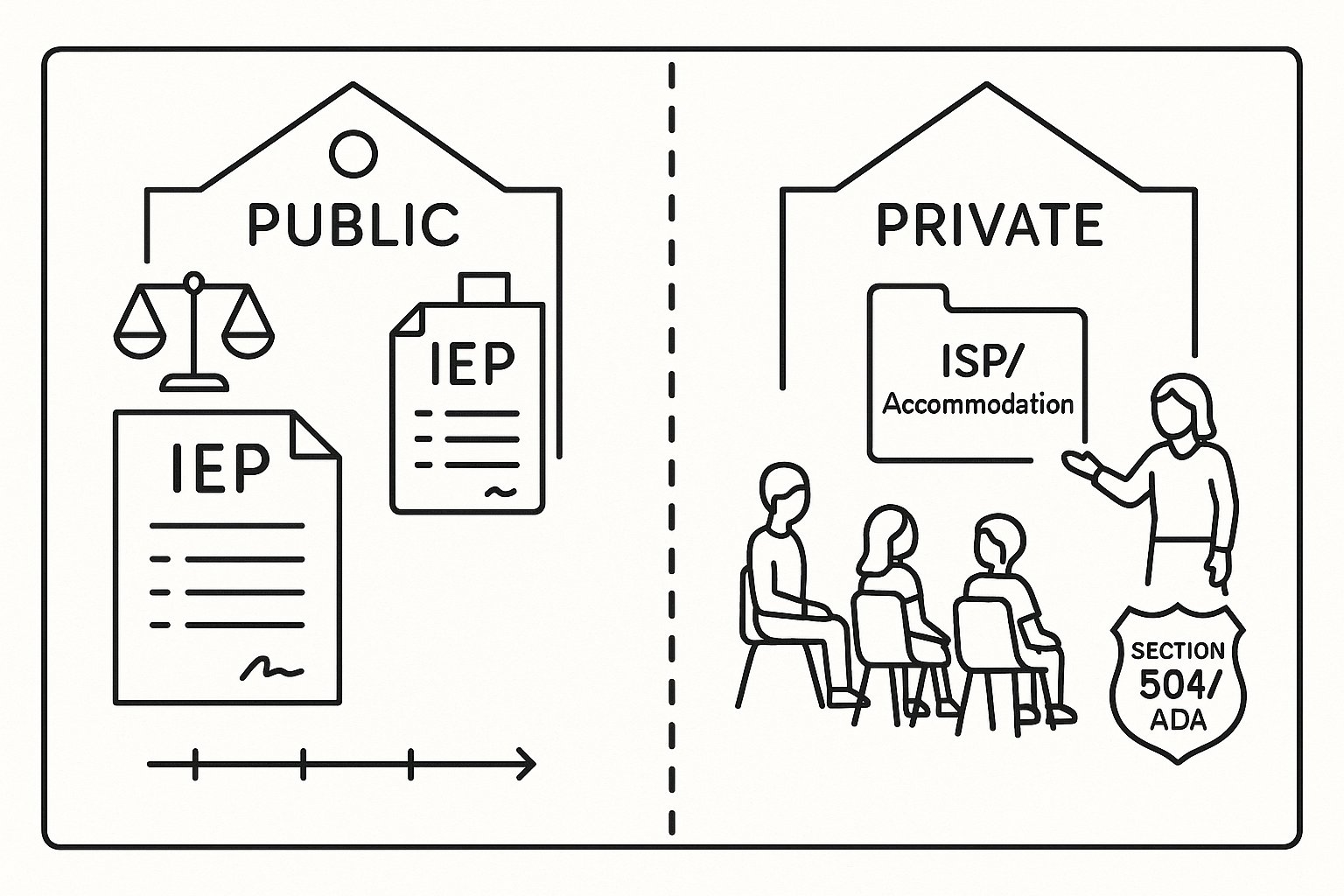
Public schools are governed by the Individuals with Disabilities Education Act (IDEA), which requires evaluation, an Individualized Education Program (IEP), and specified procedural protections, including free appropriate public education (FAPE). Private schools, by contrast, are generally not subject to IDEA in the same way. That difference is the starting point for how services and rights diverge.
First, private schools rarely provide an IEP. Instead, many use school-created plans, sometimes called Individualized Service Plans (ISPs), learning plans, or accommodation plans, that reflect the school’s resources and philosophy. Those plans can be thoughtful and effective, but they do not carry the same legal weight or federally mandated entitlement to services that an IEP does. We need to understand that when families move from public to private, responsibility for securing services often shifts onto parents and the private institution’s policies.
Second, eligibility and evaluation procedures differ. Public districts must evaluate when a disability is suspected and follow a specific timeline. Private schools usually require parents to provide recent evaluations or to consent to school-initiated assessments under the terms of enrollment. Schools vary in the professionals they consult (school psychologists vs. outside clinicians) and in how frequently they reassess.
Third, procedural protections are narrower. IDEA offers due process hearings and clear dispute-resolution paths. Private school families generally have fewer guaranteed procedural remedies under IDEA: but, private schools that receive federal funds (including some charter or voucher-funded schools) must comply with Section 504 of the Rehabilitation Act and the Americans with Disabilities Act (ADA), which require reasonable accommodations and prohibit discrimination.
Finally, culture and pedagogy matter. Many private schools offer smaller classes, specialized curricula, or therapeutic models that better suit certain learners. But those advantages are programmatic, not legal guarantees. We recommend evaluating both the educational fit and the contractual/financial implications before enrolling.
Assessment, Individualized Plans, And Service Delivery In Private Settings
Assessment processes in private schools tend to be more variable. Some independent schools maintain in-house testing teams and follow a structured psychoeducational evaluation protocol. Others ask for a recent external evaluation (from a school district or private clinician) and then supplement it with targeted classroom observations. When we advise families, we suggest confirming exactly what evaluations the school will accept, who conducts them, and whether parents can obtain copies.
Once a need is identified, private schools typically create an individualized plan that aligns with their staffing and curriculum. These plans may include:
- Academic accommodations (extended time, modified assignments)
- Behavior support strategies and positive behavioral interventions
- Related services available on campus (speech, occupational therapy, counseling) or provided off-site
- Progress-monitoring dates and parent communication protocols
A key difference: private plans are commonly implemented through collaborative agreements between parents and the school, not through a mandated IEP team process. That means the parent’s role is often more central: we encourage parents to document meetings, request written plans, and set measurable goals with timelines.
Service delivery can take several forms. Some schools employ specialists directly (special education teachers, learning specialists), while others contract outside providers who come to campus. Hybrid models are common: a child may receive in-class supports for literacy while attending weekly outside speech therapy. When services are outsourced, contracts and consent forms determine frequency and liability.
Progress reporting also varies. In public schools, IEPs require periodic progress reports tied to specific goals. Private schools may provide narrative reports, quarterly checkpoints, or informal updates. We recommend asking for a clear progress-monitoring schedule and a mechanism to revisit or revise the plan if supports aren’t working.
Funding, Contracts, Accommodations, And Practical Enrollment Considerations
Funding is often the most practical hurdle families face. Private schools charge tuition and are not obligated to provide FAPE, so the cost of specialized supports frequently falls to families. That said, there are several funding and legal pathways to consider:
- Public-school services while enrolled privately: In some states, districts must consider providing certain services to students placed in private schools by the district (child-find obligations) or when parents unilaterally place their child in private school after an IEP dispute. Rules vary widely: we suggest checking state education agency guidance.
- IDEA equitable services: When a student attends a private school by parental choice, districts still have limited obligations to provide “equitable services” for eligible children with disabilities. These services are usually fewer and provided directly by the district where feasible.
- Vouchers and scholarship programs: Some states and municipalities offer special needs scholarships or voucher programs that can offset private tuition and services. Eligibility, allowable uses, and availability fluctuate by year and political environment.
- Private-pay and insurance: Many families pay directly for tutoring, therapy, or learning specialists. Depending on the service and insurer, some therapies may be covered: we recommend verifying benefits and obtaining pre-authorizations.
Contracts and enrollment agreements are critical documents. Private schools often include clauses about academic expectations, termination of enrollment, arbitration, and fee schedules. We find these provisions influence how disputes over services are resolved. For example, mandatory arbitration clauses can limit access to court proceedings, while refund policies determine recourse if the school cannot meet promised supports. Given our firm’s experience with contract review in related professional contexts, we encourage families to:
- Request and review sample service agreements and accommodation policies before enrolling
- Ask whether the school will incorporate agreed-upon supports into the written enrollment contract
- Clarify who is responsible for hiring and supervising outside contractors
Accommodations under Section 504 and the ADA also matter. If a private school receives federal funds, it must provide reasonable accommodations for documented disabilities. Even when a school is private and independent, many voluntarily adopt inclusive policies. We suggest obtaining written confirmation of agreed accommodations and an appeal process if needed.
Practical enrollment tips: visit classrooms during a typical day, meet the special education or learning support staff, observe how teachers differentiate instruction, and ask other parents about outcomes. Keep copies of all evaluations, correspondence, and contracts, those records matter when negotiating services or resolving disputes.
Conclusion
Navigating special education in private schools requires both a practical and legal lens. We recommend assessing fit first, curriculum, staff expertise, and culture, then scrutinizing assessments, written plans, funding pathways, and the enrollment contract. Where legal clarity is needed, a contract review or brief consultation can save time and protect your child’s access to services. With the right questions and documentation, families can make private placement work while preserving options if adjustments are needed.
Frequently Asked Questions About Special Education in Private Schools
How do private schools differ from public schools in handling special education?
Private schools are not governed by IDEA like public schools; they typically do not provide IEPs but use individualized plans based on their resources and philosophy. Parents often have more responsibility in securing services, and procedural protections are narrower compared to public schools.
What types of individualized plans do private schools use for special education needs?
Private schools commonly create Individualized Service Plans (ISPs), learning plans, or accommodation plans that include academic accommodations, behavior supports, related services, and progress monitoring tailored to their staffing and curriculum.
How are evaluations for special education eligibility handled in private schools?
Private schools usually require parents to provide recent evaluations or consent to school-initiated assessments. Evaluation procedures vary widely, including who conducts them and how often reassessments occur, unlike the mandated public school evaluation timelines.
Can families receive funding or services from public schools when their child attends private school?
In some states, public districts must consider providing certain services or offer equitable services under IDEA. Additionally, special needs scholarships, vouchers, and insurance coverage may help offset private tuition and therapies, but availability and rules vary widely.
What legal protections do students have in private schools receiving federal funding?
Private schools that receive federal funds must comply with Section 504 and the ADA, which require reasonable accommodations and prohibit discrimination, even though they are not subject to IDEA’s full procedural requirements.
What practical steps should parents take when enrolling a child with special needs in a private school?
Parents should visit classrooms, meet with special education staff, review enrollment contracts and accommodation policies carefully, request written plans and progress reports, and maintain thorough records of evaluations and communications to ensure appropriate services and supports.