
Last Updated on July 8, 2026 by Jennifer Hanson
Starting kindergarten with questions about special education is normal, and we can help make those questions manageable. An Individualized Education Program (IEP) is a legal document that shapes a child’s school experience when they qualify for special education. In this guide we’ll explain what an IEP for kindergarten is, who qualifies, how evaluations work, what to expect at the IEP meeting, and the key components you’ll find in a plan. We’ll keep things practical and focused on what parents need to know in 2026, including basic legal rights and where to look for support.
In this guide, What Is An IEP For Kindergarten A Clear Parent-Friendly Guide For 2026 is explained with clear steps and tips.
Key Takeaways — What Is An IEP For Kindergarten A Clear Parent-Friendly Guide For 2026
- An IEP for kindergarten is a legal document that outlines tailored special education services to support a child’s learning and participation in school.
- Eligibility for a kindergarten IEP requires a disability that affects learning and a thorough multidisciplinary evaluation to determine needs.
- The IEP meeting is a collaborative process involving parents and educators to set measurable goals and decide on services, placements, and accommodations.
- Key components of an IEP include the child’s current performance, annual goals, service details, least restrictive environment, accommodations, and progress reporting.
- Parents have the right to consent to evaluations, participate in decisions, request changes, and access dispute resolution under IDEA.
- Preparing for kindergarten with an IEP involves understanding your rights, attending meetings informed, and seeking support from advocates or attorneys when needed.
What An IEP Means For A Kindergartner: Purpose And Basics
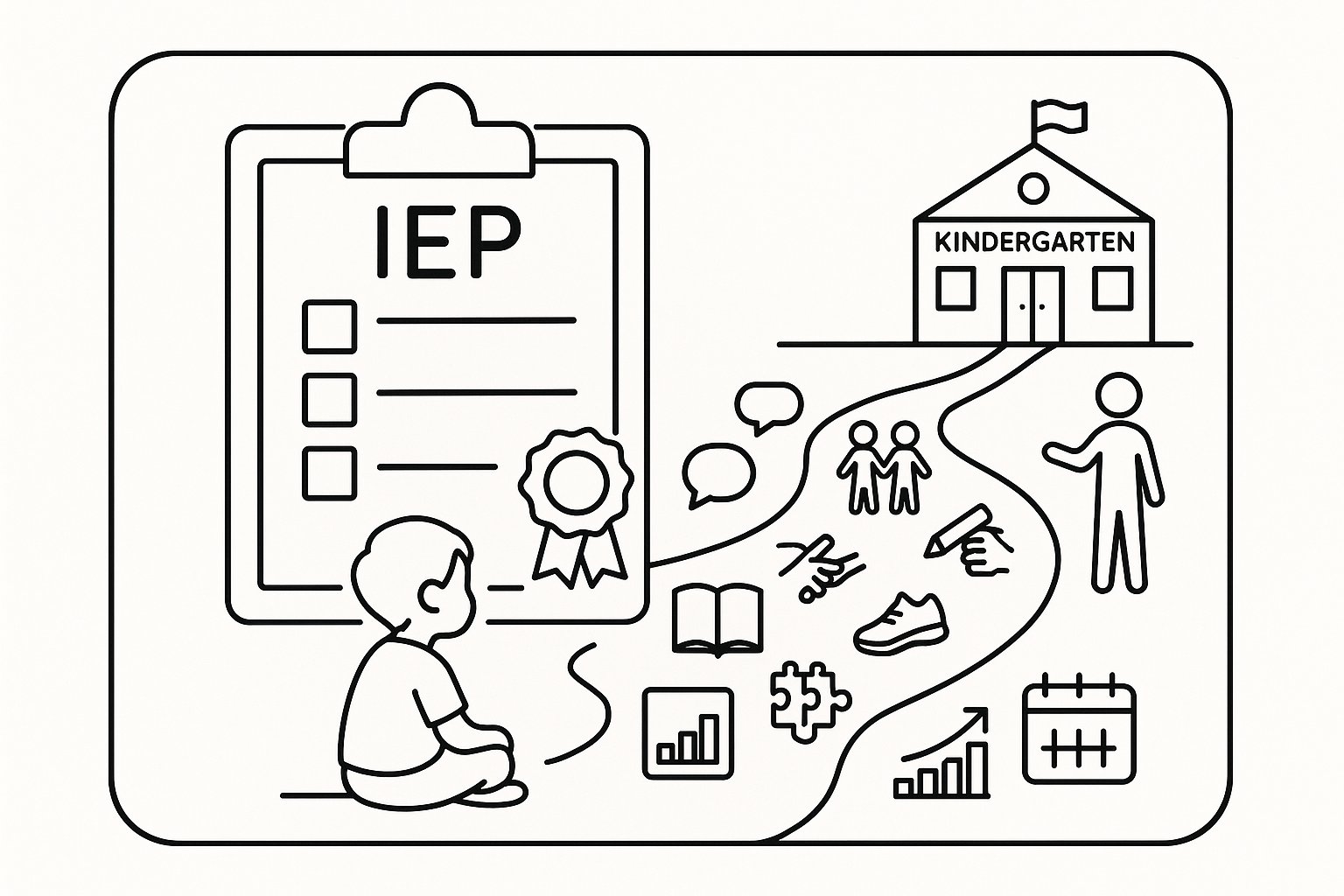
An IEP for kindergarten is both a roadmap and a legal promise: it spells out the special education and related services a child will receive to access kindergarten curriculum and participate in school. The core purpose is to identify educational needs, set measurable goals, and document accommodations and supports tailored to the child’s unique profile.
IEPs are guided by the federal Individuals with Disabilities Education Act (IDEA), which requires public schools to provide a free appropriate public education (FAPE) to eligible children. For families that means we should expect individualized instruction, progress monitoring, and regular team meetings. An IEP is not an automatic label of limitation: rather, it’s a tool to remove barriers so a child can learn alongside peers whenever appropriate.
In kindergarten the IEP often focuses on early literacy, language, social skills, fine and gross motor development, and behavior supports. Services might be provided in the general classroom, in small groups, or in pull-out sessions depending on need. Importantly, the IEP also includes progress reporting so parents and teachers can track whether interventions are working and adjust supports as the child develops.
Who Qualifies For A Kindergarten IEP: Eligibility Categories And Evaluation Process
Eligibility for an IEP starts with showing that a child has a disability that affects educational performance and requires specially designed instruction. Common categories for kindergarten students include speech or language impairment, specific learning disability, developmental delay (in some states), autism spectrum disorder, emotional disturbance, and other health impairments.
The evaluation process typically begins when parents, teachers, or pediatricians raise concerns. We can request an evaluation in writing: once the school receives that request, they must respond within state-specific timelines. The school will conduct a full and multidisciplinary evaluation, speech-language assessments, developmental screenings, psychological testing, observations in the classroom, and input from parents, to gather a comprehensive picture.
After evaluations, the multidisciplinary team meets to determine eligibility. If the child qualifies, the team (including parents) develops the IEP. If the child does not qualify, schools must provide prior notice explaining the decision and any available alternatives, such as a 504 plan or targeted interventions through MTSS/RTI. We should track timelines carefully, IDEA and state rules set specific time limits for evaluations, meetings, and the provision of services, and it’s our right to ask for them in writing and to request an independent educational evaluation if we disagree with the school’s assessment.
What To Expect At The IEP Meeting And Key Plan Components
An IEP meeting is where the team turns evaluation findings into an actionable plan. Expect a collaborative meeting that includes parents, a general education teacher, a special education teacher, a school psychologist or other evaluator, and a district representative who can commit resources. We can request additional participants, therapists or advocates, if we think their presence will help.
The meeting will review evaluation results, discuss the child’s strengths and needs, and propose annual goals, services, placement, and accommodations. Key components we should see in the IEP include:
- Present levels of academic achievement and functional performance (PLAAFP): a clear, specific description of where the child is now.
- Measurable annual goals: what the child should be able to do within the year, with criteria and timelines.
- Special education services and related services: frequency, duration, and delivery method (e.g., 30 minutes of speech twice weekly).
- Least restrictive environment (LRE) statement: explanation of how much time the child will spend in general education and in specialized settings.
- Accommodations and modifications: supports for classroom access, testing, behavior, and communication.
- Progress reporting: how and when the school will report progress to us.
We should come prepared with questions, examples of the child’s work, and our priorities. If we disagree with proposed language, we can request changes, ask for follow-up meetings, or pursue dispute resolution options, mediation, due process, or complaint to the state education agency. It’s helpful to document everything discussed and to request the finalized IEP in writing.
Conclusion: Next Steps, Your Rights, And How To Get Support
As we prepare for kindergarten, remember that an IEP is a collaborative, living document designed to help our child succeed. Next steps include requesting evaluations if needed, attending the IEP meeting prepared, and reviewing the written plan carefully. Know your rights under IDEA: consent for evaluations, timely meetings, participation in decisions, and dispute-resolution options.
If we want legal guidance, for example, to interpret timelines, clarify FAPE obligations, or pursue dispute resolution, consulting an attorney familiar with education law can be useful. Firms like ours, while focused on healthcare and employment law, often point parents to local special education advocates and resources. Reach out to your state education agency, local parent training and information center (PTI), or a special education attorney if you need assistance. Working together with the school, and standing firm on your child’s needs, gives the best chance for a strong start in kindergarten.
Frequently Asked Questions About IEPs for Kindergarten
What is an IEP for kindergarten and why is it important?
An IEP for kindergarten is a legal document that outlines special education services tailored to a child’s needs, ensuring access to the kindergarten curriculum. It sets educational goals, accommodations, and supports to help the child learn alongside peers effectively.
Who qualifies for a kindergarten IEP?
Kindergarten students who have a disability affecting their educational performance may qualify for an IEP. Common eligibility categories include speech/language impairments, learning disabilities, developmental delays, autism spectrum disorder, emotional disturbance, and other health impairments.
How does the evaluation process for a kindergarten IEP work?
Evaluations begin after concerns are raised by parents or educators, involving multidisciplinary assessments such as psychological testing, speech-language evaluations, and classroom observations. The team then reviews results to determine eligibility for special education services.
What should I expect during the kindergarten IEP meeting?
The IEP meeting includes parents, teachers, evaluators, and district representatives. The team discusses evaluation findings, sets measurable annual goals, decides on services and accommodations, and defines the least restrictive environment for the child’s education.
Can I request changes or dispute decisions in my child’s IEP?
Yes, parents can request changes to IEP language, ask for follow-up meetings, or pursue dispute resolution options such as mediation, due process, or complaints to the state education agency if disagreements arise.
How does an IEP support early literacy and social skills in kindergarten?
IEPs often target early literacy, language development, social skills, motor abilities, and behavior support, using individualized instruction in settings like general classrooms, small groups, or pull-out sessions to meet each child’s unique needs.