
Last Updated on April 20, 2026 by Jennifer Hanson
A 504 Plan is one of the most important tools families and schools use to ensure students with disabilities get equal access to education. In Indiana, these plans operate under Section 504 of the Rehabilitation Act of 1973 and are distinct from special education under IDEA. We’ll walk through who qualifies in Indiana, how schools identify and document eligibility, the kinds of accommodations a 504 plan can provide, and the steps for requesting, implementing, monitoring, and appealing a plan. Our goal is to give parents, educators, and clinicians clear, practical steps so a child’s educational needs are met consistently and lawfully.
In this guide, What Is a 504 Plan in Indiana A Practical Guide for Parents Educators and Healthcare Professionals 2026 is explained with clear steps and tips.
Key Takeaways — What Is a 504 Plan in Indiana A Practical Guide for Parents Educators and Healthcare Professionals 2026
- A 504 Plan in Indiana ensures students with disabilities receive reasonable accommodations for equal educational access under Section 504 of the Rehabilitation Act.
- Eligibility for a 504 Plan requires a physical or mental impairment that substantially limits major life activities, even if the disability is not severe.
- Schools evaluate eligibility through documented medical and educational evidence, involving parents and a multidisciplinary team in the decision-making process.
- 504 Plans provide tailored accommodations such as instructional supports, assessment modifications, environmental adjustments, and health-related provisions to meet each student’s needs.
- Families should request 504 Plans in writing with supporting documentation, actively participate in reviews, and monitor the plan’s effectiveness through measurable criteria.
- If accommodations are denied or insufficient, parents can seek reconsideration, file complaints with education authorities, or consult legal experts to protect their child’s rights.
Who Qualifies For a 504 Plan In Indiana? Eligibility Criteria And Examples
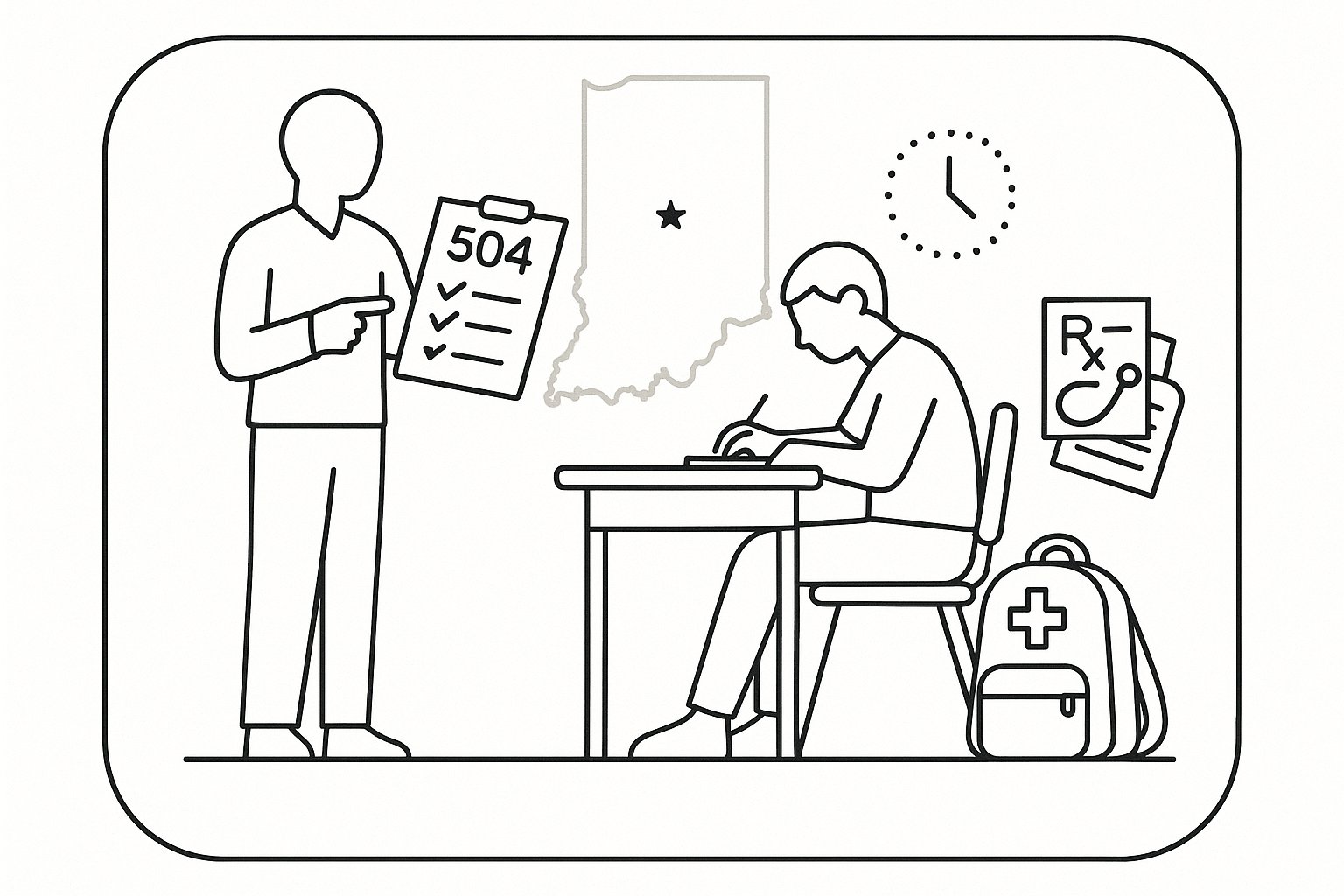
Section 504 protects students with disabilities by requiring schools that receive federal funds to provide reasonable accommodations so students can participate in school programs. In Indiana, eligibility hinges on two core questions: (1) Does the child have a physical or mental impairment? and (2) Does that impairment substantially limit one or more major life activities (learning, reading, concentrating, communicating, mobility, etc.)? If the answer to both is yes, the student may qualify for a 504 plan.
We should emphasize that “substantially limits” doesn’t mean the student must be severely disabled. The standard is broader than IDEA’s criteria for special education eligibility. Conditions commonly qualifying for 504 plans include attention-deficit/hyperactivity disorder (ADHD), diabetes, severe allergies, asthma, anxiety disorders, concussions with prolonged symptoms, and temporary but significant impairments (for example, recovery from surgery). Chronic health conditions like epilepsy or cystic fibrosis also often qualify.
Concrete examples help: a middle-schooler with ADHD who can’t complete classwork without extended time and frequent breaks may meet the standard. A child with Type 1 diabetes who needs blood-sugar monitoring and permission to treat during class likely qualifies when those needs affect school participation. By contrast, a short-term cold that causes a day of missed school generally wouldn’t meet the threshold.
Indiana schools must consider medical, educational, and observational evidence. We recommend families gather documentation from healthcare providers describing the diagnosis, functional limitations, and recommended accommodations to support the 504 team’s determination.
How Schools Identify, Evaluate, And Document 504 Eligibility
Identification typically starts when a parent, teacher, counselor, or healthcare professional raises concerns. Under federal rules, schools are required to evaluate any student who, because of disability, needs or is believed to need accommodations. In practice, the process varies by district, but core steps usually look like this:
- Referral: A written or verbal referral to the school’s 504 coordinator or student services team. We advise making referrals in writing and keeping a copy.
- Gathering information: The school collects medical records, academic work samples, behavior data, teacher observations, and any formal testing. Parents should share physicians’ notes, individualized treatment plans, or hospital discharge summaries.
- Eligibility meeting: A team, often including the parent, a school administrator or 504 coordinator, teachers, and sometimes a school nurse or psychologist, reviews the evidence and determines if the student is “disabled” under Section 504.
- Documentation: If eligible, the school drafts a written 504 plan that describes the disability, the specific accommodations, who implements them, and how progress will be monitored. The team also documents the basis for eligibility if they determine the student does not qualify.
Important procedural safeguards: Indiana districts must provide parents notice of evaluation outcomes and allow parent participation in meetings. While the formal procedural protections of IDEA (like formal due process hearings) do not apply to 504 in the same way, parents still have rights to challenge decisions, request mediation, or file complaints with the U.S. Department of Education’s Office for Civil Rights (OCR). We recommend documenting all communications and requesting written decisions to preserve evidence for any future dispute.
Services, Accommodations, And Examples: What A 504 Plan Can Provide
A 504 plan is tailored to remove barriers and provide equal access, it’s not a one-size-fits-all checklist. Accommodations fall into several categories: environmental, instructional, assessment-related, and health/medical supports. Examples commonly used in Indiana schools include:
- Instructional supports: Preferential seating, access to notes or outlines, use of assistive technology (speech-to-text, audiobooks), reduced assignments load, or modified deadlines.
- Assessment accommodations: Extended time for tests, separate testing locations, scribe or reader services, or multiple shorter assessments instead of one long exam.
- Environmental modifications: Seating near the teacher, noise-reduction strategies, frequent breaks, or adaptive furniture.
- Health and safety provisions: Permission for medication administration, blood-sugar monitoring, emergency action plans for allergies or seizures, and plans for toileting or related needs.
- Behavioral supports: Written behavior intervention strategies, cueing systems, or scheduled check-ins with a counselor.
We frequently see combinations, for instance, a student with concussion history may have short-term accommodations such as reduced screen time, extended time, and rest breaks until symptoms resolve. A student with severe pollen allergies might have an allergy action plan and relocation from outdoor activities during high pollen days.
Crucially, accommodations must be reasonable and directly tied to the documented limitation. Schools aren’t required to fundamentally alter programs or provide services that constitute an individualized education program (IEP) under IDEA, like specialized instruction, unless those needs trigger IDEA eligibility. When a student’s needs blur the lines between accommodations and specialized instruction, teams should discuss both paths and consider an IDEA referral as appropriate.
Requesting, Implementing, Monitoring, And Appealing A 504 Plan In Indiana
Requesting a 504 plan starts with a clear written request to the school’s 504 coordinator, principal, or special education office. We recommend parents include relevant medical documentation and a concise description of functional limitations and needed supports. After referral and evaluation, if a 504 plan is approved, implementation should begin promptly and be communicated to all staff who interact with the student.
Monitoring is ongoing. The 504 team should set measurable ways to track effectiveness, attendance, grades, behavior logs, symptom reports, or periodic teacher feedback. We advise scheduling regular review meetings (often annually or more frequently if needed) and documenting any changes. If an accommodation isn’t working, request an interim meeting rather than waiting for the annual review.
If the school denies a 504 plan or refuses requested accommodations, families have options:
- Request an internal reconsideration or a new eligibility meeting with updated documentation.
- File a complaint with the Indiana Department of Education’s Office for Civil Rights liaison or the U.S. Department of Education’s Office for Civil Rights (OCR).
- Pursue due process through OCR’s complaint procedures or seek legal counsel for administrative appeals.
Given Chelle Law’s practice assisting healthcare professionals and employers, we recognize the power of well-documented medical evidence and clear functional statements. If a family believes their child’s civil rights under Section 504 are violated, consulting with an attorney experienced in education law can help clarify options and preserve deadlines. We emphasize early, collaborative communication, most disputes are resolved when teams refocus on student needs and adjust supports.
Conclusion
A 504 plan in Indiana is a flexible, legally protected way to ensure students with disabilities get the accommodations they need to access a school’s programs. We encourage families and professionals to document concerns early, compile medical and educational evidence, and participate actively in 504 meetings. When disagreements arise, administrative complaints and legal consultation are available routes. By staying organized and collaborative, we can help students get effective supports without unnecessary delay.
Frequently Asked Questions About 504 Plans in Indiana
What is a 504 Plan in Indiana?
A 504 Plan in Indiana is a legally protected document under Section 504 of the Rehabilitation Act that ensures students with disabilities receive reasonable accommodations to access education equally in schools receiving federal funds.
Who qualifies for a 504 Plan in Indiana?
Students qualify if they have a physical or mental impairment that substantially limits one or more major life activities such as learning or concentrating. Common examples include ADHD, diabetes, asthma, anxiety, or recovery from surgery.
How do Indiana schools identify and evaluate students for a 504 Plan?
Identification begins with a referral from parents, teachers, or healthcare professionals. Schools gather medical records, academic work, and observations, then a team reviews the evidence to determine eligibility and documents a written 504 plan if qualified.
What types of accommodations can a 504 Plan provide in Indiana schools?
Accommodations include instructional supports like assistive technology, assessment modifications like extended test time, environmental changes such as preferential seating, and health supports including medication administration or allergy action plans.
How can parents request, monitor, or appeal a 504 Plan in Indiana?
Parents start by submitting a written request with medical documentation to the school’s 504 coordinator. They should monitor the plan regularly with the team and can appeal denials by requesting reconsideration, filing complaints with education departments, or seeking legal counsel.
What is the difference between a 504 Plan and an IEP under IDEA in Indiana?
A 504 Plan provides accommodations for students with disabilities to access general education, while an IEP under IDEA offers specialized instruction and related services for students who meet stricter eligibility criteria. 504 plans do not include specialized teaching.