
Last Updated on April 20, 2026 by Jennifer Hanson
Families and school professionals often hear the term “504 plan” but aren’t sure what it really means in practice. In this guide we explain what a 504 plan is under federal law and Illinois policy, who qualifies, how schools develop and carry out plans, typical accommodations, how 504s differ from IEPs, and the rights and dispute-resolution options available in Illinois. We aim to give parents, educators, and allied professionals clear, practical steps so you can advocate effectively for a student’s educational access.
In this guide, What Is a 504 Plan in Illinois The Practical Guide for Parents and Professionals 2026 is explained with clear steps and tips.
Key Takeaways — What Is a 504 Plan in Illinois The Practical Guide for Parents and Professionals 2026
- A 504 plan in Illinois is a federal civil-rights accommodation plan that ensures students with disabilities receive equal access to education without altering curriculum standards.
- Eligibility for a 504 plan depends on having a physical or mental impairment that substantially limits major life activities, assessed through medical records, teacher input, and observations.
- Schools develop 504 plans collaboratively with families and staff, detailing specific accommodations, responsible personnel, and timelines for review and adjustment.
- Common 504 accommodations include extended test time, preferential seating, assistive technology, health supports like medication administration, and behavioral check-ins.
- Unlike IEPs, 504 plans focus on providing access through accommodations rather than specialized instruction or services under IDEA.
- Illinois parents have rights to participate in evaluations, request revisions, and pursue dispute resolution processes including mediation and impartial hearings to ensure proper plan implementation.
What A 504 Plan Covers Under Federal Law and Illinois Policy
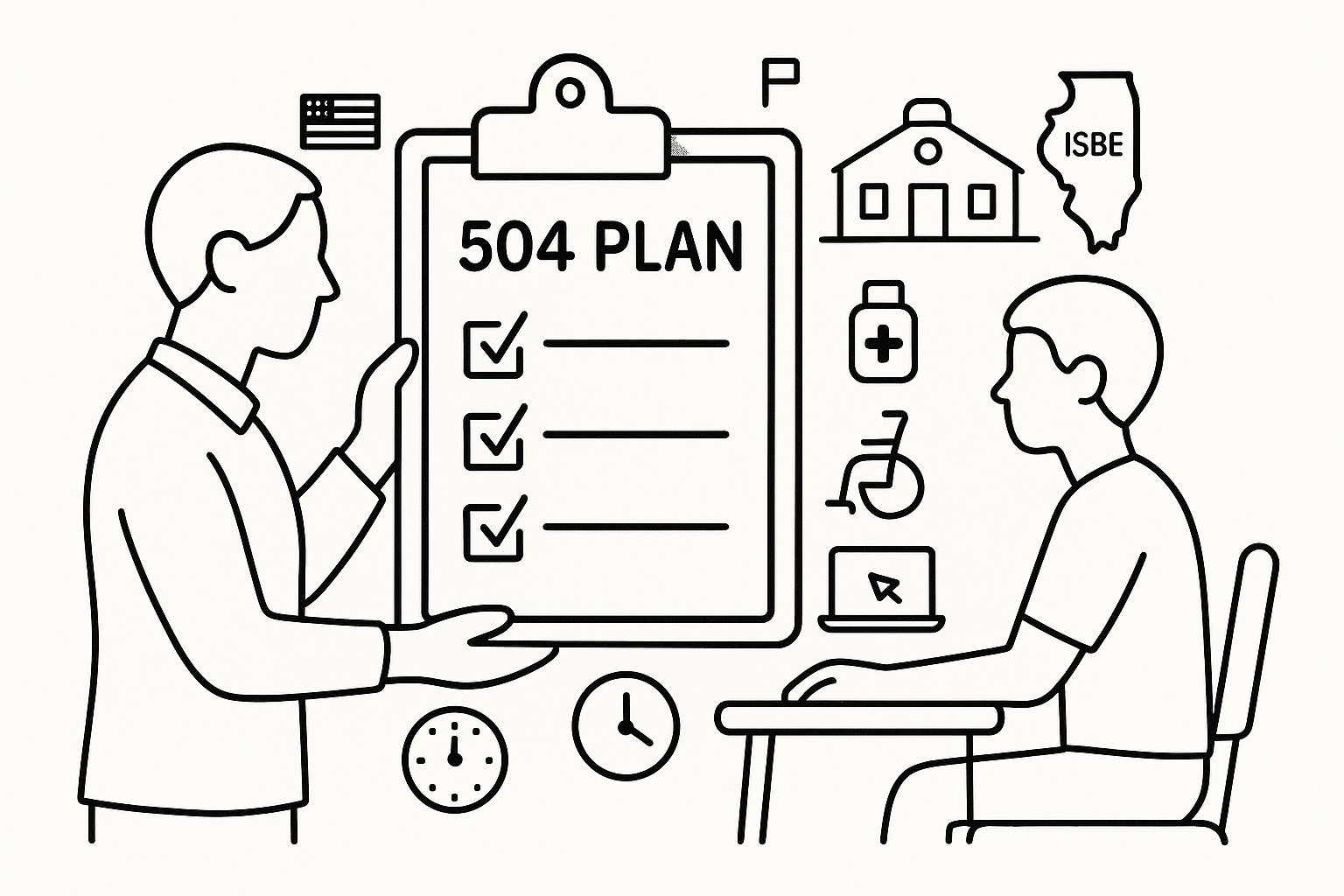
Section 504 of the Rehabilitation Act of 1973 is a federal civil-rights law that prohibits disability-based discrimination in programs receiving federal funds, public K–12 schools included. A 504 plan is not an education program like an IEP: it’s a written plan that describes accommodations and services a student needs so they can access the school environment and curriculum on an equal basis with peers.
Under federal guidance, a covered disability is any physical or mental impairment that substantially limits one or more major life activities (learning, reading, concentrating, walking, seeing, hearing, etc.). Illinois follows this framework but also maintains state-level procedures and guidance through the Illinois State Board of Education (ISBE). Illinois emphasizes timely evaluation, use of existing medical or educational records, and clear documentation of accommodations that are reasonably calculated to provide equal access.
Practically, that means a 504 plan can cover classroom accommodations (preferential seating, extra time), health-related supports (medication administration, emergency action plans), and physical access (assistive technology or environmental changes). Unlike special education services under IDEA, 504 accommodations typically don’t change the curriculum’s learning expectations: they remove barriers so the student can meet them. Schools must also avoid unnecessary labeling and should coordinate with teachers, school nurses, counselors, and families when designing plans.
We recommend documenting medical and educational evidence early, doctor notes, teacher reports, and attendance/discipline records all help show how an impairment affects school life.
Who Qualifies For a 504 Plan in Illinois
Eligibility centers on two questions: 1) Does the student have a disability (physical or mental impairment)? and 2) Does that impairment substantially limit a major life activity at school? The bar isn’t whether the student needs special education: it’s whether they need reasonable accommodations to access education equally.
Examples of conditions commonly qualifying for 504 plans include diabetes, asthma, ADHD, concussions with persistent symptoms, anxiety disorders, major depressive disorder, mobility impairments, visual or hearing impairments, and specific medical conditions that require regular interventions during the school day. Importantly, temporary conditions can qualify if they substantially limit functioning for a significant period (for example, a long recovery from surgery).
Schools should avoid rigid checklists. Under both Section 504 and Illinois policy, evaluations must consider multiple sources: medical records, teacher observations, standardized testing, and parent input. If the student is already receiving accommodations through health plans or private therapists, those records help establish need.
We encourage families to request an evaluation in writing if they believe their child may qualify. A written request starts a timeline and creates documentation if disputes arise later.
How Schools Evaluate Eligibility and Document Disability
When a parent or teacher requests a 504 evaluation, the school will convene a 504 team, typically including the parent, a knowledgeable school official, a teacher, and sometimes the school nurse or counselor. The team reviews available data and decides whether further testing is necessary. Evaluations should be nondiscriminatory and may include classroom observations, behavior rating scales, academic records, and medical documentation.
If the team finds the student eligible, the 504 plan will specify the substantial limitation and match accommodations to that limitation. If the team finds the student ineligible but parents disagree, they can request reconsideration, an impartial hearing, or pursue mediation (more on dispute rights later). Document every interaction: dates, attendees, and materials reviewed, those notes matter if legal steps become necessary.
How a 504 Plan Is Developed and Implemented in Illinois Schools
Developing a 504 plan is a collaborative, problem-solving process. The 504 team’s goal is practical: identify barriers and prescribe reasonable adjustments so the student can access learning. In Illinois, many districts use templates aligned to ISBE guidance: the core components typically include student information, a description of the disability or health condition, the functional impact at school, specific accommodations, responsible staff, and a review date.
Stepwise, the process looks like this: 1) Referral/request for evaluation (by parent, teacher, or staff): 2) Consent and gathering of records: 3) Team meeting to review evidence and determine eligibility: 4) If eligible, drafting the 504 plan with measurable accommodations and implementation details: 5) Communicating the plan to staff and training where necessary: 6) Monitoring and periodic review, usually annually or more often if needed.
Implementation is where plans succeed or fail. A good plan names who will carry out each accommodation (classroom teacher, paraeducator, school nurse), how teachers will be notified, and what fallback steps exist if an accommodation can’t be provided immediately. For medical needs, implementation must coordinate with emergency plans and health office protocols.
We advise parents to request copies of the final 504 plan, ask for a quick staff briefing at the start of implementation, and set a 30- to 90-day check to review whether accommodations are working. If a child’s needs change, reconvene the team, plans are living documents.
Common Accommodations, Modifications, and Examples
504 accommodations are diverse because they respond to specific barriers. Common academic and classroom accommodations include:
- Extended time on tests and assignments
- Preferential seating (near teacher or away from distractions)
- Frequent breaks or a flexible schedule
- Use of assistive technology (text-to-speech, speech-to-text)
- Modified assignments load or alternative formats
- Visual aids, written instructions, or chunked assignments
Health and safety accommodations include:
- Medication administration and permitted self-carry (e.g., inhalers, EpiPens)
- Emergency action plans for chronic conditions like diabetes or epilepsy
- Permission to visit the nurse without penalty for attendance/participation
Behavioral and executive-function supports often overlap with Section 504: daily check-ins with a counselor, behavior intervention strategies, organizers or planners, and cues for transitions.
Examples: A student with ADHD might receive preferential seating, a reduced-distraction testing environment, and a daily planner with teacher check-ins. A student with Type 1 diabetes could have an individualized health plan listing blood-glucose checks during class, snack permissions, and staff training to recognize hypoglycemia.
We stress specificity: effective plans list the accommodation, who provides it, when it applies, and how success will be measured. Vague language like “support as needed” invites inconsistent implementation.
How 504 Plans Differ From IEPs — Key Practical Differences
Although both 504 plans and IEPs support students with disabilities, they differ fundamentally in purpose, legal source, scope, and procedural safeguards.
- Legal source: Section 504 (civil rights law) vs. IDEA (Individuals with Disabilities Education Act). 504 protects access: IDEA provides specialized instruction.
- Eligibility: 504 asks whether the student has a disability that substantially limits major life activities. IDEA requires a qualifying disability category and a need for special education services.
- Services: 504 plans provide accommodations and supports to ensure access. IEPs provide specially designed instruction and related services, often with specific academic goals and progress reporting.
- Procedural safeguards: IDEA includes more formalized procedural protections (detailed IEP meeting requirements, progress reporting, state complaint processes). Section 504 procedural protections exist but are generally less prescriptive: but, Illinois requires schools to follow state guidance and provide notice and impartial hearing rights.
- Placement: IEPs may change the student’s program or placement (e.g., resource room). 504 plans typically keep the student in general education with accommodations.
For parents and professionals, the practical takeaway is this: if the student needs changes to instruction, specialized goals, or frequent pull-out services, an IEP might be appropriate. If the student largely participates in general education and needs access supports, a 504 plan is often the right tool. Sometimes students have both a health plan and a 504: schools should coordinate to avoid gaps.
Parental Rights, Dispute Resolution, and Legal Options in Illinois
Parents have rights under Section 504 and Illinois policy to participate in evaluations, receive written notice of decisions, review records, and request an impartial hearing. If we disagree with a school’s eligibility decision, proposed accommodations, or implementation, there are several steps we can take:
- Informal resolution: Start with the 504 team or building administrator. Request meetings, bring documentation, and propose compromise accommodations.
- Written request for reevaluation or revision: Put concerns in writing and ask the school to reconvene the 504 team.
- ISBE complaint: Illinois parents can file a complaint with the Illinois State Board of Education if they believe the district violated Section 504 or state rules.
- Impartial hearing and due process: Section 504 grants the right to an impartial hearing with an opportunity to present evidence. Illinois provides processes for impartial hearings that parallel federal protections.
- Mediation: Some disputes resolve through mediation, a voluntary, confidential process that can preserve relationships and lead to creative solutions.
- Legal representation: If disputes remain unresolved, parents may pursue administrative appeals or civil litigation. Given the overlap between education and medical issues, families sometimes retain attorneys experienced in both education law and medical-related workplace issues. At Chelle Law we’ve assisted clients in understanding rights and navigating administrative appeals when school-district communications stall, though our core practice focuses on healthcare employment matters.
Document everything: keep copies of evaluation reports, emails, meeting notes, and the 504 plan itself. Time-sensitive actions, such as filing for an impartial hearing, have deadlines, so act promptly once informal steps fail. We usually recommend trying collaborative steps first, but preserving written records early keeps options open.
Frequently Asked Questions About 504 Plans in Illinois
What is a 504 plan under federal law and Illinois policy?
A 504 plan is a written document under Section 504 of the Rehabilitation Act that outlines accommodations a student with a disability needs to access education equally, without altering curriculum expectations. Illinois follows federal guidelines while emphasizing timely evaluation and clear documentation of accommodations.
Who qualifies for a 504 plan in Illinois schools?
Students with a physical or mental impairment that substantially limits one or more major life activities at school, such as learning or concentrating, qualify. Conditions like asthma, ADHD, anxiety, or diabetes often qualify. Temporary impairments with significant impact may also be eligible.
How is eligibility for a 504 plan determined in Illinois?
A team including parents and school staff reviews medical, educational, and observational data to decide if the student has a disability substantially limiting major life activities at school. Evaluations are nondiscriminatory and consider multiple sources like teacher reports and medical records.
What types of accommodations are commonly included in a 504 plan?
Common accommodations include extended test time, preferential seating, assistive technology, medication administration, emergency health plans, flexible scheduling, and behavioral supports like daily counselor check-ins, tailored to remove barriers while maintaining standard learning goals.
How do 504 plans differ from Individualized Education Programs (IEPs)?
504 plans provide civil rights protections ensuring equal access through accommodations without changing instruction. IEPs, under IDEA, deliver specialized instruction and goals. Eligibility criteria, services offered, procedural safeguards, and placement options also differ between the two.
What rights and dispute options do parents have regarding 504 plans in Illinois?
Parents have the right to participate in evaluations, receive notices, review records, and request hearings if they disagree with decisions. They can seek informal resolution, file complaints with the Illinois State Board of Education, request impartial hearings, pursue mediation, or engage legal representation.