
Last Updated on April 20, 2026 by Jennifer Hanson
When a student’s anxiety interferes with learning, a Section 504 plan can level the playing field. We’ll walk you through who qualifies, the legal points to keep in mind, and the exact language that makes a strong 504 request letter for anxiety. Whether you’re a parent, guardian, or provider preparing the request, this guide gives a clear template plus a filled example you can adapt. Our goal is practical: help you submit a concise, persuasive letter that gets the process started and protects the student’s rights.
In this guide, How To Write A 504 Request Letter For Anxiety A StepByStep Sample 038 Template 2026 is explained with clear steps and tips.
Key Takeaways — How To Write A 504 Request Letter For Anxiety A StepByStep Sample 038 Template 2026
- A sample 504 request letter for anxiety should clearly identify the student, state the request for a Section 504 evaluation, and describe how anxiety impacts school functioning.
- Including medical or clinical documentation that supports the diagnosis and functional limitations strengthens the 504 request letter for anxiety.
- Specific accommodation requests such as extra test time, preferential seating, and breaks help schools tailor effective support plans.
- Submitting the 504 request via traceable methods and requesting written confirmation ensures proper tracking and follow-up.
- A clear, concise 504 request letter speeds the evaluation process and helps protect the student’s rights to equal educational access.
Who Qualifies For A 504 Plan And Key Legal Considerations For Anxiety
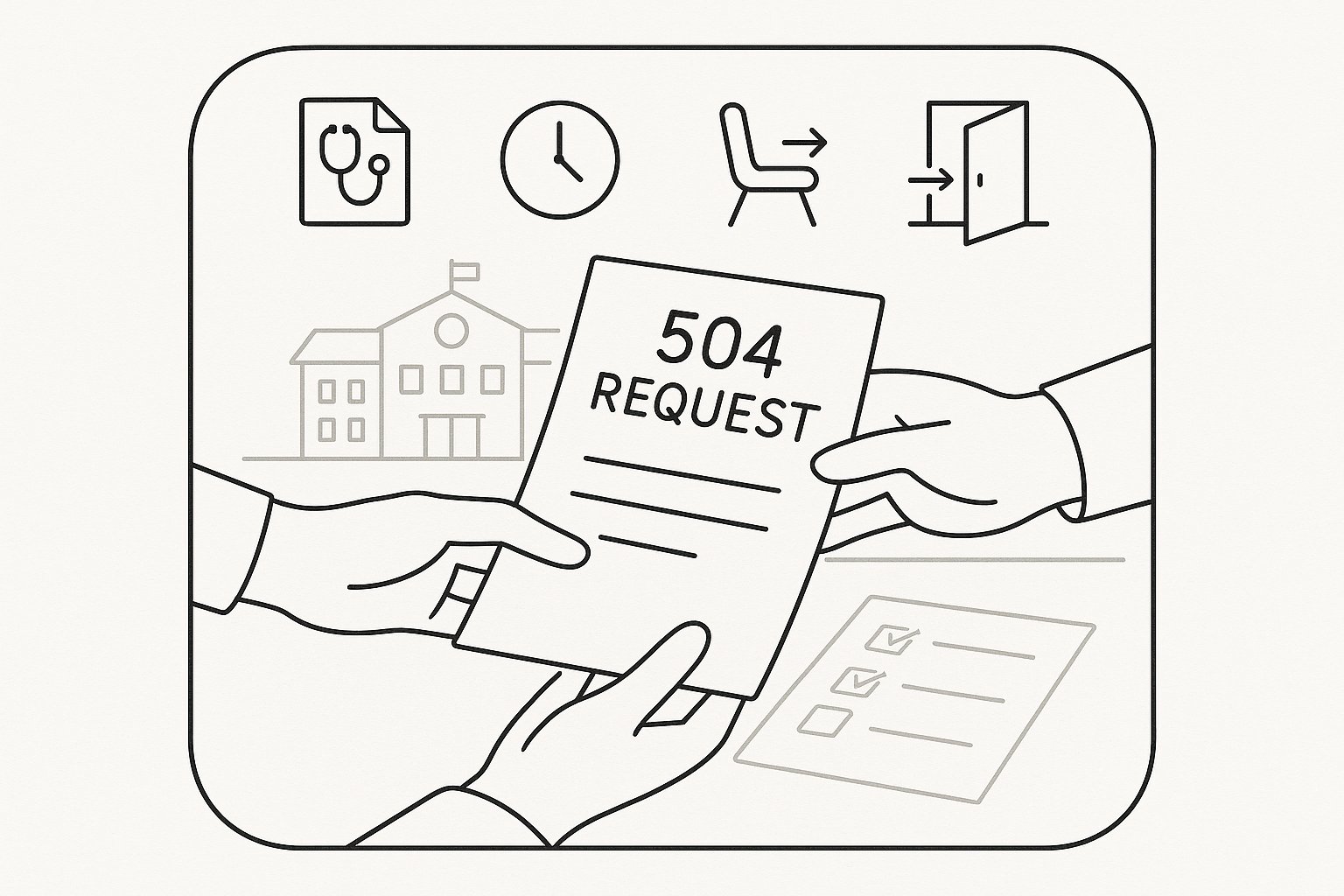
A Section 504 plan covers students with a physical or mental impairment that substantially limits one or more major life activities, including learning, concentrating, and interacting with others. Anxiety disorders (generalized anxiety disorder, panic disorder, social anxiety, and others) often meet this standard when symptoms meaningfully impede school performance or access to classroom instruction.
Who typically qualifies: students whose anxiety causes frequent school avoidance, panic attacks during class, severe difficulty completing assignments, or the need for extended breaks or reduced testing conditions. Qualification is not limited to students with an IEP: 504 is a civil-rights protection under the Rehabilitation Act.
Key legal considerations we emphasize:
- Documentation: Schools will look for medical or psychological documentation that explains diagnosis and functional impact. A note from a pediatrician, licensed therapist, or psychiatrist describing how anxiety affects school activities strengthens the request.
- Timeline and notice: Schools must evaluate requests promptly. If the school declines, parents have procedural rights to appeal and request a due-process hearing or file a complaint with the Office for Civil Rights.
- Least restrictive accommodations: 504 plans should provide accommodations that permit access without fundamentally altering the curriculum. Examples for anxiety include preferential seating, extra time, testing in a separate room, or a plan for safe exits during panic attacks.
We recommend starting the conversation with the school team and collecting any supporting records before submitting a formal 504 request letter. If you work in healthcare or legal fields, consider providing a clear, plain‑language statement tying symptoms to functional limitations, that’s what school teams need to act.
Essential Elements To Include In Your 504 Request Letter
A strong 504 request letter is short, specific, and organized. Include these elements to make the school’s evaluation straightforward:
- Identifying information: student’s full name, date of birth, grade, school, and your relationship to the student (parent, guardian, or provider). Add contact information for follow-up.
- Statement of request: a clear sentence asking the school to evaluate the student for a Section 504 plan due to anxiety-related impairments. Use the phrase “Section 504” so there’s no ambiguity.
- Functional impact: describe in concrete terms how anxiety affects the student’s school day, e.g., missed classes, inability to complete tests, panic attacks during transitions, or concentration issues that require modified assignment deadlines.
- Medical/clinical support: note enclosed or forthcoming documentation from a licensed professional. If no formal diagnosis exists yet, include observations, school records, or behavior logs that show the impairment.
- Specific accommodations requested: suggest reasonable accommodations based on the student’s needs (preferential seating, extra test time, breaks during class, a hallway pass, check‑ins with a counselor, reduced assignments load during flare-ups). Schools aren’t bound to every request, but specific suggestions help the team design an appropriate plan.
- Request for action and timeline: ask for an evaluation within a reasonable time frame (we often request 10 business days) and ask for written confirmation that the school received the request.
- Signature and date: sign and date the letter: keep a copy and send it via a traceable method (email to the 504 coordinator and principal plus certified mail, if you want proof).
Including these elements reduces back-and-forth, speeds evaluation, and documents your good-faith effort to secure accommodations.
Sample 504 Request Letter Template With Fill‑In Example
Below is a concise, adaptable template we use when advising families. It’s written so you can copy, paste, and fill in the blanks. Keep the tone factual and focused on function rather than emotions.
Template (fill in the bracketed fields):
[Date]
[Principal’s Name]
[School Name]
[School Address]
Re: Request for Section 504 Evaluation for [Student Name], DOB: [MM/DD/YYYY]
Dear [Principal/504 Coordinator Name],
We are writing to request a Section 504 evaluation for our child, [Student Name], who is in [Grade/Class] at [School Name]. [Student Name] has been experiencing anxiety that substantially limits [his/her/their] ability to access the educational program. Specifically, [briefly describe how anxiety affects school functioning: e.g., frequent panic attacks, inability to complete tests, missed school days, difficulty with transitions].
We are providing documentation from [provider name/clinic], which confirms [diagnosis or description of symptoms] and describes the functional limitations. Based on these limitations, we request that the school evaluate [Student Name] for accommodations including but not limited to: [list specific accommodations requested].
Please confirm receipt of this request in writing and advise us of the next steps for assessment. We appreciate your prompt attention and request that the evaluation begin within 10 business days.
Sincerely,
[Parent/Guardian Name]
[Phone]
[Email]
[Address]
If you prefer, attach this template to an email and request a read receipt, then follow up with a printed copy. Keep all confirmations and any school responses in a folder, those records help if later advocacy or legal assistance is needed.
Sample Letter: Completed Example For A Student With Anxiety (Fill‑In Fields Shown)
Date: August 15, 2026
Ms. Lauren Davis, Principal
Maple Ridge Middle School
123 School Lane
Hometown, ST 00000
Re: Request for Section 504 Evaluation for Emily Johnson, DOB: 04/12/2012
Dear Ms. Davis and 504 Coordinator,
We are writing to request a Section 504 evaluation for our daughter, Emily Johnson, who is entering 7th grade at Maple Ridge. Emily has a history of generalized anxiety disorder that substantially limits her ability to participate fully in school. Over the past school year she experienced frequent panic episodes during transitions between classes, missed multiple days due to anxiety, and is frequently unable to complete timed tests because of concentration difficulties.
We have enclosed a letter from Dr. Karen Lee, PsyD (Licensed Clinical Psychologist), dated August 10, 2026, which documents Emily’s diagnosis and describes the functional limitations. Based on Emily’s needs, we request the school evaluate her for accommodations including: preferential seating near the door, permission to take breaks and use a quiet room during severe anxiety episodes, extended time for tests (time-and-a-half), the ability to take make-up tests without penalty after anxiety-related absences, and daily brief check‑ins with the school counselor.
Please confirm receipt of this request in writing and advise us of the timeline and next steps for assessment. We request the evaluation process begin within 10 business days. Thank you for your prompt attention to Emily’s needs.
Sincerely,
Samantha and David Johnson
(555) 123-4567
samantha.johnson@email.com
456 Parent Way
Hometown, ST 00000
This example shows how to be specific yet concise: name dates, describe functional effects, attach clinical documentation, and propose reasonable accommodations. Schools will appreciate a clear roadmap.
How To Submit The Letter, What To Expect Next, And Tips For Follow‑Up
Submission best practices:
- Send to the school principal and the 504 coordinator (if known). Copy the child’s teacher and the school counselor when appropriate.
- Use both email (with read receipt) and certified mail, or deliver in person and request a dated receipt. Maintain copies of everything.
What to expect after submission:
- Acknowledgment: The school should acknowledge receipt and schedule an initial meeting or evaluation within a reasonable time. State laws vary, but we recommend asking for confirmation within 10 business days.
- Evaluation: The school will assemble a team to review records, teacher input, and any medical documentation. They may request permission to conduct assessments or ask for additional information from providers.
- Meeting: A 504 team meeting will be scheduled to determine eligibility and, if eligible, develop accommodations. Attend prepared with notes, examples, and your accommodation suggestions.
- Implementation and review: Once a plan is adopted, the school must carry out reasonable accommodations. Plans should include a review date and a process for revising accommodations if they prove insufficient.
Follow‑up tips we recommend:
- Be persistent but collaborative. Frame requests as working together to remove barriers to learning.
- Keep a symptom log and notes about when accommodations help or don’t, specific examples matter in meetings.
- If the school denies the request, ask for the reasons in writing and consult the school district’s 504 procedural safeguards. You can file an internal complaint, contact the state education agency, or reach out to the Office for Civil Rights.
- If you want legal help, seek counsel experienced with education law in your state. For healthcare professionals concerned about contract or employment implications when supporting students, consider counsel familiar with education-related documentation.
Thoughtful record-keeping and polite persistence usually produce the best outcomes.
Conclusion
A clear, focused 504 request letter for anxiety speeds the path to needed supports. We recommend documenting the functional impact, attaching clinical information, proposing specific accommodations, and sending the request via traceable methods. Stay collaborative but firm: you’re protecting the student’s right to equal access. If the process becomes difficult, consult educational or legal advocates to ensure the student gets fair evaluation and effective accommodations.
Frequently Asked Questions About Section 504 Request Letters for Anxiety
What is a Section 504 request letter for anxiety?
A Section 504 request letter for anxiety is a formal document parents or guardians submit to a school, requesting an evaluation to determine if a student with anxiety qualifies for accommodations that help them access education equally.
Who qualifies for a 504 plan based on anxiety?
Students with anxiety who experience significant challenges like frequent panic attacks, school avoidance, or difficulty completing assignments may qualify if their condition substantially limits major life activities such as learning or concentrating.
What key elements should I include in a 504 request letter for anxiety?
Your letter should include student details, a clear request for evaluation under Section 504, a description of how anxiety affects school functioning, documentation from a healthcare provider, specific accommodation requests, and a timeline for action.
How can I submit the 504 request letter effectively?
Send the letter to the school principal and 504 coordinator via email with a read receipt and certified mail, or deliver in person requesting a dated receipt. Keep copies and all communication records for follow-up.
What accommodations can a student with anxiety request under a 504 plan?
Common accommodations include preferential seating, extra test time, breaks during class, use of a quiet room, permission for make-up tests, and regular check-ins with a counselor to manage anxiety symptoms in school.
What should parents do if the school denies the 504 request?
Parents should request a written explanation, review the school’s procedural safeguards, file a complaint with the school district or Office for Civil Rights, and consider consulting a legal advocate familiar with education law.