
Last Updated on April 20, 2026 by Jennifer Hanson
When families and educators ask, “What are IEP goals for writing?” they’re looking for clear, usable objectives that turn a broad need into classroom progress. We’ll walk through the legal purpose of writing goals, the elements that make them measurable and student-centered, and real sample goals you can adapt. Our aim is practical: to help teams craft IEP writing goals that guide instruction, support progress monitoring, and hold schools accountable, without getting lost in jargon.
In this guide, IEP Writing Goals That Work A Practical Guide To Measurable Student-Centered Objectives 2026 is explained with clear steps and tips.
Key Takeaways — IEP Writing Goals That Work A Practical Guide To Measurable Student-Centered Objectives 2026
- IEP goals for writing are specific, measurable objectives designed to address a student’s unique writing challenges and guide specialized instruction.
- Effective writing goals must link to a student’s present levels of performance and include clear conditions, accuracy criteria, and timelines for progress monitoring.
- Writing goals should focus on skills essential for the student’s academic success, with documented supports and accommodations to ensure access to instruction.
- Regular progress monitoring using assessment tools is critical to evaluate student growth and adjust instruction timely.
- Sample IEP writing goals include targeted areas such as handwriting, spelling, grammar, and written expression, each with measurable criteria and support strategies.
- Crafting measurable IEP writing goals helps hold schools accountable while fostering tangible improvements in a student’s writing abilities.
Understanding IEP Writing Goals: Purpose, Legal Basis, And When They Apply
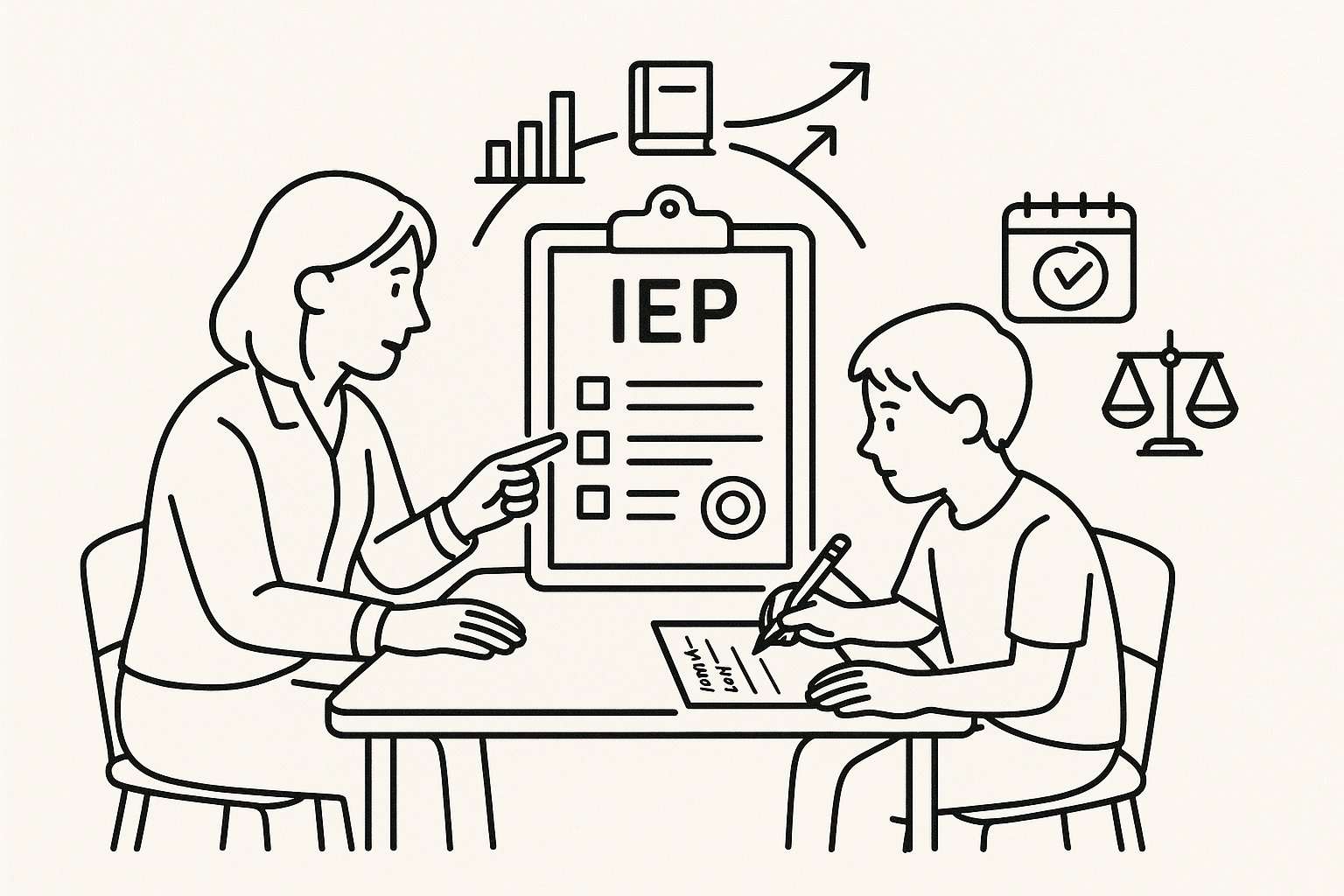
Individualized Education Program (IEP) writing goals exist to ensure a student with a qualifying disability receives specialized instruction and related services tailored to their unique writing needs. Legally, goals are required under the Individuals with Disabilities Education Act (IDEA) as part of a student’s IEP when the disability affects educational performance. Practically, a writing goal translates an identified deficit, for instance, difficulty organizing ideas or frequent spelling errors, into a measurable objective the team can teach and evaluate.
We treat goals as both instructional roadmaps and accountability tools. They specify what the student will learn, how the school will teach or support that learning, and how progress will be measured. An effective writing goal is linked to present levels of performance (PLOP) derived from assessments and classroom work. It applies whenever writing challenges materially impact access to the general curriculum, from producing legible handwriting in early grades to composing multi-paragraph essays in secondary school.
Because school teams must revisit IEPs annually (or sooner if needed), we view writing goals as living documents: they should be updated when baseline data changes, when interventions are ineffective, or when the student meets the goal and needs a new target.
Core Elements Of A Measurable Writing Goal
A measurable writing goal has several interlocking pieces that make it teachable and reportable. At minimum it includes the target skill, the conditions for performance, the level of accuracy or frequency expected, and the timeline. When these elements are clear, parents and educators can objectively determine whether the student is making progress.
We emphasize that writing goals should connect to classroom expectations while remaining individualized. That means the skill targeted should be necessary for the student’s academic success (not simply a generic classroom standard), and supports or accommodations should be documented so everyone knows how the student will access instruction.
Finally, progress monitoring procedures, what assessment tools will be used and how often data will be collected, must be part of the plan. Without regular data, anecdote replaces evidence and teams lose their ability to make timely instructional changes.
Concrete IEP Writing Goal Examples By Skill Area
Below are adaptable samples organized by common writing skill areas. We present them as templates, you’ll want to tailor condition, accuracy rate, and timeline to the student’s baseline and supports.
Handwriting
- Goal: Given daily guided practice and fingertip-cue prompts, the student will produce legible manuscript letters on lines with correct spacing on 9 out of 10 opportunities across three consecutive weeks.
Spelling
- Goal: Using weekly spelling lists and a multisensory strategy, the student will correctly spell 18 of 20 grade-level words on dictation across three of four weekly probes.
Grammar/Conventions
- Goal: When editing a 150–200 word draft with a checklist, the student will identify and correct subject-verb agreement and verb tense errors in 80% of opportunities over six successive assignments.
Composition & Written Expression
- Goal: Given a graphic organizer and 30 minutes to write, the student will produce a cohesive paragraph with a topic sentence, three supporting details, and a concluding sentence in 4 out of 5 trials as measured by a 4-point rubric by the end of the semester.
We make a point to include supports (e.g., graphic organizers, assistive tech, scribe) and the exact metric to avoid puffier language like “improve writing.” These templates work across grades by adjusting length expectations, rubric sophistication, and word counts.
Conclusion
When we answer “What are IEP goals for writing?” the short answer is: specific, measurable targets that connect a student’s present abilities to classroom expectations and clear instruction. By using SMART language, documenting baseline data, setting benchmarks, and specifying supports, teams create goals that guide teaching and show progress. If you need help translating assessment data into defensible goals, or if legal clarity about services is necessary, professionals who understand both special education practice and legal protections can help ensure the IEP truly supports the student’s writing growth.
Frequently Asked Questions about IEP Goals for Writing
What are IEP goals for writing?
IEP goals for writing are specific, measurable objectives tailored to a student’s unique writing needs that guide instruction and track progress within their Individualized Education Program.
Why are measurable writing goals important in an IEP?
Measurable writing goals ensure that writing objectives are clear, teachable, and allow educators and families to objectively assess student progress using defined criteria and timelines.
How do writing goals in an IEP support a student’s academic success?
Writing goals connect a student’s present performance to classroom expectations by targeting necessary skills and specifying supports, allowing for personalized instruction that improves writing ability and curriculum access.
What elements should an effective IEP writing goal include?
An effective writing goal includes the target writing skill, conditions for performance, expected accuracy or frequency, timeline, and documented supports to tailor instruction to the student’s needs.
Can you give an example of a writing goal related to composition?
Yes. For example, a goal might state: Given a graphic organizer and 30 minutes, the student will write a cohesive paragraph with a topic sentence, three details, and a conclusion in 4 out of 5 trials, measured by a rubric by semester’s end.
How often should IEP writing goals be reviewed or updated?
IEP writing goals should be reviewed at least annually or sooner if baseline data changes, interventions are ineffective, or when the student meets a goal and requires new targets to continue progress.