
Last Updated on April 20, 2026 by Jennifer Hanson
When schools, therapists, and families talk about improving outcomes for students with disabilities, “evidence-based practices in special education” keeps coming up. But what does that phrase actually mean in everyday classrooms and IEP meetings? In this guide we cut through jargon to explain the concept, show the classroom strategies supported by research, and give practical steps for evaluating evidence and applying these practices in Individualized Education Programs (IEPs). Whether you’re a parent, teacher, or administrator, we want to make evidence actionable so students get instruction that is both effective and defensible.
In this guide, What Are Evidence-Based Practices In Special Education A Practical Guide For Schools And Families 2026 is explained with clear steps and tips.
Key Takeaways — What Are Evidence-Based Practices In Special Education A Practical Guide For Schools And Families 2026
- Evidence-based practices in special education use research-backed methods to improve outcomes for students with disabilities effectively and reliably.
- Explicit instruction, including clear objectives, modeling, guided practice, and feedback, is central to many successful special education programs.
- Evaluating evidence involves checking study design, sample relevance, outcome validity, replication, and fidelity of implementation.
- Implementing evidence-based practices in IEPs requires assessing student needs, selecting supported interventions, monitoring progress, and documenting details clearly.
- Using evidence-based practices ensures that special education services meet legal and ethical standards while encouraging transparency and collaboration among families and schools.
What Evidence-Based Practices Really Mean In Special Education
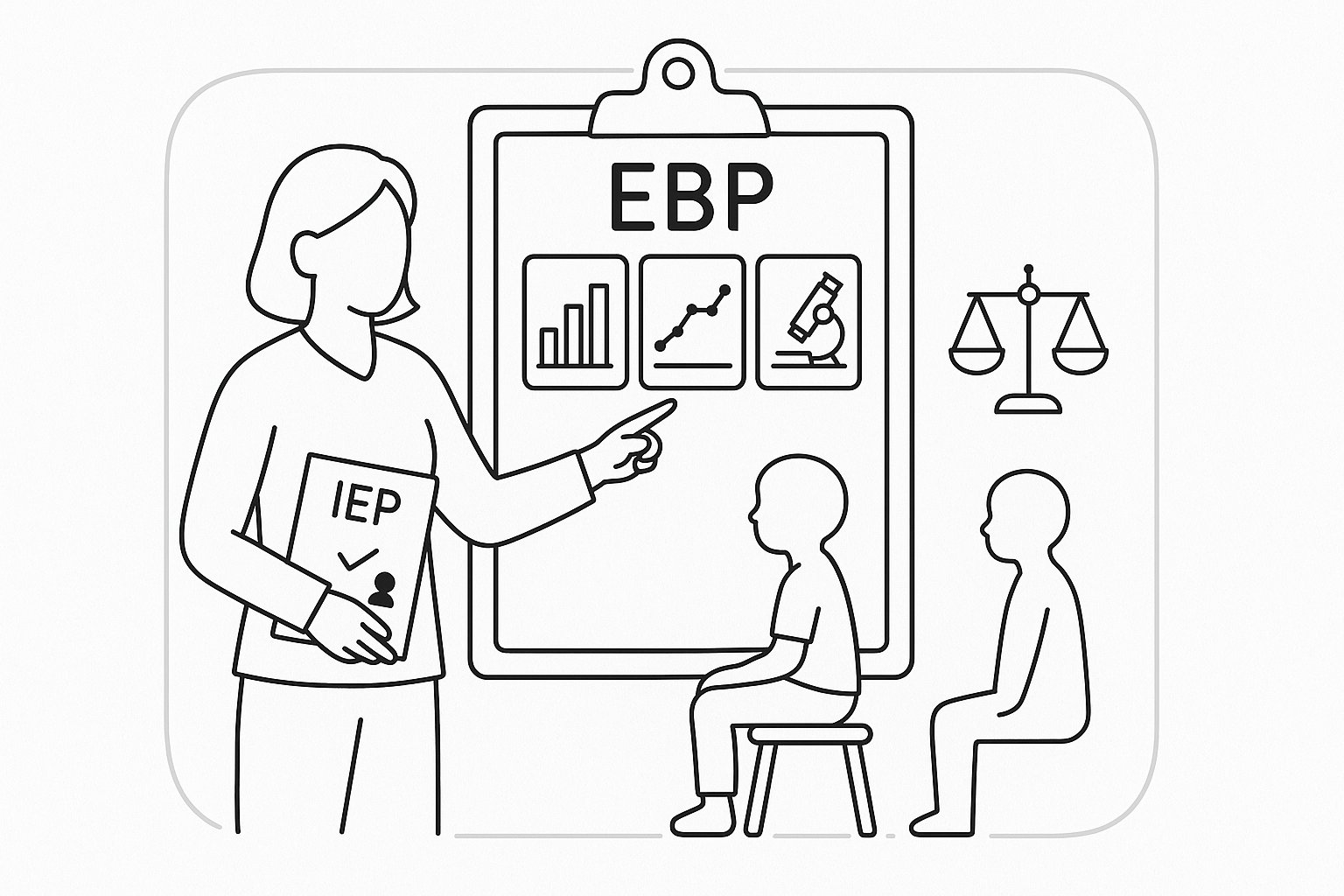
Evidence-based practices (EBPs) in special education are instructional methods and interventions that have been tested systematically and shown to produce measurable improvements for students with disabilities. Unlike approaches based on tradition, intuition, or single anecdotes, EBPs rely on empirical studies, randomized trials, quasi-experimental designs, or well-controlled single-case research, that demonstrate positive effects on learning, behavior, communication, or daily living skills.
We should be clear: evidence exists on a continuum. A practice supported by multiple randomized controlled trials carries more weight than one backed by a single small study. Context matters too, what works for a middle-school student with autism in one setting might need adaptation for a preschooler with developmental delays. The core idea is that decisions about instruction and supports are grounded in data, transparent about expected outcomes, and open to monitoring and adjustment.
Framing practices as evidence-based also helps schools meet legal and ethical expectations. When we recommend goals and services on IEPs, documenting the evidence behind those recommendations strengthens the program and protects schools and families if disputes arise. That’s one reason we recommend pairing clinical judgment with available research when planning interventions.
Core Evidence-Based Strategies Used In Classrooms
A number of classroom strategies have consistent research support across age groups and disabilities. Below are widely recognized EBPs that we see make a difference when implemented with fidelity:
- Explicit instruction and systematic teaching
- Direct, frequent feedback and corrective feedback
- Systematic prompting and prompt fading
- Positive behavior supports and functional behavior assessment
- Peer-mediated interventions and cooperative learning
- Task analysis and chaining for complex skills
- Visual supports and structured routines
These strategies aren’t silver bullets: their effectiveness increases when matched to student needs, monitored with data, and integrated into a team-based plan that includes families. The next subsection breaks down explicit instruction, since it’s central to many special education programs.
Explicit Instruction: What It Looks Like And Why It Works
Explicit instruction is a clear, structured approach where teachers model skills, guide practice, provide corrective feedback, and gradually release responsibility to the student. In practice, it looks like these steps:
- Clear learning objective stated and modeled.
- Teacher demonstration with think-alouds.
- Guided practice with immediate feedback.
- Independent practice with mastery criteria.
- Ongoing progress monitoring and reteaching as needed.
Why it works: explicit instruction reduces ambiguity and cognitive load, which benefits learners who struggle with executive function, language, or attention. The combination of modeling, scaffolding, and frequent feedback creates repetition with variation, essential for durable learning. Research shows explicit instruction reliably improves reading, math, and language outcomes for students with learning disabilities when teachers carry out the steps faithfully and monitor progress.
How To Evaluate The Quality Of Evidence And Research
Not all studies are created equal. When we evaluate evidence for a practice, we look at several factors:
- Research design: randomized controlled trials and well-executed single-case designs rank higher than uncontrolled case reports.
- Sample characteristics: does the study include students similar in age, disability, language, and setting to the student we’re serving?
- Outcome measures: are the outcomes meaningful, academic, functional, or behavioral, and measured with valid tools?
- Replication: have independent teams replicated the findings across settings and populations?
- Implementation fidelity: did the study check whether practitioners delivered the intervention as intended?
Practical steps for schools and families:
- Consult reputable clearinghouses (for example, the What Works Clearinghouse or professional organizations’ reviews) and peer-reviewed journals.
- Look for meta-analyses and systematic reviews that synthesize multiple studies rather than relying on single reports.
- Ask questions during team meetings: “What evidence supports this approach for students like ours?” and “How will we measure progress?”
We also caution against overgeneralizing. A practice supported in tightly controlled research may require adaptation for everyday classrooms: those adaptations should be tracked and evaluated locally.
Implementing Evidence-Based Practices In Individualized Education Programs (IEPs)
Translating EBPs into IEPs requires three honest steps: assess the student, match interventions to needs, and monitor outcomes. Here’s a practical workflow we recommend:
- Baseline and assessment: use standardized and curriculum-based measures to understand current performance and underlying skill gaps.
- Select interventions with supporting evidence for the targeted skill and population. Document the rationale on the IEP, cite study types or reviews where possible.
- Specify how the strategy will be delivered: who, where, frequency, duration, materials, and fidelity checks.
- Set measurable annual goals and short-term benchmarks tied to the intervention.
- Monitor progress frequently (weekly or biweekly for many interventions) and keep data to guide adjustments.
Example: if a third-grade student with reading disability needs decoding support, the IEP might specify 30 minutes daily of a structured, explicit phonics program delivered by a trained specialist, with weekly curriculum-based measures and quarterly review.
We stress team communication. Families should understand the evidence behind chosen strategies and how they’ll be measured. Teachers and service providers need training and time to carry out with fidelity. When districts document these details, programs become both more effective and more defensible legally, important when disputes surface or when services need to be justified during due process.
Legal, Ethical, And Practical Considerations For Schools And Families
Evidence-based practices intersect with law and ethics in several ways. Under IDEA and related laws, schools must provide services that are reasonably calculated to enable progress, using EBPs strengthens that position. But, legal standards don’t require the “best” or most cutting-edge intervention: they require an individualized program supported by sound methods and data.
Ethically, we must balance innovation with caution. New or experimental practices should be transparent, voluntary for families, and monitored closely. Families have the right to ask about the evidence behind recommended services and to request independent evaluations.
Practical concerns often drive implementation challenges: staffing, training, time, and materials. Schools should plan for professional development and fidelity monitoring. Families can support implementation by sharing observations, reinforcing strategies at home, and asking for clear progress reports.
When conflicts arise, such as disagreements about services or evidence, early, collaborative problem-solving usually works best. If resolution fails, families and districts may need mediation or legal counsel. Given our practice focuses on healthcare and employment contracts, we also see overlap: clinicians and school-employed providers need clarity in contracts and role definitions when delivering specialized interventions, and those contractual terms can affect continuity of services.
Conclusion
Evidence-based practices in special education are tools, not mandates, that help us design instruction that’s more likely to produce meaningful gains. By understanding what counts as evidence, choosing strategies that match a student’s needs, and documenting implementation and progress, schools and families can make decisions that are both effective and legally sound. We encourage teams to prioritize transparency, measurement, and collaboration, so every IEP reflects practices that give students the best chance to succeed.
Frequently Asked Questions About Evidence-Based Practices in Special Education
What are evidence-based practices in special education?
Evidence-based practices (EBPs) in special education are instructional methods proven through rigorous research to help students with disabilities improve learning, behavior, and daily skills. They rely on studies like randomized controlled trials rather than tradition or anecdote.
Why is explicit instruction important in special education?
Explicit instruction is a structured teaching approach that models skills, provides guided and independent practice, and offers corrective feedback. It reduces confusion and supports learners with challenges in attention or language, improving outcomes in reading, math, and language.
How do schools evaluate the quality of evidence for special education strategies?
Schools assess research design, participant similarity, meaningful outcomes, replication of results, and implementation fidelity. They consult reputable clearinghouses and systematic reviews to ensure interventions are supported by strong, applicable data.
How are evidence-based practices integrated into Individualized Education Programs (IEPs)?
Integration involves assessing the student, selecting interventions with research support, specifying delivery details, setting measurable goals, and monitoring progress frequently. This ensures instruction is tailored, documented, and effective for each student.
What legal and ethical considerations surround evidence-based practices in special education?
Using EBPs helps schools meet legal requirements to provide effective services, though not necessarily the newest methods. Ethically, schools must balance innovation with transparency, allow family input, and monitor new approaches carefully.
Can evidence-based practices be adapted for different students and settings?
Yes, EBPs may require adaptation to fit different ages, disabilities, or classroom environments. These modifications should be tracked and evaluated locally to maintain effectiveness while meeting individual needs.