
Last Updated on July 8, 2026 by Jennifer Hanson
When we step into an Individualized Education Program (IEP) meeting or talk with special education providers, we often hear a compact vocabulary of phrases that carry heavy meaning. These sayings, short, familiar expressions used by educators, therapists, and case managers, help teams move decisions along, but they can also confuse families who aren’t fluent in the shorthand. In this text we unpack the most common special education sayings, explain what they actually mean, and show how to use them constructively at meetings so teams make clearer, fairer decisions for students.
In this guide, What Are Special Education Sayings 12 Phrases Their Meanings And How To Use Them In IEP Meetings 2026 is explained with clear steps and tips.
Key Takeaways — What Are Special Education Sayings 12 Phrases Their Meanings And How To Use Them In IEP Meetings 2026
- Special education sayings condense complex legal and educational concepts into brief phrases that assist IEP teams in making informed decisions.
- Understanding and clarifying common sayings like “Least Restrictive Environment” and “data-driven” helps families and educators ensure fair and effective student support.
- Turning sayings into actionable steps with defined timelines, responsible individuals, and measurable outcomes increases the effectiveness of special education planning.
- Families should request plain-language explanations and concrete examples during meetings to protect student rights and enhance collaboration.
- Using strength-based, person-first language and revisiting phrases after implementation encourages clarity and improves intervention success.
- Bringing agreed-upon definitions and decisions to IEP meetings helps maintain focus, accountability, and clear next steps for student progress.
Why Sayings Matter In Special Education Settings
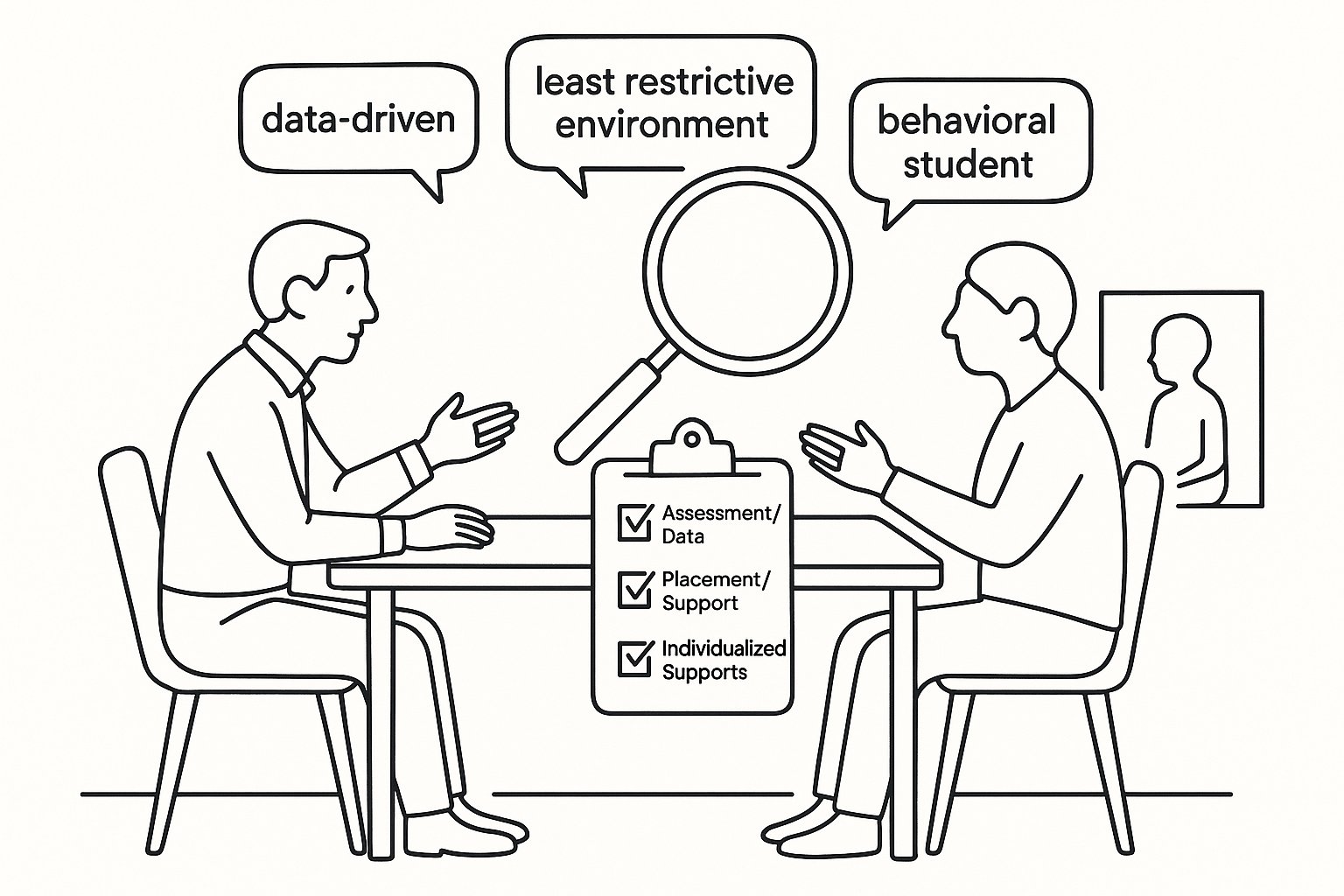
Sayings matter because they condense complex practice, policy, and judgment into bite-sized phrases. That compression can be efficient, allowing teams to communicate quickly across disciplines, but it can also obscure nuance and lead to assumptions. When we hear phrases like “data-driven” or “least restrictive environment,” we should recognize that those words summarize a set of legal obligations, evidence standards, and daily classroom realities.
Two practical reasons sayings are important: they shape expectations and they influence decisions. If a teacher says a student is a “behavioral student,” that label can set an expectation that behavior is the central issue, which may narrow the IEP team’s attention away from academic, sensory, or medical contributors. Conversely, precise use of sayings can help teams arrive at appropriate supports faster, if everyone agrees on definitions and follows them.
We should also remember power dynamics. Families may feel rushed or intimidated when professionals use jargon. Insisting on plain-language explanations and asking for concrete examples of how a phrase maps to services or supports helps protect a student’s rights and keeps meetings productive. In short: sayings streamline conversation, but only when we stop to translate them into actionable details.
12 Common Special Education Sayings, What They Actually Mean, And Real-World Examples
Below are twelve sayings you’ll commonly hear in special education settings, followed by what they mean and a short, real-world example so the phrase becomes immediately useful.
- “Least Restrictive Environment (LRE)”, Meaning: Students should be educated with peers without disabilities to the maximum extent appropriate. Example: Instead of full-time separate classroom placement, the team explores push-in support during math and a part-time resource room for reading.
- “Data-driven”, Meaning: Decisions are supported by measurable information (assessments, progress monitoring). Example: A teacher shares weekly reading fluency scores to justify increasing small-group instruction.
- Present Levels of Academic Achievement and Functional Performance (PLAAFP)”, Meaning: A snapshot of the student’s current skills and how disability affects involvement. Example: The PLAAFP notes grade-level math reasoning but below-grade reading comprehension and difficulty with sustained attention.
- “Related services”, Meaning: Supports beyond classroom instruction (speech, OT, PT, counseling). Example: An OT consult for fine motor delays and a speech-language pathologist for pragmatic language goals are added to the IEP.
- Functional Behavior Assessment (FBA)”, Meaning: Systematic analysis to identify why a behavior occurs. Example: After an FBA, a team finds a student acts out to avoid difficult tasks and adds task modification and a graduated prompting plan.
- Behavior Intervention Plan (BIP)”, Meaning: A plan that outlines strategies to reduce problematic behaviors identified in the FBA. Example: The BIP includes reinforcement for task completion and scheduled sensory breaks.
- “Supplementary Aids and Services”, Meaning: Supports provided in general education to help the student participate. Example: Providing preferential seating, visual schedules, and a peer note-taker.
- “Least restrictive assistive tech”, Meaning: Tools that help independence without unnecessarily separating the student. Example: A tablet with text-to-speech in class rather than pulling the student out for specialized instruction.
- “Eligibility”, Meaning: Whether a student meets criteria for special education under IDEA. Example: The team reviews evaluation results and determines the student qualifies for services under Specific Learning Disability.
- “Transition planning”, Meaning: Preparing older students for post-school life, including work and independent living. Example: The IEP includes vocational assessments and community-based instruction beginning at age 14.
- “Progress monitoring”, Meaning: Regular checks to see if the student is meeting IEP goals. Example: We review biweekly goal probes showing steady gains in number sense.
- “Accommodations vs. Modifications”, Meaning: Accommodations change how a student learns (same standard, different access): modifications change what is expected. Example: Allowing extra time on tests (accommodation) vs. simplifying grade-level assignments (modification).
For each saying, we recommend asking: “How will this look in practice?” and “What evidence will show it’s working?” That turns jargon into measurable commitments.
How Teachers, Parents, And Providers Can Use Sayings Constructively
We can all use sayings constructively by turning them into shared actions and evidence-based expectations. Here are practical habits teams should adopt:
- Define terms at the start of a meeting. A quick mutual definition prevents misinterpretation. For instance, agree what “accommodations” will be implemented and who will monitor them.
- Translate into timelines and owners. If a speech goal is added, name the provider, frequency, and measurement, don’t leave “speech” as a vague promise.
- Request and review concrete data. When someone says “data-driven,” ask for the actual probes, graphs, or assessment dates and put them in the meeting notes.
- Use person-first, strength-based language. Replace labels like “behavior problem” with descriptions of specific behaviors and contexts to reduce stigma and focus on solutions.
- Revisit phrasing after implementation. Sayings aren’t static: if an intervention fails, reframe the conversation: what did the phrase mean in practice, and what must change?
When disagreements surface, lean on the PLAAFP and evidence. Saying “it’s not working” isn’t enough, show which measures indicate lack of progress and propose next steps.
Practical Phrase Scripts: What To Say And What To Avoid In IEP Meetings
Below are short scripts we can use to keep meetings clear and productive, followed by phrases we should avoid.
What to say (scripts):
- “When you say ‘data-driven,’ can you show the last three progress monitoring graphs and the criteria you’re using for success?” This invites specifics, not generalities.
- “By ‘supplementary aids,’ do you mean the teacher will use a behavior cue card daily? Who will train staff and how will we measure fidelity?” This converts a phrase into roles and measures.
- “The PLAAFP indicates difficulty with reading comprehension. Let’s list two measurable goals, each with a baseline, an intervention, and a timeline.” This forces concrete goal-writing.
- “If we try this BIP for six weeks and don’t see improvement, we’ll reconvene and consider an FBA. Agreed?” This sets a timeline and review point.
What to avoid (phrases that shut down clarity):
- “We’ll keep an eye on it.” (Too vague, ask who, how, and when.)
- “That’s just behavioral.” (Reductive, ask what behavior, when, and why.)
- “We tried everything.” (Rarely true, ask for a list of specific interventions and data.)
Using these scripts keeps meetings evidence-focused and rights-oriented. We suggest bringing a one-page summary of agreed definitions and decisions to every IEP meeting so the team leaves with clear, enforceable next steps.
Conclusion
Sayings in special education are shortcuts, they can clarify or confuse depending on how we use them. By asking for definitions, evidence, timelines, and responsible parties, we turn shorthand into enforceable practice that benefits students. Bring these phrase scripts to your next IEP meeting, insist on concrete examples, and watch how small shifts in language improve outcomes and accountability.
Special Education Sayings: Frequently Asked Questions
What are special education sayings and why are they important?
Special education sayings are short, familiar phrases used by educators and providers to summarize complex practices and policies. They help teams communicate efficiently but can confuse families if unclear, so understanding them ensures fairer, clearer decisions for students.
What does ‘Least Restrictive Environment (LRE)’ mean in special education?
LRE means educating students with peers without disabilities to the greatest extent appropriate. For example, a student might receive support in a general classroom rather than being placed full-time in a separate class.
How can families use special education sayings constructively during IEP meetings?
Families can ask for plain-language definitions, request concrete examples and data, clarify timelines and responsible persons, and use person-first language to ensure meetings are clear, evidence-based, and focused on student rights.
What is the difference between accommodations and modifications in special education?
Accommodations change how a student learns without altering expectations, like extra test time. Modifications change what is expected, such as simplifying assignments to a different grade level.
What does ‘data-driven’ mean when making decisions about special education services?
‘Data-driven’ means decisions are based on measurable information like assessments or progress monitoring. Teams use concrete data to justify supports and adjust interventions as needed.
Why should IEP teams avoid vague phrases like ‘We’ll keep an eye on it’?
Vague phrases lack clarity on who is responsible, how to measure progress, and timelines. Avoiding them ensures accountability and that supports are effectively monitored and adjusted for the student’s success.