
Last Updated on July 8, 2026 by Jennifer Hanson
If we’re planning a career helping students with disabilities in California classrooms, one of the earliest gateposts we’ll encounter is the CSET for Special Education. This exam verifies subject-matter competence for candidates seeking an Education Specialist credential. In this guide we’ll walk through what the CSET covers, who needs it, how the test is structured, logistics around registration and test day, study strategies that actually work, and the certification steps after you pass. Our goal is to give you a realistic roadmap so you can plan time, money, and preparation efficiently.
In this guide, What Is the CSET for Special Education A Practical Guide for Aspiring Special Educators 2026 is explained with clear steps and tips.
Key Takeaways — What Is the CSET for Special Education A Practical Guide for Aspiring Special Educators 2026
- The CSET for Special Education is a mandatory exam demonstrating subject-matter competence for candidates seeking an Education Specialist credential in California.
- Passing the CSET confirms readiness to support students with disabilities through legal, ethical, and instructional knowledge critical for special education roles.
- The exam consists of three subtests covering foundational knowledge, assessment & planning, and instructional strategies, combining multiple-choice and written responses.
- Candidates should plan a 6–12 week study schedule, focusing on weaker areas with practice tests and constructed responses to improve pacing and clarity.
- After passing the CSET, candidates must submit proof to the California Commission on Teacher Credentialing and meet additional credential requirements before teaching.
- Register early for the CSET, understand test-day logistics, and request accommodations in advance if needed to ensure a smooth testing experience.
What The CSET For Special Education Is And Why It Matters
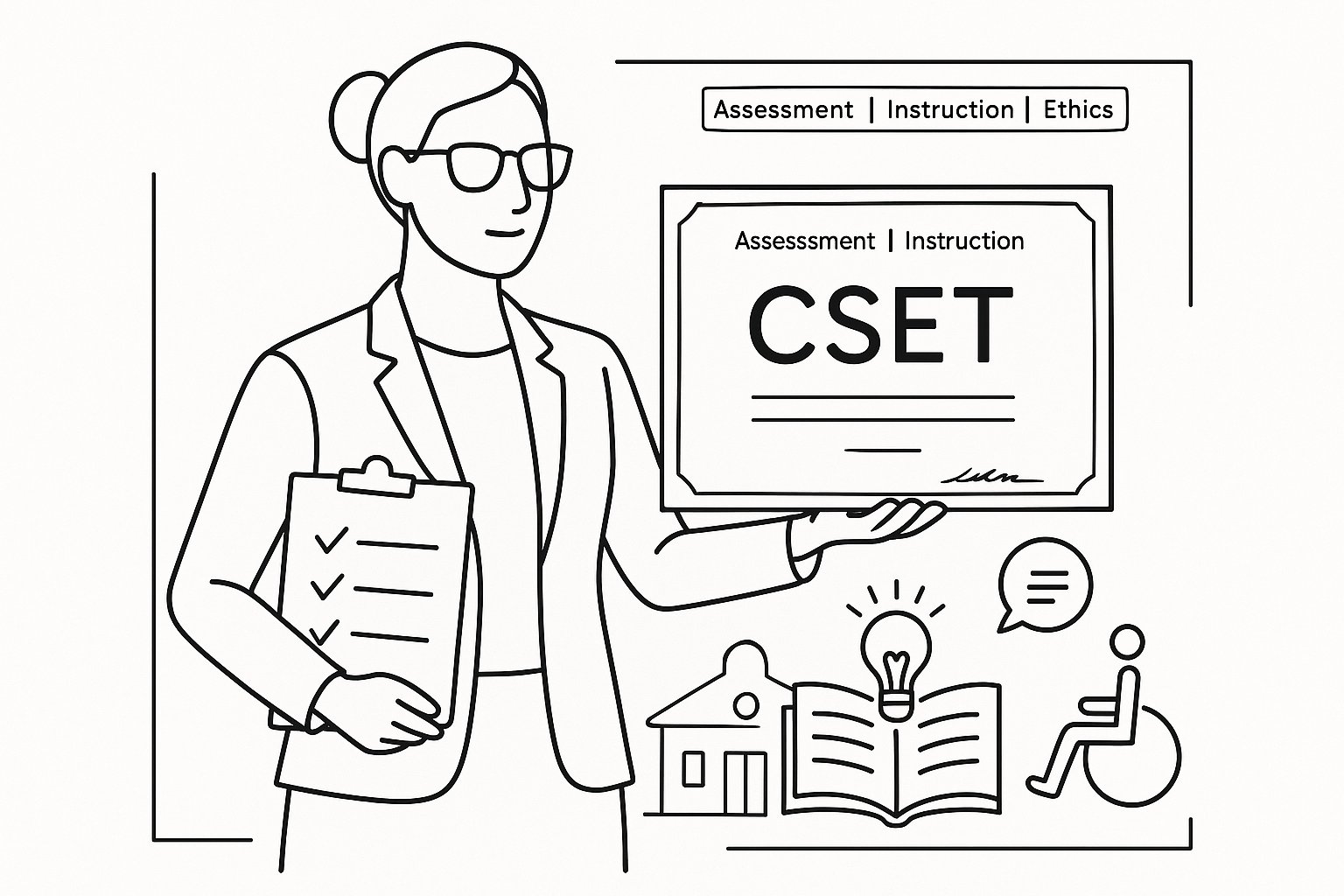
The CSET (California Subject Examinations for Teachers) for Special Education is the subject-matter assessment used to demonstrate competence for candidates pursuing an Education Specialist credential in California. In practical terms, passing the CSET shows that we understand the knowledge and skills needed to teach students with a wide range of disabilities, intellectual, learning, communication, and physical, among others. That matters because school districts and credential programs rely on the CSET as objective evidence of content knowledge before placing candidates into classrooms.
Beyond credentialing, the CSET helps shape our preparation: its domains define what university programs and induction mentors expect us to know. For employers, a passed CSET signals readiness to handle assessment, individualized instruction, and legal/ethical responsibilities in special education. If we plan to teach in California public schools, the CSET is a central credentialing milestone.
Who Needs The CSET And Certification Pathways In Special Education
Candidates aiming for a California Education Specialist credential (mild/moderate, moderate/severe, or other specialist designations) will generally need to satisfy subject matter competence, commonly by passing the CSET for Special Education. That includes pre-service teacher candidates in credential programs and some career-changers entering via intern routes.
Certification pathways include:
- Traditional credential programs: Enroll in a CA-approved Education Specialist program: the program typically requires subject-matter verification via CSET or approved coursework.
- Intern/employment-based routes: We can work while completing our credential: districts may hire us on intern credential while we finish coursework and pass required exams.
- Alternative or transitional programs: These may allow flexibility on timeline but still require eventual CSET passage and other CTC requirements.
Other states don’t use the CSET: they have their own exams or reciprocal licensure rules. If we trained or worked elsewhere, we should check California’s Commission on Teacher Credentialing (CTC) for equivalency and specific requirements.
Test Structure, Domains, And Question Types
The CSET for Special Education is organized into subtests that map to major domains of professional knowledge. Each subtest typically contains a mix of multiple-choice (selected-response) questions and constructed-response tasks where we must write brief analyses, IEP-related responses, or instructional plans.
Although details can shift, the usual structure divides content into three broad subtests: foundational knowledge (legal/ethical/professional issues and development), assessment and planning (assessment, progress monitoring, IEP development), and instruction/access to curriculum (strategies, behavior supports, transition planning). The exam emphasizes practical application, case vignettes, data interpretation, and designing differentiated instruction are common.
Timing is sectioned by subtest, and each subtest is scored separately. We should budget time to read vignettes carefully and practice written responses under timed conditions, since constructed-response items often determine passing status.
Sample Topics And Competencies Covered In The CSET
Sample Topics And Competencies Covered In The CSET
- Foundations and characteristics of learners with disabilities: definitions, etiologies, developmental trajectories, and co-occurring conditions.
- Legal, ethical, and professional responsibilities: IDEA, FAPE, LRE, confidentiality, due process, and parent collaboration.
- Assessment and diagnostic processes: formal/informal assessment tools, interpreting standardized scores, progress monitoring, and conducting functional behavior assessments (FBAs).
- IEP development and individualized instruction: writing measurable goals, designing accommodations/modifications, and aligning instruction to grade-level standards.
- Instructional strategies and curriculum access: differentiation, Universal Design for Learning (UDL), augmentative or alternative communication, literacy and math interventions.
- Behavior support and classroom management: positive behavioral interventions and supports (PBIS), behavior intervention plans (BIPs), and crisis prevention.
- Transition planning and family/community collaboration: postsecondary planning, vocational supports, and cross-agency coordination.
We’ll want to review subject-specific standards and practice translating assessment data into instructional decisions, those are frequent test tasks.
Registration, Fees, Deadlines, And Test-Day Logistics
Registration for the CSET is handled through the official test vendor: we register online, choose date and center, and select the subtest(s) we’ll take. Subtests can be scheduled individually or together depending on availability.
Fees vary over time and by the number of subtests we register for: check the official registration site for current pricing. Important deadlines include the registration cutoff (usually a few days before a test date) and cancellation/refund windows, if our plans change, we should act early to avoid forfeiting fees.
On test day we must bring acceptable identification, arrive early, and follow center rules for calculators, notes, and electronic devices. Many CSET centers require a government-issued photo ID and will provide lockers for personal items. Expect security checks and a check-in process: testing centers provide scratch paper and pencils, while calculators or formula sheets are generally restricted, verify the current policy before arriving.
If we have a documented disability, reasonable testing accommodations are available but require advance approval during registration, so start that process early.
Study Strategies, Timeline, And Recommended Resources
Effective preparation combines content review, skill practice, and timed simulations. We suggest a 6–12 week study plan for most candidates, adjusted if we’re taking multiple subtests or returning to school after a break.
Study strategies that work:
- Start with the test blueprint: identify domains where we’re weakest and prioritize them.
- Use practice tests under timed conditions to build stamina and pacing: review every missed item to understand conceptual gaps.
- Practice constructed responses: write clear, focused answers that link assessment data to instructional decisions and include measurable outcomes.
- Join or form a study group with other credential candidates to review case vignettes and give feedback on written responses.
- Integrate coursework and field experiences: connect projects or IEP work from your credential program to likely test scenarios.
Recommended resources:
- Official practice materials from the test vendor and the California Commission on Teacher Credentialing.
- CSET prep guides and practice banks focused on Special Education.
- University credential program materials, professional organizations (e.g., Council for Exceptional Children), and targeted workshops.
We should also set scheduled mock-test dates and treat them like real test days, same start time, breaks, and pacing, to avoid surprises on exam day.
Passing Scores, Score Reporting, Certification Steps, And Next Moves
CSET scoring is reported as scaled scores for each subtest: a passing scaled score is required for each subtest we take. Historically, passing has meant achieving the established scaled score threshold for each subtest (candidates should verify the current passing score on the official site). Scores are typically reported online within a few weeks after testing: paper reports may follow.
After we pass the necessary CSET subtests, the next steps toward the Education Specialist credential generally include:
- Submitting proof of subject-matter competence and program completion to the California Commission on Teacher Credentialing (CTC) or applying through our credential program.
- Meeting other credential requirements: basic skills verification, program coursework, supervised student teaching or internship, fingerprint clearance, and any required health or CPR documentation.
- Applying for the Preliminary Education Specialist credential through the CTC, or moving into an induction or clear credential pathway once employment and additional requirements are satisfied.
Strategically, once we have CSET results in hand, we should: share them with our credential program or hiring district, confirm remaining program requirements and timelines, and plan for induction supports. If we don’t pass a subtest, use the score report to target weak domains and schedule a retake, most candidates pass after focused remediation.
Finally, remember the credential journey includes legal and professional obligations around student records, confidentiality, and discipline procedures. If we encounter contract or employment questions as we move into district positions, especially around intern agreements, evaluation expectations, or termination clauses, consulting an employment or education attorney can help protect our rights and clarify obligations.
Frequently Asked Questions About the CSET for Special Education
What is the purpose of the CSET for Special Education?
The CSET for Special Education verifies subject-matter competence for candidates seeking an Education Specialist credential in California, demonstrating knowledge and skills needed to teach students with disabilities.
Who needs to take the CSET for Special Education?
Candidates pursuing a California Education Specialist credential, including pre-service teachers and some career changers, generally need to pass the CSET to demonstrate subject-matter competence.
How is the CSET for Special Education structured?
The exam is divided into three subtests covering foundational knowledge, assessment and planning, and instruction access. It includes multiple-choice and constructed-response questions focused on practical teaching applications.
What topics are covered in the CSET for Special Education exam?
It covers disabilities characteristics, legal and ethical responsibilities, assessment and IEP development, instructional strategies, behavior support, and transition planning, among others.
How should I prepare for the CSET for Special Education exam?
Effective preparation involves 6–12 weeks of content review, timed practice tests, writing constructed responses, studying with peers, and using official CSET guides and credential program materials.
What are the next steps after passing the CSET for Special Education?
After passing, candidates must submit proof of competence to the California Commission on Teacher Credentialing, complete program requirements, and apply for the Preliminary Education Specialist credential.