
Last Updated on July 8, 2026 by Jennifer Hanson
We often hear about IEPs and 504 plans but parents and clinicians still ask: what exactly is a 504 plan in Pennsylvania and how does it help a child at school? In this practical guide we explain what a Section 504 plan is, who qualifies, how Pennsylvania schools must act, and the steps to request, evaluate, and carry out one. Our aim is to give parents and healthcare professionals clear, actionable information so they can advocate effectively for students with disabilities in Pennsylvania schools.
In this guide, What Is a 504 Plan in Pennsylvania A Practical Guide for Parents and Healthcare Professionals 2026 is explained with clear steps and tips.
Key Takeaways — What Is a 504 Plan in Pennsylvania A Practical Guide for Parents and Healthcare Professionals 2026
- A 504 plan in Pennsylvania ensures students with disabilities receive reasonable accommodations for equal access to education under federal law.
- Section 504 protects students with physical or mental impairments that substantially limit major life activities, including chronic health conditions and learning challenges.
- Pennsylvania schools must identify eligible students, evaluate needs, develop written 504 plans, and implement accommodations such as schedule adjustments and health supports.
- Parents should submit a written request with medical documentation, participate in evaluations, and maintain communication to ensure effective plan implementation.
- If disagreements arise, families can request internal reviews, impartial hearings, or file complaints with the Office for Civil Rights; consulting an attorney is advisable when accommodations are not honored.
- Regular documentation and proactive communication with schools strengthen advocacy and help protect the student’s educational rights under the 504 plan.
What A Section 504 Plan Is And Who It Protects
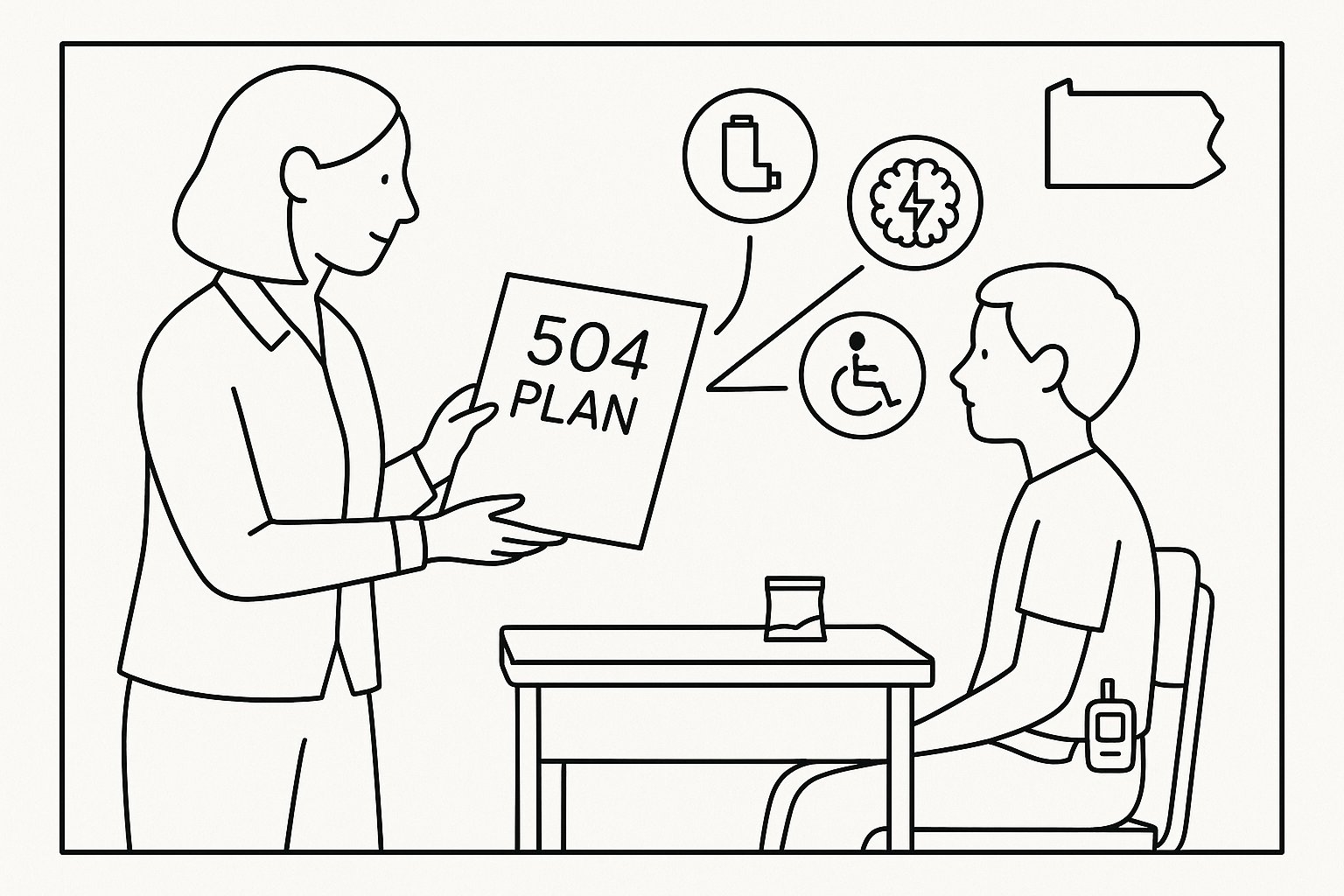
Section 504 is part of the federal Rehabilitation Act of 1973: a 504 plan is the school’s written plan to provide accommodations so a student with a disability has equal access to education. Unlike an IEP (which comes from the Individuals with Disabilities Education Act and focuses on specialized instruction), a 504 plan centers on removing barriers and providing supports in the general education setting.
Who it protects: any student with a physical or mental impairment that substantially limits one or more major life activities. That definition is broad, it includes chronic health conditions (asthma, diabetes), attention disorders (ADHD), mobility or sensory impairments, some learning disabilities, and mental health conditions when they substantially limit activities like learning, concentrating, or communicating.
Why this matters in Pennsylvania: Pennsylvania public schools, charter schools, and many private schools that receive federal funds must comply with Section 504. That means schools can’t discriminate against qualified students with disabilities and must provide reasonable accommodations. We see frequent cases where parents or treating clinicians aren’t sure whether a condition “substantially limits” functioning: schools should evaluate based on current functioning and medical documentation, not assumptions.
Practical example: A student with Type 1 diabetes may need permission to test blood sugar, eat snacks in class, and have excused absences for medical appointments. These are common 504 accommodations because they remove barriers without changing educational standards.
How 504 Plans Work In Pennsylvania: Laws, School Responsibilities, And Typical Accommodations
Legal framework: Section 504 is federal law: Pennsylvania enforces it through local education agencies (LEAs) and the Pennsylvania Department of Education (PDE) provides guidance. Schools must identify students who need accommodations, evaluate them, and develop a plan when eligible. Parents and guardians have procedural rights: notice, participation in meetings, and an impartial hearing if disagreements arise.
School responsibilities: Schools must (1) identify and locate students who may need services (child find), (2) evaluate when indicated, (3) create a written 504 plan if eligible, and (4) carry out and monitor accommodations. Staff training and a clear point person (often a school counselor or principal) are essential, but practice varies by district. We recommend parents ask who will oversee implementation and how the school will communicate with outside providers.
Typical accommodations in Pennsylvania classrooms: schedule or location adjustments (testing in a quiet room), environmental changes (preferential seating), procedural accommodations (extended time, breaks), and health-related supports (medication administration, emergency plans). Technology supports such as speech-to-text or audio books may also be included.
Key distinction from IEPs: 504 plans do not automatically provide specialized instruction or related services (like occupational therapy) unless those needs are addressed through accommodations. If a child requires specialized instruction to make progress, an IEP evaluation may be appropriate instead of, or plus to, a 504 plan.
How To Request, Evaluate, And Implement A 504 Plan In Pennsylvania
Requesting a 504 plan: Start with a written request to the school (teacher, counselor, or principal). Include medical documentation from a pediatrician, psychologist, or other treating clinician that describes the diagnosis, functional limitations, and recommended accommodations. Keep copies and request confirmation of receipt.
Evaluation: The school should assemble a team to review existing records, input from parents and clinicians, and school-based observations. Evaluations can include academic records, teacher reports, rating scales, and medical notes. Unlike IDEA evaluations for IEPs, 504 evaluations are often less formal but must still be thorough and individualized.
Creating the plan: If eligible, the school drafts a written 504 plan listing accommodations, responsible staff, timelines, and monitoring procedures. We advise parents to request measurable implementation steps: who provides the accommodation, how often it’s reviewed, and how progress is documented.
Implementation tips: Keep lines of communication open. Meet with the 504 coordinator at least once a trimester to review effectiveness. Provide the school with updated medical notes when conditions change. If a student transitions to a new school in Pennsylvania, request transfer of the 504 plan and arrange an enrollment meeting before the first day.
Documentation checklist: written request, clinician letters, teacher input, meeting minutes, final 504 plan, and contacts for implementation. For caregivers of healthcare professionals, sharing a concise one-page summary of medical needs often speeds school understanding and adoption of accommodations.
Handling Disagreements, Appeals, And When To Seek Legal Help
If you disagree with the school’s decision, Pennsylvania provides procedural protections. First, request an internal review or meeting to clarify the rationale and present additional documentation. Keep communication written when possible.
Impartial hearing and due process: Parents may file for an impartial hearing under Section 504 to challenge eligibility, placement, or failure to carry out a plan. The hearing is conducted by an impartial hearing officer: parties can present evidence and witnesses. Administrative complaints can also be filed with the U.S. Department of Education’s Office for Civil Rights (OCR) when there’s an allegation of discrimination.
When to seek legal help: We encourage families to consult an attorney if the school repeatedly fails to carry out accommodations, removes accommodations without proper process, or engages in discriminatory conduct. Healthcare professionals who regularly provide documentation or letters of support should be familiar with the school’s timelines and be prepared to testify or provide clarifying statements if disputes arise.
How we can help: At Chelle Law, we work with healthcare professionals and school staff on documentation review and with families on appeals related to employment and licensing in healthcare contexts: while our core practice focuses on medical employment and licensing, we also help clients understand administrative appeals, hearings, and procedural rights. If a 504 dispute escalates to a due process hearing or OCR complaint, a lawyer with experience in administrative law can clarify rights, draft effective submissions, and represent parents at hearings.
Practical steps before hiring counsel: document missed accommodations, attempt good-faith resolution in writing, and gather contemporaneous records (emails, nurse logs, assignment records). These items strengthen any administrative complaint or hearing request.
Conclusion
A 504 plan is a powerful, flexible tool to ensure students in Pennsylvania get equal access to education through reasonable accommodations. We recommend starting with clear medical documentation, maintaining regular communication with the school, and documenting everything. If disputes can’t be resolved, Pennsylvania offers administrative appeals and OCR complaints, and when implementation repeatedly fails, consulting an attorney experienced with education and administrative processes can protect a child’s rights and educational access.
Frequently Asked Questions About 504 Plans in Pennsylvania
What is a 504 plan in Pennsylvania schools?
A 504 plan in Pennsylvania is a written document that provides accommodations to students with disabilities, ensuring they have equal access to education by removing barriers in the general education setting.
Who qualifies for a 504 plan in Pennsylvania?
Any student with a physical or mental impairment that substantially limits major life activities, such as learning or concentrating, qualifies. This includes conditions like asthma, diabetes, ADHD, sensory impairments, and some mental health issues.
How do I request a 504 plan for my child in Pennsylvania?
Begin by submitting a written request to your child’s school, including medical documentation from a healthcare provider detailing the diagnosis and recommended accommodations. Keep copies and ask for confirmation of receipt.
What types of accommodations are typical under a Pennsylvania 504 plan?
Common accommodations include extended test time, preferential seating, breaks, permission for medical tasks like blood sugar testing, and environmental adjustments to support learning without altering educational standards.
What is the difference between a 504 plan and an IEP in Pennsylvania?
A 504 plan provides accommodations to remove barriers in general education, while an IEP delivers specialized instruction and related services for students who need more intensive support to make educational progress.
What should parents do if they disagree with their child’s 504 plan decision?
Parents can request an internal review, present additional documentation, and if needed, file for an impartial hearing or an administrative complaint with the U.S. Department of Education’s Office for Civil Rights to challenge decisions or discrimination.