
Last Updated on April 20, 2026 by Jennifer Hanson
An IEP meeting checklist keeps the many moving parts of Individualized Education Program (IEP) meetings organized, focused, and productive. Whether you’re a parent attending your child’s first IEP meeting or an educator who leads dozens each year, a concise checklist prevents missed documents, unclear goals, and avoidable conflict. In this guide we explain what an IEP meeting checklist is, outline the essential components to include, walk through preparation step-by-step, and highlight common pitfalls with practical ways to avoid them. Our aim is to make IEP meetings less stressful so teams can design meaningful supports for students.
In this guide, What Is an IEP Meeting Checklist A Practical Guide For Parents And Educators 2026 is explained with clear steps and tips.
Key Takeaways — What Is an IEP Meeting Checklist A Practical Guide For Parents And Educators 2026
- An IEP meeting checklist organizes critical tasks and documents to ensure focused, productive Individualized Education Program meetings.
- Using an IEP meeting checklist before, during, and after meetings improves compliance, prevents missed steps, and supports clear communication among team members.
- Essential checklist components include student information, required legal documents, measurable goals, services details, and follow-up actions to track progress.
- Preparing a document packet and distributing it for review ahead of the meeting shifts time from information sharing to collaborative problem-solving.
- Following a step-by-step checklist-driven agenda ensures all participant concerns are addressed, goals are clearly defined, and decisions are properly documented.
- Avoid common pitfalls by verifying current data, setting SMART goals, confirming procedural steps, and scheduling timely follow-ups to maintain momentum.
What An IEP Meeting Checklist Is And When To Use It
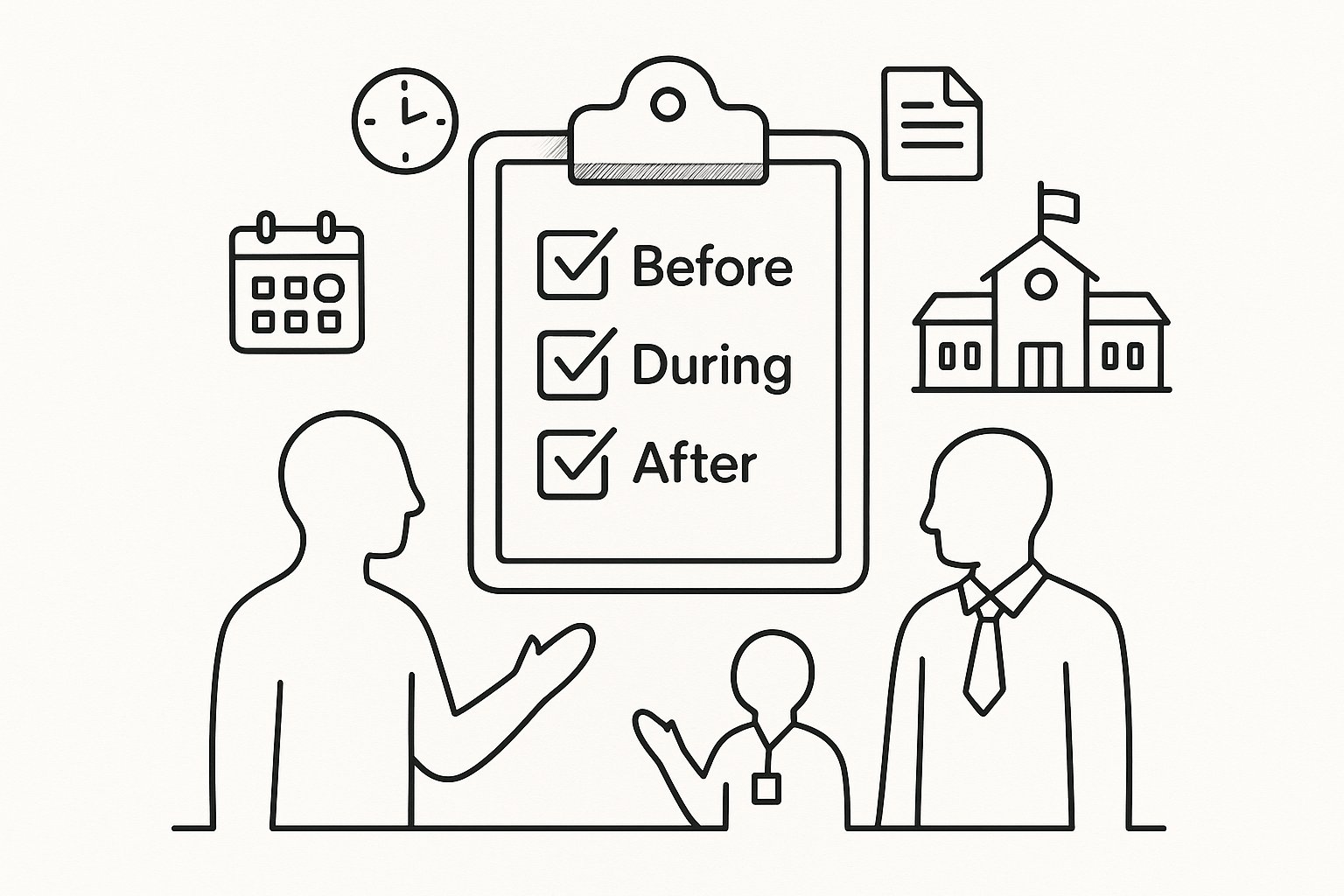
An IEP meeting checklist is a concise, purpose-built list of tasks, documents, questions, and outcomes to guide team members through the Individualized Education Program process. We use it as a planning and reference tool before, during, and after meetings. Before the meeting, the checklist ensures all relevant records are collected and reviewed: during the meeting it helps the team stay on topic and document decisions: after the meeting it serves as a post-meeting action tracker so entitlements and timelines aren’t lost.
When should you use an IEP meeting checklist? Always. New evaluations, annual reviews, triennial re-evaluations, placement changes, manifestation determinations, or when disputes arise, each is a situation where a checklist matters. For parents unfamiliar with special education jargon, a checklist reduces overwhelm. For educators and related-service providers, it creates consistent practice across students and caseloads. From an administrative perspective, checklists also support compliance with IDEA timelines and local district procedures, reducing the risk of missed steps that could later become legal or procedural issues.
Key Components To Include In Your IEP Meeting Checklist
A functional IEP meeting checklist balances legal requirements, educational substance, and practical meeting logistics. We recommend organizing items into categories: records review, team logistics, goal planning, accommodations/services, assessment needs, and follow-up tasks. Start with student identifiers (name, DOB, grade, school) and meeting basics (date, time, location, participants).
Next, ensure compliance items are listed: prior written notice, consent forms, current IEP or past IEP, assessment reports, and progress data. Include prompts to confirm whether the student’s eligibility category, present levels of academic achievement and functional performance (PLAAFP), and measurable annual goals are documented. Add clear checks for related services (speech, OT, PT), frequency/duration, and transition planning if the student is 14–16 or older.
Finally, incorporate communication items: parent concerns, student input, interpreter needs, and a plan to send finalized IEP copies and procedural safeguards. A well-structured checklist will prevent last-minute scrambling and help the team produce a usable, legally sound IEP.
Documents To Gather Before The Meeting
Collecting the right documents ahead of time is one of the highest-yield checklist tasks. We advise creating a packet that every participant can review at least a few days prior. Core documents include current and prior IEPs, evaluation and re-evaluation reports (psychological, educational, speech-language, OT/PT), progress monitoring data (benchmarks, grades, work samples), behavior intervention plans (BIP), and discipline records if relevant.
Include any medical or health reports that affect learning, like ADHD or seizure disorder documentation, and recent attendance records. For transition-age students, gather vocational assessments, transcript summaries, and community agency referrals. If outside evaluators or private therapists are involved, ask parents to provide recent reports or consent for information exchange.
Finally, add a short “what to read first” guide to the packet: highlight the PLAAFP, current goals, and any evaluations with recommendations. When everyone arrives informed, the meeting shifts from information transfer to problem-solving.
How To Prepare And Use The Checklist Step-By-Step
Start preparation by assigning responsibilities. We recommend designating one person, often the case manager or special education lead, to compile the packet and distribute it to team members and the parent at least 3–5 business days before the meeting. Use your checklist to confirm distribution and note receipt.
Step 1: Pre-meeting review. Participants read the packet, complete any pre-meeting notes, and forward questions to the case manager. Parents should jot down priorities, examples of strengths and needs, and questions about services or placement.
Step 2: Meeting agenda guided by the checklist. Open with introductions, review parent/student concerns, and confirm procedural safeguards and consent. Move through PLAAFP, measurable goals, special education and related services, accommodations/modifications, and assessment/placement decisions. Use checklist prompts to ensure each required element is discussed and agreed upon.
Step 3: Real-time documentation. As decisions are made, record precise language on the checklist: goal timelines, service minutes, providers, location, and start dates. If consensus isn’t reached, note specific points of disagreement and next steps (e.g., independent evaluation request, reconvened meeting).
Step 4: Post-meeting follow-up. Use the checklist’s action section to assign tasks, who finalizes the written IEP, who communicates with parents, when services start, and follow-up dates for progress reviews. Share the finalized IEP and procedural safeguards promptly and maintain a record of delivery.
Common Pitfalls During IEP Meetings And How To Avoid Them
IEP meetings can stall or become contentious when basic processes break down. We see recurring pitfalls and practical ways to avoid them.
Pitfall 1: Going in without current data. Solution: Use the checklist’s document section as a gate, don’t finalize goals without up-to-date progress data and recent evaluations.
Pitfall 2: Vague goals and services. Solution: Require SMART goals (Specific, Measurable, Achievable, Relevant, Time-bound) and write service delivery details (who, what, where, when, how often) onto the checklist during the meeting.
Pitfall 3: Miscommunication about parent concerns. Solution: Start by documenting parents’ priorities on the checklist and read them back aloud to ensure shared understanding.
Pitfall 4: Missing procedural steps or signatures. Solution: Include a compliance sublist (consents, procedural safeguards provided, meeting notice) and check off each item before adjourning.
Pitfall 5: Failure to schedule follow-up. Solution: Block calendar dates for progress reviews and specify interim data collection points on the checklist to avoid drifting from planned benchmarks.
When legal or complex medical issues intersect with IEP decisions, such as disputes about appropriate placement, denial of services, or workplace accommodations for a student who is also employed, consulting knowledgeable counsel can help protect rights and clarify obligations. While Chelle Law focuses on healthcare employment and contract matters, families and school teams sometimes need legal guidance: when that’s the case, we recommend reaching out to professionals experienced in education law for timely advice.
Conclusion
An IEP meeting checklist is a simple tool that delivers outsized benefits: clarity, compliance, and stronger decisions for students. By gathering documents, using a step-by-step meeting flow, and avoiding common pitfalls, we make meetings more efficient and focused on student progress. Start with a clean, shared checklist at your next IEP and watch how it changes the conversation from confusion to constructive planning.
Frequently Asked Questions About IEP Meeting Checklists
What is an IEP meeting checklist and why is it important?
An IEP meeting checklist is a concise list of tasks, documents, and questions that guide team members through the Individualized Education Program process. It helps keep meetings organized, ensures legal compliance, and facilitates meaningful support planning for students.
When should I use an IEP meeting checklist?
You should use an IEP meeting checklist for new evaluations, annual reviews, triennial re-evaluations, placement changes, manifestation determinations, and when disputes arise, to ensure thorough preparation and clear documentation.
What key components should be included in an effective IEP meeting checklist?
An effective checklist includes student identifiers, meeting logistics, compliance items like consent forms, current and past IEPs, assessment reports, goals, accommodations, related services, communication needs, and follow-up action items.
How can parents and educators prepare for an IEP meeting using a checklist?
Assign responsibilities for gathering documents, distribute the packet in advance, review materials beforehand, jot down questions or priorities, follow a checklist-guided agenda during the meeting, document decisions in real time, and use post-meeting action items to track follow-ups.
What are common pitfalls in IEP meetings and how does a checklist help avoid them?
Common issues include missing current data, vague goals, miscommunication, missed procedural steps, and lack of follow-up. A checklist ensures up-to-date documents, SMART goals, clear communication, procedural compliance, and scheduled reviews to prevent these problems.
Can an IEP meeting checklist help with compliance with IDEA and other regulations?
Yes, using a checklist supports compliance with IDEA timelines and local procedures by preventing missed steps, ensuring all required documentation is reviewed, and confirming that procedural safeguards and consents are properly handled.