
Last Updated on April 20, 2026 by Jennifer Hanson
Special education teachers play a central role in helping students with diverse learning needs access education, build practical skills, and prepare for life beyond the classroom. In this guide we’ll clarify the core goal of a special education teacher, explain the tools they use (like IEPs), show how success is measured across domains, and outline classroom strategies and collaboration practices that turn plans into real progress. Whether you’re a parent, educator, or administrator, our aim is to give a clear, practical view of what outcomes truly matter and how teams achieve them.
In this guide, What Is the Goal of a Special Education Teacher A Practical Guide to Student-Centered Outcomes 2026 is explained with clear steps and tips.
Key Takeaways — What Is the Goal of a Special Education Teacher A Practical Guide to Student-Centered Outcomes 2026
- The primary goal of a special education teacher is to ensure students with disabilities gain access to education, achieve measurable learning growth, and develop independence.
- Individualized Education Plans (IEPs) serve as the central tool for setting specific, achievable goals that align educators, families, and service providers.
- Measuring success involves tracking academic, functional, and social-emotional outcomes through diverse data sources to inform instructional adjustments.
- Effective classroom strategies include differentiated instruction, scaffolding, assistive technology, and proactive behavior supports to meet unique student needs.
- Collaboration with families, general educators, and related service providers is essential to implement consistent supports and prepare students for post-school transition.
The Core Purpose: Ensuring Access, Learning, and Independence
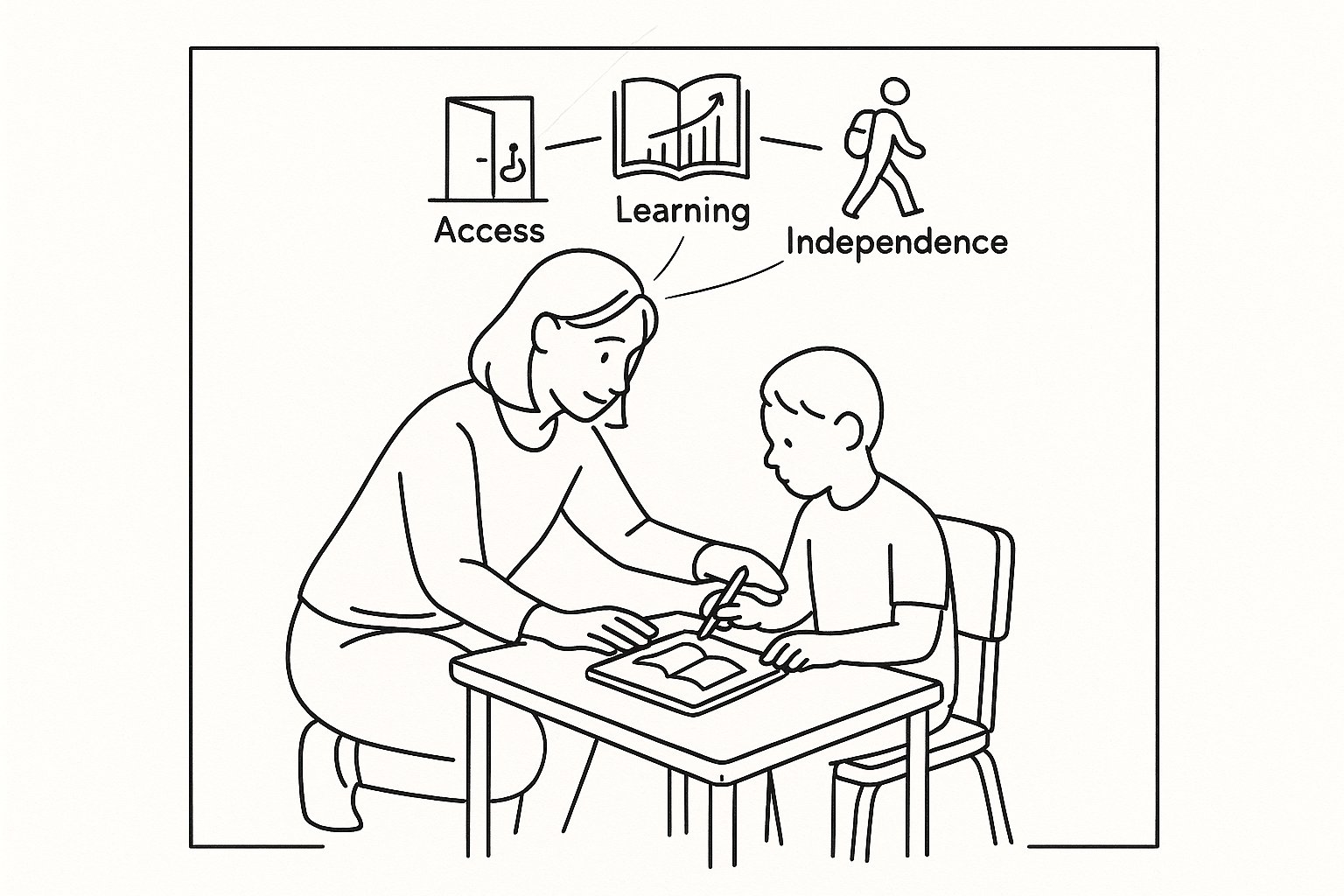
At the heart of special education is a simple but ambitious mission: ensure that students with disabilities have equitable access to learning and gain the skills they need to live as independently and successfully as possible. We often summarize this as three interlocking goals, access, learning, and independence, because focusing on just one leaves gaps.
Access means removing barriers so students can participate meaningfully in the general curriculum and school life. That might look like providing accommodations (extended time, assistive technology), modifying materials, or arranging for related services such as speech or occupational therapy. But access isn’t just physical or procedural: it’s also about creating an environment where students feel safe to try, fail, and try again.
Learning refers to measurable growth in academic and functional skills. For some students that’s phonics and math fluency: for others it’s task initiation, self-regulation, or vocational skills. We think in outcomes, not seat time: what can the student do now that they couldn’t before? That growth drives instructional choices and resource allocation.
Independence is the long view. We want students to make choices, communicate their needs, manage daily tasks, pursue postsecondary opportunities, and participate in their communities. Independence can be academic, social, or vocational, and most meaningful when it reflects the student’s own goals and family priorities.
Together, these three aims shape a special education teacher’s daily work: designing accessible lessons, teaching targeted skills, and coaching students (and their supports) toward autonomous functioning.
Individualized Education Plans (IEPs): The Central Goal-Setting Tool
The Individualized Education Plan, or IEP, is the legal and instructional blueprint for a student’s progress. We treat the IEP as the central tool for defining what success looks like, and for aligning educators, families, and service providers around measurable, time-bound goals.
Good IEPs start with accurate assessment and family input. We collect data on academic performance, functional skills, behavior, and the student’s daily routines. From there we write goals that are specific, observable, and achievable within the IEP year. Instead of vague aims like “improve behavior,” we define the behavior, set a criterion (for example, reducing interruptions to fewer than three per class period), and specify supports.
Accommodations, modifications, and service minutes belong in the plan, too: they’re not optional extras but the means to reach the goals. We list who provides each service, how often, and how progress will be measured. For transitional-age students, the IEP should also include postsecondary goals and a coordinated plan for work, higher education, or community living.
We also view the IEP as living: it should be reviewed and revised when data indicate the student is not making expected progress or when circumstances change. Regular progress reporting keeps everyone accountable and helps us adjust instruction quickly rather than waiting until the annual review.
Measuring Success: Academic, Functional, and Social-Emotional Outcomes
Measuring success in special education requires a broader lens than standardized test scores alone. We look at three outcome domains, academic, functional, and social-emotional, and use multiple data sources to build a complete picture.
Academic outcomes are familiar: mastery of grade-level standards (when appropriate), progress on individualized goals, reading fluency, math computation, and content knowledge. For many students, progress is measured in small, cumulative gains that translate into greater access to the general education curriculum.
Functional outcomes capture daily living and independent-living skills: following multi-step directions, self-care, time management, and vocational tasks. For students on certificate or transition pathways, functional skill acquisition can be the primary indicator of readiness for adulthood and employment.
Social-emotional outcomes are equally critical. We monitor skills such as self-regulation, frustration tolerance, communication, and peer interaction. Social skills often determine whether a student can generalize academic learning into inclusive settings.
To measure across these domains we triangulate: curriculum-based measurements, observational data, work samples, behavior tracking, and family reports. Frequent, objective progress monitoring lets us know when to intensify instruction, change strategies, or revise goals. Eventually, success is shown when gains lead to increased participation, reduced supports, and clearer pathways to post-school outcomes.
Classroom Strategies and Collaboration to Achieve Student Goals
Practices that move students toward IEP goals are both instructional and collaborative. In the classroom we use differentiated instruction, scaffolding, explicit teaching of routines, and assistive technology. But we also recognize that a teacher can’t do it alone, collaboration with families, general educators, related-service providers, and when relevant, legal or vocational counselors, is essential.
Differentiation means adapting content, process, and product to student needs. We simplify tasks without lowering expectations, chunk complex assignments, and use visual supports and modeling. Scaffolds are gradually removed as mastery increases so that independence grows.
Assistive technology ranges from low-tech organizers to speech-to-text tools and can be a game-changer for access. We pilot tools, collect evidence of effectiveness, and train staff and families in their use.
Behavior supports are proactive: we teach replacement behaviors, set clear expectations, and use positive reinforcement. For some students we carry out evidence-based interventions, and we collect baseline behavior data to measure change.
Collaboration is the engine that keeps plans realistic and consistent. We hold regular team meetings, share progress monitoring data, and coordinate classroom accommodations across teachers and settings. Families are partners: their insights shape meaningful goals, and consistent strategies at home and school amplify gains.
When transition planning is needed, we expand the team to include vocational counselors, community agencies, and employers. Preparing for life after school requires practical experiences, work sampling, community-based instruction, and supported internships, that align with the student’s postsecondary goals.
Conclusion
The goal of a special education teacher is not a single test score or an abstract ideal, it’s to create measurable, student-centered outcomes that increase access, promote learning, and build independence. We meet that goal by writing strong IEPs, measuring progress across academic, functional, and social-emotional domains, and using classroom strategies plus coordinated collaboration to turn plans into real-world gains. When teams stay focused on meaningful outcomes, students move closer to lives they choose and control.
Frequently Asked Questions About the Goal of a Special Education Teacher
What is the main goal of a special education teacher?
The main goal of a special education teacher is to ensure students with disabilities have equitable access to learning, achieve measurable academic and functional growth, and build independence for successful, autonomous lives.
How do special education teachers use IEPs to support student success?
Special education teachers use Individualized Education Plans (IEPs) as legal and instructional blueprints that define specific, measurable goals, accommodations, and services tailored to each student’s needs, guiding instruction and progress monitoring.
What kinds of outcomes do special education teachers measure to determine success?
They measure success across academic, functional, and social-emotional domains, including mastery of skills, daily living abilities, and social interactions, using diverse data like observations, work samples, and family reports.
Why is collaboration important in special education teaching?
Collaboration with families, general educators, therapists, and counselors ensures consistency, realistic goal-setting, coordinated accommodations, and effective transitions, all of which enhance student progress and independence.
What classroom strategies do special education teachers use to achieve their goals?
Teachers use differentiated instruction, scaffolding, assistive technology, explicit routine teaching, and positive behavior supports to tailor learning experiences that increase student engagement and autonomy.
How does a special education teacher promote independence for their students?
They help students develop skills to make choices, communicate needs, manage tasks, and prepare for postsecondary opportunities, aligning instruction with the student’s goals and family priorities to foster independent living.