
Last Updated on April 20, 2026 by Jennifer Hanson
When a student’s disability makes it hard to access school, a 504 plan can level the playing field. In this guide we’ll explain what a 504 plan is under federal and Ohio law, who qualifies, typical accommodations you’ll see in Ohio classrooms, and, most importantly, how to request, develop, modify, or appeal a plan step‑by‑step. We wrote this for parents, teachers, and school professionals who want clear, actionable guidance in 2026. Throughout, we’ll flag legal rights and practical tips so you can move from confusion to confident advocacy.
In this guide, 504 Plans In Ohio A Practical Guide For Parents And Professionals In 2026 is explained with clear steps and tips.
Key Takeaways — 504 Plans In Ohio A Practical Guide For Parents And Professionals In 2026
- A 504 plan in Ohio ensures students with disabilities receive accommodations to access education equally under federal and state laws.
- Eligibility for a 504 plan requires a disability that substantially limits major life activities, with common conditions including ADHD, chronic health issues, and psychological disorders.
- Typical accommodations include extended test time, preferential seating, assistive technology, and health-related supports tailored to individual needs.
- Parents and educators should request 504 evaluations in writing, actively participate in plan development, and request specific, measurable accommodations.
- Modification and appeals processes exist if accommodations are ineffective or denied, including filing grievances with school districts, the Ohio Department of Education, or the Office for Civil Rights.
- Maintaining thorough documentation throughout requests, meetings, and communications is essential for successful advocacy and appeals.
What A 504 Plan Is, Its Legal Basis, And How It Differs From An IEP
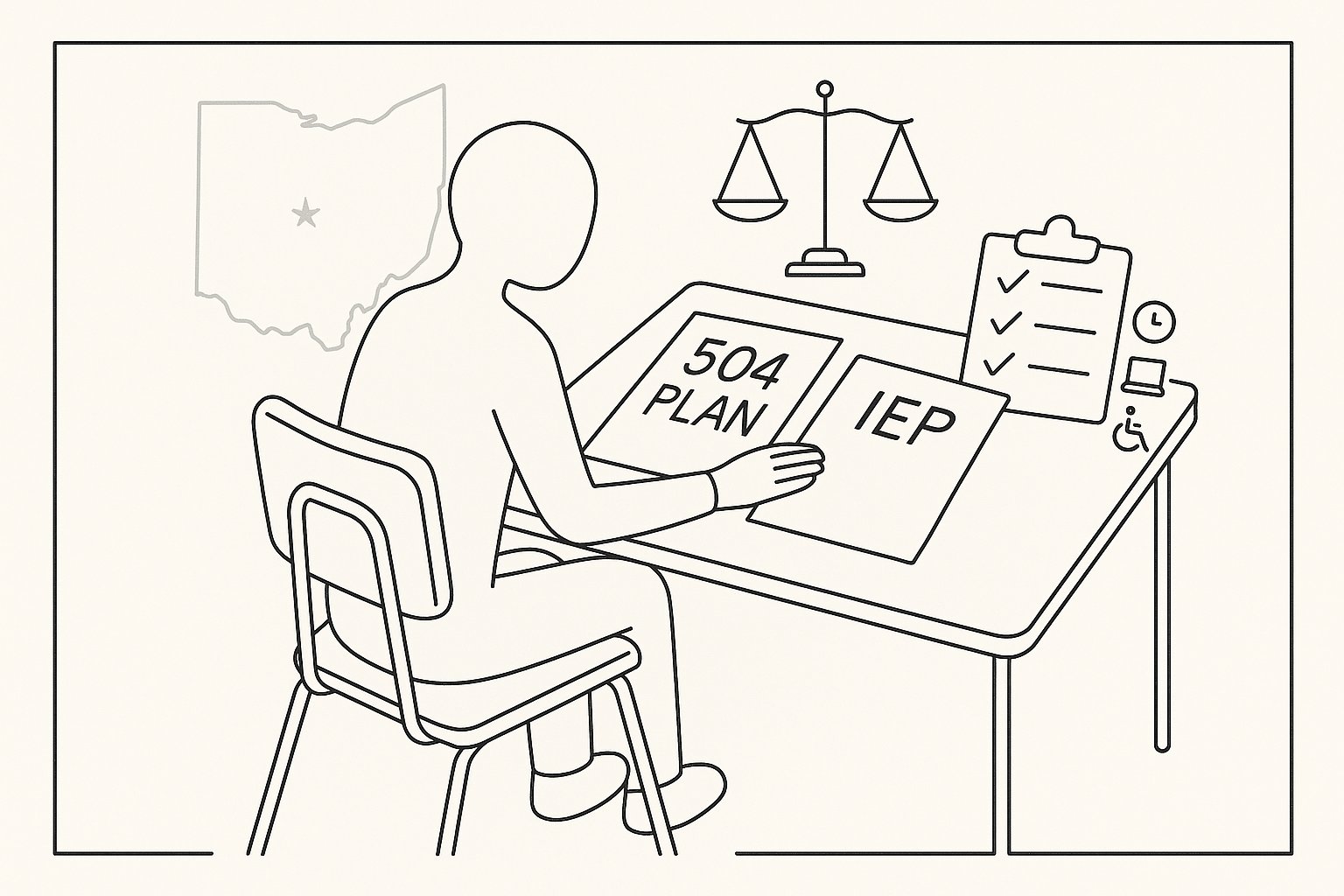
Section 504 of the Rehabilitation Act of 1973 is the federal civil‑rights law that prohibits disability based discrimination in programs receiving federal funding, including public schools. A “504 plan” is the practical tool schools use to document accommodations and services that allow a student with a qualifying disability to access education on par with nondisabled peers.
Legal basis and protections
Under Section 504, schools must provide reasonable accommodations to avoid excluding students from participation. In Ohio, state education rules carry out these federal obligations: local districts create 504 procedures consistent with both federal guidance and state policies. Unlike IDEA (the Individuals with Disabilities Education Act), 504 does not guarantee specialized instruction, it guarantees access.
How a 504 plan differs from an IEP
We often get asked how a 504 plan compares to an IEP (Individualized Education Program). Key differences:
- Eligibility trigger: 504 covers disabilities that substantially limit one or more major life activities: IDEA covers specific categories of disability and requires that the disability adversely affects educational performance and requires specially designed instruction.
- Services: IEPs can include specialized instruction, related services (like speech or occupational therapy), and measurable annual goals. 504 plans typically list accommodations (extended time, preferential seating, assistive tech) and sometimes related services but not an IEP’s education‑centered programming.
- Procedural safeguards: IDEA has a more robust set of procedural protections (formal evaluation timelines, parent consent for evaluation, due process hearings). 504 has fewer specified procedures but still provides important rights, parents can request evaluations, participate in meetings, and file complaints with the school, state, or U.S. Department of Education’s Office for Civil Rights (OCR).
In practice, a student might have both a 504 and services under IDEA, though schools generally place IDEA‑eligible students under an IEP. We recommend starting with an evaluation request if you suspect a disability: the evaluation will clarify the best pathway.
Who Qualifies In Ohio And How Schools Evaluate Eligibility
Eligibility for a 504 plan hinges on whether the student has a disability that substantially limits a major life activity, such as learning, concentrating, walking, seeing, hearing, or major bodily functions (like immune or respiratory systems). In Ohio, districts follow these federal standards but may have local procedures for documentation and meetings.
Common qualifying conditions
We see 504 plans used for students with:
- Attention‑related conditions (ADHD) that substantially limit concentration or learning
- Chronic health conditions (asthma, diabetes, severe allergies) that require accommodations
- Psychological conditions (anxiety, depression) that affect attendance or participation
- Physical or sensory disabilities that limit mobility or access
The evaluation process
How schools determine qualification typically follows these steps:
- Request: A parent, teacher, or school staff member requests a 504 evaluation. We advise making requests in writing and keeping copies.
- Initial review: The school collects existing data, report cards, teacher observations, medical records, standardized test results, and any prior evaluations.
- Formal evaluation (if needed): The district may conduct additional assessments (academic, behavioral, medical). Schools should offer reasonable accommodations during evaluation.
- 504 team meeting: A group that understands the student, the meaning of evaluation data, and placement options meets to decide eligibility and accommodations.
Documentation and timelines
Ohio districts generally have local timelines for 504 evaluations: federal law doesn’t set strict timelines the way IDEA does. That said, schools must evaluate promptly and cannot unreasonably delay. If we’re representing a parent or advising a professional, we recommend requesting written confirmation of the evaluation timeline and following up in writing if there’s delay.
If a district denies eligibility, parents may request reconsideration, file a grievance under the district’s 504 procedures, or file a complaint with the Ohio Department of Education or OCR. We’ll cover appeals in more detail below.
Common Accommodations, Services, And Real‑World Examples In Ohio Classrooms
A 504 plan’s value is its practicality: reasonable adjustments that let a student participate. Below are commonly used accommodations and short examples of how they play out in Ohio classrooms.
Typical accommodations
- Extended time for tests and quizzes: Common for students with processing speed or attention challenges.
- Preferential seating: Placing a student near the teacher to support focus or hearing needs.
- Modified assignment formatting: Allowing typed responses, oral reports, or reduced visual clutter.
- Breaks during class or testing: For medical or attention‑related reasons.
- Use of assistive technology: Text‑to‑speech, speech‑to‑text, or audio books.
- Health‑related accommodations: Quick bathroom access, emergency medication plans, or allergy‑free seating in cafeterias.
- Reduced assignments load or alternative assignments formats: When extended work time exacerbates disability impact.
Real‑world examples from Ohio schools
- An elementary student with severe pollen allergies has a 504 that includes a cleaned and allergen‑controlled seat, permission to eat in an alternate location during high‑pollen days, and an asthma action plan filed with the school nurse.
- A middle schooler diagnosed with ADHD receives noise‑reducing headphones for independent work, frequent short breaks, and extended time on assessments: teachers receive brief strategies for task initiation.
- A high school student recovering from a concussion has a short‑term 504 with reduced screen time, scheduled rest breaks, and staggered school start times until symptoms resolve.
How plans translate to classroom routines
We advise that accommodations be concrete and measurable. Instead of “provide preferential seating,” a stronger entry reads: “Student will sit in the front two rows and within five feet of the teacher during direct instruction: teacher will provide a proximity cue if the student is off‑task.” These specifics make implementation and monitoring easier.
Schools should train staff assigned to carry out accommodations. We also recommend periodic review (at least annually) and sooner if the student’s needs change.
How To Request, Develop, Modify, And Appeal A 504 Plan In Ohio (Step‑By‑Step)
We’ll walk through practical steps you can take at each stage: requesting, developing, modifying, and, if needed, appealing a 504 decision.
Requesting an evaluation
- Write a clear request: Address it to your child’s school principal and 504 coordinator (if known). State that you’re requesting a 504 evaluation because you believe your child has a disability that substantially limits a major life activity. Keep a dated copy.
- Provide supporting records: Include recent medical notes, prescriptions, behavioral observations, or teacher comments.
- Ask for a meeting timeline: Request that the school schedule an eligibility meeting within a specific number of school days (e.g., 30 days), and ask for confirmation in writing.
Developing the plan
- Participate actively: The 504 team should include people who know your child. Bring notes, examples of classroom struggles, and suggestions.
- Focus on measurable accommodations: Be concrete about how accommodations will be implemented and monitored.
- Set review dates: Even if the plan seems to work, schedule a follow‑up in 6–12 weeks to review effectiveness.
Modifying the plan
If accommodations aren’t working or your child’s needs change:
- Request an interim meeting in writing. Describe what’s ineffective and suggest alternatives.
- Keep documentation of instances when the plan failed (missed supports, repeated struggles), these help the team refine the plan.
Appealing decisions and next steps
If the district denies evaluation, refuses a 504 plan, or fails to carry out it, options include:
- File an internal grievance: Use the district’s 504 grievance procedures. Many districts post these on their websites.
- Contact the Ohio Department of Education: The state can review compliance questions and provide guidance.
- File a complaint with OCR: OCR enforces Section 504: complaints can allege discrimination or failure to provide a free appropriate public education.
- Consider legal counsel: For persistent denials or serious implementation failures, legal advice can clarify remedies, timelines for appeals, and whether court action or settlement is appropriate. Given our practice background, we recognize the importance of preserving records, following appeal deadlines, and seeking timely advocacy when necessary.
Throughout, document every meeting, request, and correspondence. Clear records make appeals and oversight far more effective.
Conclusion
A 504 plan is a practical, flexible tool that ensures students with disabilities in Ohio can access education equitably. We encourage parents and professionals to be proactive: request evaluations in writing, insist on clear, measurable accommodations, and document everything. If the school resists or delays, use local grievance processes and, when necessary, state or federal complaint channels. With informed advocacy, and, when helpful, legal guidance, most families secure plans that make a real difference in the classroom.
Frequently Asked Questions About 504 Plans in Ohio
What is a 504 plan in Ohio and what legal protections does it provide?
A 504 plan in Ohio is a written document under Section 504 of the Rehabilitation Act that ensures students with disabilities receive accommodations to access education equally. It prohibits disability-based discrimination in federally funded schools and guarantees reasonable accommodations but not specialized instruction.
Who qualifies for a 504 plan in Ohio schools?
Students who have a disability that substantially limits one or more major life activities—like learning, concentrating, walking, or other bodily functions—may qualify for a 504 plan. Common conditions include ADHD, chronic health issues, psychological or physical disabilities impacting school participation.
How does a 504 plan differ from an Individualized Education Program (IEP)?
A 504 plan provides accommodations to ensure access to education, while an IEP offers specialized instruction and related services. Eligibility for 504 is broader and focuses on substantial limitations, whereas IEP requires specific disability categories affecting educational performance and need for specialized teaching.
What are typical accommodations provided under a 504 plan in Ohio classrooms?
Common accommodations include extended test time, preferential seating, breaks during class, assistive technology, modified assignments, and health-related supports like emergency medication plans or allergy-aware seating to help students participate fully in school activities.
How can a parent or guardian request a 504 plan evaluation in Ohio?
To request a 504 evaluation, parents should submit a written request to the school principal or 504 coordinator, stating the belief that the child has a qualifying disability. Including supporting medical or behavioral records and asking for a timeline for an eligibility meeting is advised.
What steps should be taken if a 504 plan is denied or accommodations are not implemented properly?
Parents can file an internal grievance with the school district, contact the Ohio Department of Education for guidance, or file a complaint with the U.S. Department of Education’s Office for Civil Rights. Keeping detailed documentation and seeking legal advice may be necessary for appeals or serious issues.