
Last Updated on April 20, 2026 by Jennifer Hanson
Due process in special education is a formal legal procedure parents, guardians, or school districts use when they disagree about a child’s special education services. In 2026 the basics remain grounded in the Individuals with Disabilities Education Act (IDEA), but recent procedural clarifications and remote hearing practices mean the pathway looks a bit different than it did a decade ago. We’ll walk through what due process actually means, who can start it and when, the hearing process itself (including timelines and necessary documents), and what to expect so families and professionals can move forward with confidence.
In this guide, Due Process In Special Education Your Rights Steps And What To Expect In 2026 is explained with clear steps and tips.
Key Takeaways — Due Process In Special Education Your Rights Steps And What To Expect In 2026
- Due process in special education is a legal procedure under IDEA that resolves disputes about a child’s special education services when informal efforts fail.
- Both parents and school districts can initiate due process complaints, especially when disagreements arise over evaluations, placement, or services.
- The due process hearing involves filing a complaint, response, a resolution session, discovery, the hearing itself, and a final decision by an impartial officer.
- Families should prepare by organizing key documents like IEPs, evaluations, and communication records, and expect timelines typically ranging from 30 to 90 days for hearings.
- Virtual hearings and electronic records, such as digital assessments and teletherapy notes, are increasingly common and should be requested early.
- Engaging legal counsel or an advocate can strengthen representation during due process hearings, but families may also represent themselves.
What Due Process Means In Special Education And Why It Matters
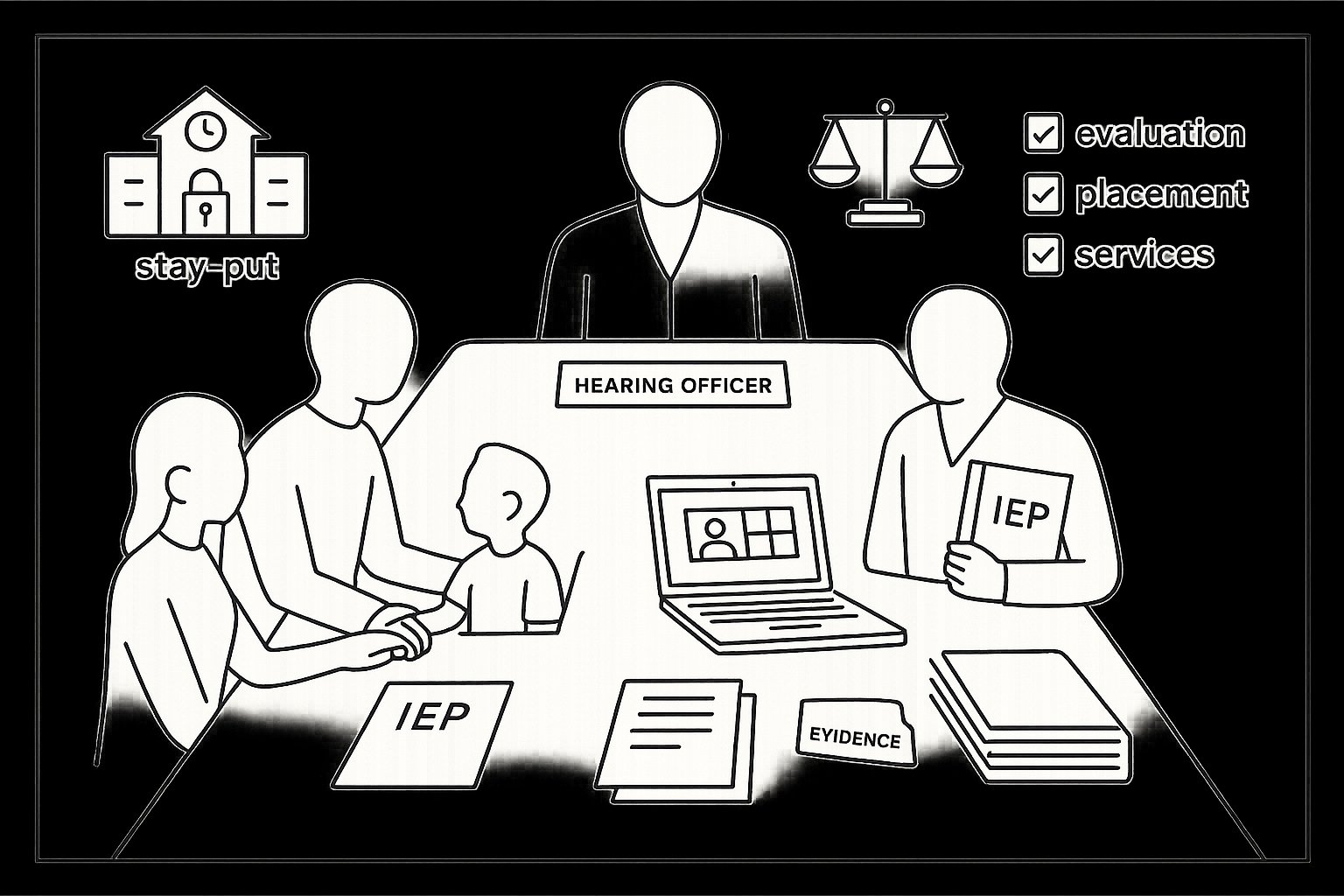
Due process in special education is a legal safeguard under the Individuals with Disabilities Education Act (IDEA) that guarantees procedural protections for children with disabilities and their families. At its core, due process is a formal dispute-resolution mechanism: when parents and a school district can’t agree on identification, evaluation, placement, or the provision of a free appropriate public education (FAPE), either party can request a due process hearing. Why it matters: due process gives us a structured way to get a neutral decision-maker involved, preserve important rights, and create a public record, all of which help resolve disputes that informal discussions have failed to fix.
There are a few practical points we want to highlight. First, a due process hearing is different from mediation. Mediation is voluntary and collaborative: due process is adversarial and results in a binding or reviewable decision. Second, schools must continue certain services during disputes under the “stay-put” provision, which preserves a child’s current placement while the disagreement is resolved, a critical protection for families worried about sudden changes. Third, remedies from due process can include compensatory services, placement changes, or directives for the district to conduct evaluations or revise the individualized education program (IEP).
Finally, the landscape in 2026 includes increased use of virtual hearings and clearer rules about disclosure of digital assessment tools and teletherapy records. That means families and advocates should expect more electronic evidence and should be prepared to request and review those records early in the process.
Who Can Request Due Process, When To Use It, And Common Triggers
Who can request it? Either the parents (or guardians) of a student eligible or thought to be eligible for special education, or the school district, can file a due process complaint. Parents most often start the process, but districts sometimes initiate it, for example, when they propose a significant change in placement and believe parental consent is required.
When should we use due process? We advise considering due process when informal meetings, IEP team negotiations, and mediation haven’t produced a workable solution. Common triggers include:
- Denial of FAPE: Parents believe the IEP does not meet the child’s needs.
- Disagreements over evaluations: Parents or schools disagree about whether additional or different assessments are needed.
- Placement disputes: The district recommends a setting the family finds inappropriate (e.g., more restrictive placement).
- Discipline & manifestation determinations: When suspension or expulsion raises questions about whether behavior was a manifestation of the disability.
- Related services disputes: Conflicts over services such as speech, occupational therapy, or mental health supports.
Timing matters. IDEA imposes strict timelines for filing a due process complaint after the events that give rise to the dispute. Many states set a one-year statute of limitations from the date the party knew or should have known about the problem, but that can vary. Before filing, families typically must have exhausted procedural prerequisites such as requesting an IEP meeting or providing written notice, depending on state rules. We recommend documenting every meeting and communication, dates, participants, decisions, because that record becomes crucial if the dispute escalates.
Practical tip: Use a complaint letter to the district first. It often sparks productive clarifying conversations and creates a paper trail. If those attempts fail, a well-drafted due process complaint should clearly state the facts, the legal basis, specific relief sought, and the relevant dates.
The Due Process Hearing Process
A due process hearing moves through several defined stages. Although procedures differ slightly by state, the major steps are consistent: filing a complaint, the district’s response, a resolution meeting or session, prehearing discovery and motions, the hearing itself before an impartial hearing officer, and then the decision. Post-hearing, parties can seek review in state or federal court. We’ll unpack those pieces so you know what to expect and how to prepare.
Key points to keep in mind:
- Neutral decision-maker: The hearing officer is independent and trained to adjudicate IDEA disputes. They evaluate evidence and issue a written decision.
- Evidence rules: Hearings aren’t as formal as courtroom trials, but they do follow evidence and procedure rules. We recommend preparing witness lists, written exhibits, and direct testimony plans in advance.
- Burden of proof: Depending on your jurisdiction, the burden of proof can fall on the party initiating the complaint. Knowing who must prove what early on shapes your strategy.
- Representation: Parents can represent themselves, but many families choose counsel or an advocate, particularly for complex cases. School districts will usually have legal representation. We advise weighing the benefits of legal counsel: attorneys know local hearing officers, procedural pitfalls, and effective evidence presentation.
We also note a trend toward settlement-focused resolution periods. Some states require a resolution meeting within 15 days of a complaint: this is a window for productive negotiation. If the parties reach agreement during that period, they may avoid a full hearing.
H3: Timeline, Key Documents, And What To Expect At The Hearing
Timeline: After filing, expect an initial scheduling conference within a few weeks and a hearing date typically set within 30–90 days, depending on complexity and backlog. Administrative decisions usually follow within 45 days after the hearing record closes, though extensions happen.
Key documents to collect and organize:
- The child’s current and past IEPs (including progress reports).
- Evaluation reports (psychological, educational, speech, OT/PT assessments).
- Discipline records and manifestation determination documents, where applicable.
- Attendance and academic records, teacher notes, and communication logs (emails, letters, meeting notes).
- Service logs for related services and therapy records, including teletherapy session notes.
- Any independent evaluations or external provider reports.
What to expect at the hearing:
- Opening statements from each side that frame the dispute and desired outcome.
- Witness testimony: teachers, evaluators, service providers, parents, and sometimes the student (with protections). Witnesses give direct testimony and are cross-examined.
- Documentary evidence: we introduce exhibits and lay foundation for things like evaluations and progress reports.
- Closing arguments: both sides synthesize evidence and request specific remedies.
- A written decision from the hearing officer that explains findings of fact and conclusions of law.
Practical preparation tips: create a clear exhibit binder (or indexed digital files), practice witness testimony with simple questions that bring out key facts, and prepare concise opening and closing statements focused on the remedies you want. If we represent a family, we often draft a timeline of events to help the hearing officer quickly see the dispute’s arc, judges and officers appreciate organized narratives.
Conclusion
Due process in special education is a powerful tool when negotiations stall and a child’s educational services are at stake. By understanding who can file, the common triggers, the step-by-step hearing process, and the documents and timelines involved, families and professionals can make informed choices and preserve important rights. If you’re facing a significant dispute, we recommend early documentation, considering mediation or a resolution meeting, and consulting experienced counsel, especially where remedies or complex evidence are at issue. At Chelle Law, we help clients navigate administrative hearings and protect professional and educational rights: if you need guidance, reach out and we’ll review your options with practical, legally grounded advice.
Frequently Asked Questions About Due Process in Special Education
What is due process in special education and why is it important?
Due process in special education is a formal legal procedure under the Individuals with Disabilities Education Act (IDEA) that helps resolve disputes between families and school districts about a child’s educational services. It ensures procedural protections and allows a neutral decision-maker to resolve disagreements about identification, evaluation, or placement.
Who can start the due process hearing in special education, and when should it be used?
Either parents or guardians of a student eligible for special education, or the school district, can initiate due process. It is typically used when informal meetings, IEP negotiations, and mediation have failed to resolve disagreements, such as disputes over evaluations, placement, or denial of a free appropriate public education (FAPE).
What should families expect during the due process hearing timeline and procedure?
After filing a due process complaint, there is usually a scheduling conference within weeks and a hearing scheduled within 30–90 days. The hearing includes opening statements, witness testimonies, evidence presentation, and closing arguments, followed by a written decision, usually within 45 days after the hearing concludes.
How do virtual hearings and electronic evidence affect due process today?
In 2026, due process hearings often involve virtual proceedings and require disclosure of digital assessment tools and teletherapy records. Families should be prepared to request, review, and submit electronic evidence early in the process to support their case effectively.
What protections does the ‘stay-put’ provision offer during a due process dispute?
The ‘stay-put’ provision requires that the student’s current educational placement and services continue unchanged while a due process dispute is being resolved, preventing sudden disruptions in the child’s education during the legal proceedings.
Can mediation replace due process hearings in special education disputes?
Mediation is a voluntary, collaborative process to resolve disagreements and is different from due process, which is adversarial and results in a binding decision. Families and districts often try mediation first, but if it fails, due process is the formal next step to settle disputes legally.